
- ®Clear roles, prioritised backlogs and well-written user stories reduce confusion and keep work aligned to outcomes.
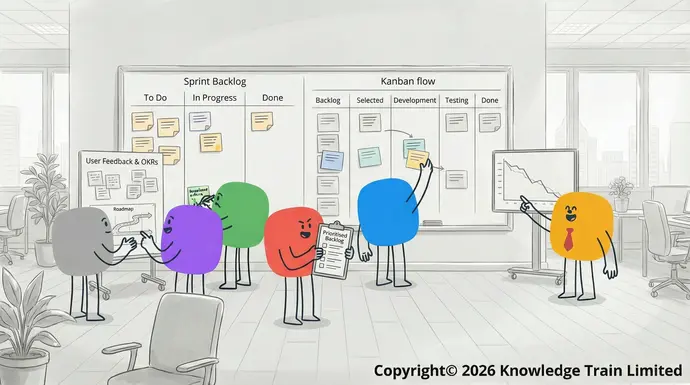
AgilePreferences encompasses various frameworks, each with its own practices and terminology. The most widely used Agile frameworks were designed for more efficient product delivery, rather than project management . They include ScrumPreferences, Kanban, Lean, and Extreme Programming (XP):
Scrum
- Main focus: Team roles, time-boxed sprints, and iterative delivery
- Core roles: Product Owner, Scrum Master , Team MembersThe technical storage or access is necessary for the legitimate purpose of storing preferences that are not requested by the subscriber or user.
- Artefacts: Product backlog, sprint backlog
- Key events: Sprint planning, daily scrum, sprint review, sprint retrospectives
- Advantages:Statistics Well-defined structure, clear accountability, transparency
Kanban
- Main focus: Visualisation of workflow, limiting work in progress, continuous flowStatistics
- Core elements: Kanban board, work-in-progress limits, cards/tasks
- Advantages: Flexibility, real-time workflow visualisation, easy adoption without role changes
Lean
- Main focus: Elimination of waste, maximising value, continuous improvement
- Core elements:The technical storage or access that is used exclusively for statistical purposes. Value stream mapping, optimised flow, customer focus
- Advantages:The technical storage or access that is used exclusively for anonymous statistical purposes. Without a subpoena, voluntary compliance on the part of your Internet Service Provider, or additional records from a third party, information stored or retrieved for this purpose alone cannot usually be used to identify you. Improved efficiency, reduced delays, enhanced quality
Extreme Programming (XP)
- Main focus: Technical excellence, frequent releases, customer involvement
- Core practices: Pair programming, test-driven development, continuous integration, Marketinguser stories
- Advantages: Rapid feedback, high product quality, adaptability to change
Comparison: Scrum, Kanban, Lean, XPMarketing
| Framework | Main focus | |||
|---|---|---|---|---|
FAQs
What is the difference between Agile and waterfall project management?
The main difference is that Agile is iterative and flexible, allowing change at any stage, while waterfall follows a strict, linear process where each phase must be completed before the next begins. Agile encourages frequent feedback and continuous delivery of value, whereas waterfall often delivers only at the end.
What are the main stages of an Agile project?
Typical stages of an Agile project include vision and roadmap creation, backlog development, sprint planning, execution (iteration), review, and retrospectives. Continuous improvement occurs at every stage.
What are the key frameworks of Agile project management?
Key Agile frameworks are Scrum, Kanban, Lean, and Extreme Programming (XP). Each offers a unique structure for managing roles, processes, and workflow.
What are the benefits and challenges of Agile project management?
Advantages include adaptability, stakeholder engagement, and high product quality. Challenges may include initial resistance, need for team discipline, and less suitability for projects with fixed, unchanging requirements.
Where is Agile project management commonly used?
While most common in software development, Agile is used in industries such as marketing, manufacturing, construction, and education wherever flexible, iterative approaches add value.