Agile project management: Frameworks, benefits and how it worksSimon Buehring

Key takeaways
Agile improves delivery by combining iterative planning, tight feedback loops and disciplined ways of working.Simon Buehring
- Agile delivers value in short iterations, using regular reviews and retrospectives to adapt quickly to change.23 Feb 2026
- Scrum, Kanban, Lean and XP offer different structures, so choose based on workflow needs and team maturity.
- Clear roles, prioritised backlogs and well-written user stories reduce confusion and keep work aligned to outcomes.Discover popular change management models and their applications. Click through for colorful infographics and detailed descriptions.
- Metrics such as velocity, cycle time and burn-down charts improve predictability when paired with a clear definition of done.
- Lightweight governance, change management and technical debt controls help Agile scale without losing quality.
- , a
- Advantages:PRINCE2 course Improved efficiency, reduced delays, enhanced quality, or an
Extreme Programming (XP)agile project management course
- Main focus: to boost your career. Technical excellence, frequent releases, customer involvementPRINCE2
- Core practices:® Pair programming, test-driven development, continuous integration, , MSPuser stories®
- Advantages:, ITIL Rapid feedback, high product quality, adaptability to change®
Comparison: Scrum, Kanban, Lean, XP, P3O
| Framework® | Main focus, PRINCE2 | Key practice® | Team structure Agile, RESILIA | Best use case® |
|---|---|---|---|---|
| Scrum, and the Swirl logo are registered trademarks of the PeopleCert group. Used under licence from PeopleCert. All rights reserved. AgilePM | Time-boxed iterations (Sprints)® | Predefined roles and events and AgileBA | Cross-functional® | Complex projects needing structure are registered trademarks of Agile Business Consortium Limited. All rights reserved. The APMG International AgilePM and Swirl Device logo, APMG International AgileBA and Swirl Device Logo, APMG International Change Management and APMG International Better Business Cases and Swirl Device logo are trademarks of The APM Group Limited, used under permission of The APM Group Limited. All rights reserved. Better Business Cases™ is a trademark of Her Majesty’s Treasury. All rights reserved. DevOps Foundation |
| Kanban® | Visual workflow & limits is a registered mark of the DevOps Institute. “PMI”, “PMBOK | Kanban board, WIP limits® | Flexible roles Guide”, “PMP” and “CAPM” are registered marks of Project Management Institute, Inc. Knowledge Train Scrum Essentials™, Business Learning Library (BLL)™, Business Analysis Learning Library (BALL)™, Agile Learning Library (ALL)™, IT Learning Library (ITLL)™, and Compliance Learning Library (CLL)™ are trademarks of Knowledge Train Limited. All rights reserved. | Ongoing support/operationsKnowledge Train Ltd is an Introducer Appointed Representative of NewDay Cards Ltd for the Newpay finance product provided by NewDay Ltd. NewDay Cards Ltd acts as a credit broker, not a lender. We will introduce you exclusively to Newpay finance products provided by NewDay Limited under this Introducer Appointed Representative arrangement. Finance available from other lenders is not covered by this arrangement. NewDay Ltd and Newday Cards Ltd are authorised and regulated by the Financial Conduct Authority (ref nos 690292 and 682417 respectively). |
| Lean | Eliminate waste | Value stream mapping | Any | Process improvement, efficiency |
| XPSearch | Technical best practices | Pair programming, TDD | Small, tech-focused teams | Software projects needing quality |
Agile vs traditional (waterfall) project management
The waterfall model is a sequential, plan-driven approach where phases follow one another with minimal overlap. Agile project management contrasts this with its focus on flexible planning, iterative progress, and stakeholder feedback throughout:Request a quote
| Aspect | Agile | Waterfall |
|---|---|---|
| Approach | Iterative and incremental | Sequential and linear |
| Flexibility | Highly adaptive to changeManage Consent | Change-resistant |
| Customer InvolvementTo provide the best experiences, we use technologies like cookies to store and/or access device information. Consenting to these technologies will allow us to process data such as browsing behavior or unique IDs on this site. Not consenting or withdrawing consent, may adversely affect certain features and functions. | Continuous collaboration | Primarily at start/end |
| Risk management | Early and ongoing detection | Late-stage identificationFunctional |
| Delivery | Work delivered frequently | Single final delivery |
| Suitable for | Complex, evolving Functionalprojects | Clear, fixed requirements Always active |
Key roles and concepts in Agile projects
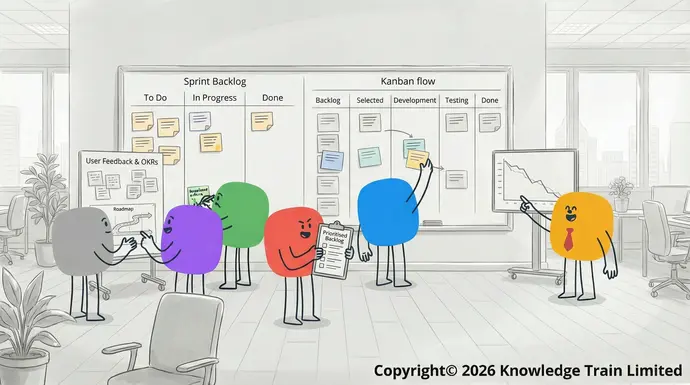
- Product Owner: Represents stakeholders, manages product backlog, prioritises features
- Scrum Master : Facilitates ScrumThe technical storage or access is strictly necessary for the legitimate purpose of enabling the use of a specific service explicitly requested by the subscriber or user, or for the sole purpose of carrying out the transmission of a communication over an electronic communications network. process, removes impediments
- User stories : Short, simple descriptions of a feature told from the perspective of the user
- Backlog:Preferences Ordered list of project tasks and features
- Sprint/Iteration: Short, time-boxed development cycles
- Stakeholders: Individuals or groups with interests in project outcomes
- Retrospectives: Regular meetings to assess and improve processes
- Deliverables: Outputs produced at the end of each iteration
- Continuous Improvement:Preferences Commitment to reflect and implement enhanced ways of working