Agile project management: Frameworks, benefits and how it works

Key takeaways
Agile improves delivery by combining iterative planning, tight feedback loops and disciplined ways of working.
- Agile delivers value in short iterations, using regular reviews and retrospectives to adapt quickly to change.
- Scrum, Kanban, Lean and XP offer different structures, so choose based on workflow needs and team maturity.
- Clear roles, prioritised backlogs and well-written user stories reduce confusion and keep work aligned to outcomes.
- Metrics such as velocity, cycle time and burn-down charts improve predictability when paired with a clear definition of done.
- Lightweight governance, change management and technical debt controls help Agile scale without losing quality.
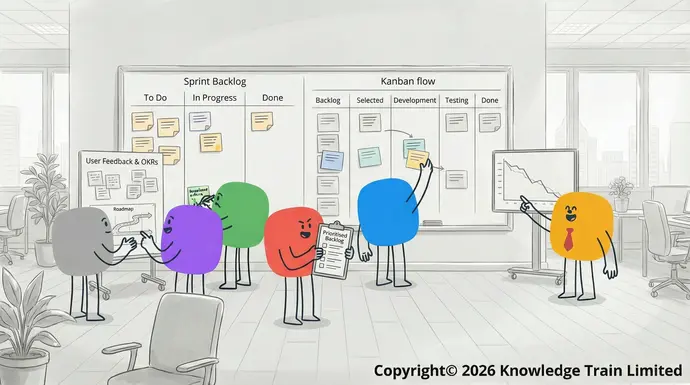
What is Agile project management? Registered in UK: 5566983.
Agile project management Registered VAT: GB872413526. is an iterative approach to planning, executing, and Knowledge Train
- ®projects, and the Swirl logo are registered trademarks of the PeopleCert group. Used under licence from PeopleCert. All rights reserved. AgilePM around motivated individuals®
- Face-to-face conversation as the best form of communication and AgileBA
- Working product as the primary measure of progress®
- Sustainable development pace are registered trademarks of Agile Business Consortium Limited. All rights reserved. The APMG International AgilePM and Swirl Device logo, APMG International AgileBA and Swirl Device Logo, APMG International Change Management and APMG International Better Business Cases and Swirl Device logo are trademarks of The APM Group Limited, used under permission of The APM Group Limited. All rights reserved. Better Business Cases™ is a trademark of Her Majesty’s Treasury. All rights reserved. DevOps Foundation
- ®
- Simplicity – the art of maximising the amount of work not done – is essential Guide”, “PMP” and “CAPM” are registered marks of Project Management Institute, Inc. Knowledge Train Scrum Essentials™, Business Learning Library (BLL)™, Business Analysis Learning Library (BALL)™, Agile Learning Library (ALL)™, IT Learning Library (ITLL)™, and Compliance Learning Library (CLL)™ are trademarks of Knowledge Train Limited. All rights reserved.
- Self-organising teams produce the best resultsKnowledge Train Ltd is an Introducer Appointed Representative of NewDay Cards Ltd for the Newpay finance product provided by NewDay Ltd. NewDay Cards Ltd acts as a credit broker, not a lender. We will introduce you exclusively to Newpay finance products provided by NewDay Limited under this Introducer Appointed Representative arrangement. Finance available from other lenders is not covered by this arrangement. NewDay Ltd and Newday Cards Ltd are authorised and regulated by the Financial Conduct Authority (ref nos 690292 and 682417 respectively).
- Regular reflections for continuous improvement
Key Agile frameworks and methodologies
Agile encompasses various frameworks, each with its own practices and terminology. The most widely used Agile frameworks were designed for more efficient product delivery, rather than project management . They include SearchScrum , Kanban, Lean, and Extreme Programming (XP):
Scrum
- Main focus: Team roles, time-boxed sprints, and iterative delivery
- Core roles: Product Owner, Scrum Master , Team Members
- Artefacts: Product backlog, sprint backlogRequest a quote
- Key events: Sprint planning, daily scrum, sprint review, sprint retrospectives
- Advantages: Well-defined structure, clear accountability, transparency
Kanban
- Main focus: Visualisation of workflow, limiting work in progress, continuous flow
- Core elements:Manage Consent Kanban board, work-in-progress limits, cards/tasks
- Advantages:To provide the best experiences, we use technologies like cookies to store and/or access device information. Consenting to these technologies will allow us to process data such as browsing behavior or unique IDs on this site. Not consenting or withdrawing consent, may adversely affect certain features and functions. Flexibility, real-time workflow visualisation, easy adoption without role changes
Lean
- Main focus:
| The technical storage or access that is used exclusively for statistical purposes.Waterfall | ||
|---|---|---|
| Approach | Iterative and incrementalThe technical storage or access that is used exclusively for anonymous statistical purposes. Without a subpoena, voluntary compliance on the part of your Internet Service Provider, or additional records from a third party, information stored or retrieved for this purpose alone cannot usually be used to identify you. | Sequential and linear |
| Flexibility | Highly adaptive to change | Change-resistant |
| Customer Involvement | Continuous collaborationMarketing | Primarily at start/end |
| Risk management | Early and ongoing detection | Late-stage identificationMarketing |
| Delivery | Work delivered frequently | Single final delivery |
| Suitable for | Complex, evolving projects | Clear, fixed requirements |
Key roles and concepts in Agile projectsThe technical storage or access is required to create user profiles to send advertising, or to track the user on a website or across several websites for similar marketing purposes.
- Product Owner: Represents stakeholders, manages product backlog, prioritises featuresManage options
- Scrum MasterManage services:Manage {vendor_count} vendors Facilitates Read more about these purposesScrum process, removes impedimentsAccept
- User stories :Deny Short, simple descriptions of a feature told from the perspective of the user
- Backlog:View preferences Ordered list of project tasks and features
- Most Agile Always active frameworks are designed for product delivery, not project management .
- Less suitable when requirements are fixed and well-defined
- Organisational resistance to cultural change
- Potential for scope creep without disciplined backlog management
Real-world applications and use casesThe technical storage or access is strictly necessary for the legitimate purpose of enabling the use of a specific service explicitly requested by the subscriber or user, or for the sole purpose of carrying out the transmission of a communication over an electronic communications network.
Agile project management originated in software development but is now used in industries including marketing, education, manufacturing, and construction. Its continuous improvement and team collaboration principles enhance innovation, adaptiveness, and client-centric outcomes.Preferences
- IT /software: Dynamic product requirements, regular releases, user feedback
- Marketing:Preferences Campaigns adapted based on analytics and feedback
- Construction: Early delivery of completed sections, iterative design
Authoritative standards organisations like the Agile Business Consortium , Agile Alliance , The technical storage or access is necessary for the legitimate purpose of storing preferences that are not requested by the subscriber or user.Scrum.org , and Project Management Institute (PMI) provide resources, definitions, and certificationsStatistics for Agile professionals.
FAQs
What is the difference between Agile and waterfall project management?The technical storage or access that is used exclusively for anonymous statistical purposes. Without a subpoena, voluntary compliance on the part of your Internet Service Provider, or additional records from a third party, information stored or retrieved for this purpose alone cannot usually be used to identify you.
The main difference is that Agile is iterative and flexible, allowing change at any stage, while waterfall follows a strict, linear process where each phase must be completed before the next begins. Agile encourages frequent feedback and continuous delivery of value, whereas waterfall often delivers only at the end.
What are the main stages of an Agile project?Marketing
Typical stages of an Agile project include vision and roadmap creation, backlog development, sprint planning, execution (iteration), review, and retrospectives. Continuous improvement occurs at every stage.
What are the key frameworks of Agile project management?
Key Agile frameworks are ScrumMarketing, Kanban, Lean, and Extreme Programming (XP). Each offers a unique structure for managing roles, processes, and workflow.
What are the benefits and challenges of Agile project management?
Advantages include adaptability, stakeholder engagement, and high product quality. Challenges may include initial resistance, need for team discipline, and less suitability for projects with fixed, unchanging requirements.
Where is Agile project management commonly used?
While most common in software development, Agile is used in industries such as marketing, manufacturing, construction, and education wherever flexible, iterative approaches add value.