Agile project management: Frameworks, benefits and how it worksGreece

Key takeaways
Agile improves delivery by combining iterative planning, tight feedback loops and disciplined ways of working.
- Agile delivers value in short iterations, using regular reviews and retrospectives to adapt quickly to change.
- Scrum, Kanban, Lean and XP offer different structures, so choose based on workflow needs and team maturity.
- Clear roles, prioritised backlogs and well-written user stories reduce confusion and keep work aligned to outcomes.
- Metrics such as velocity, cycle time and burn-down charts improve predictability when paired with a clear definition of done.
- Lightweight governance, change management and technical debt controls help Agile scale without losing quality.
What is Agile project management?Contents
Agile project management is an iterative approach to planning, executing, and Definition of Agiledelivering projects by breaking work into small, manageable increments known as iterations or sprints. Rather than following a strict linear plan, Agile methodology at a glanceAgile focuses on adaptability, team collaboration, and continuous delivery of value to stakeholders. Summary of the Agile Manifesto and Its valuesAgile principles emphasise close communication, incremental progress, and regular feedback cycles to enhance quality and meet customer needs.Agile principles
The Agile Manifesto: Values and principles
The Historical origins and evolution of AgileAgile Manifesto underpins Agile project management, defining four core values and twelve guiding principles. These foster a culture of collaboration, adaptability, and response to change.Benefits of Agile
Agile Manifesto core values
- Individuals and interactions over processes and toolsAgile vs waterfall model
- Working software (or product) over comprehensive documentation
- Customer collaboration over contract negotiationAgile frameworks and practices
- Responding to change over following a plan
Twelve principles of AgileAgile project management
- Customer satisfaction through early and continuous delivery
- Welcome changing requirements, even late in developmentKey concepts: Iterative and incremental delivery
- Deliver working products frequently
- Close, daily cooperation between business people and developersTeam collaboration and cross-functional teams
- Build projectsContinuous improvement practices around motivated individuals
- Face-to-face conversation as the best form of communicationFurther Resources
- Working product as the primary measure of progress
- Sustainable development paceFAQs
- Continuous attention to technical excellence and good designDefinition of Agile
- Simplicity – the art of maximising the amount of work not done – is essentialAgile
- Self-organising teams produce the best results refers to a set of principles and practices that guide teams in developing software products through incremental delivery, adaptive planning, and continual improvement. Agile emphasises iterative development, close team collaboration, and frequent customer feedback to deliver high-quality solutions quickly and efficiently.
- Regular reflections for continuous improvementAgile methodology at a glance
Key Agile frameworks and methodologiesAspect
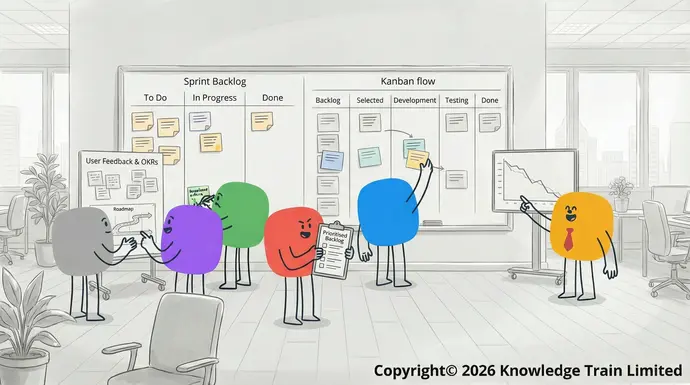
AgileDescription encompasses various frameworks, each with its own practices and terminology. The most widely used Agile frameworks were designed for more efficient product delivery, rather than Purposeproject managementDeliver working software frequently, respond to change rapidly. They include Key valuesScrumIndividuals and interactions, working software, customer collaboration, responding to change, Kanban, Lean, and Extreme Programming (XP):Approach
ScrumIterative, adaptive, and incremental
- Main focus:Popular frameworks Team roles, time-boxed sprints, and iterative deliveryScrum
- Core roles:, Kanban, Extreme Programming (XP) Product Owner, StakeholdersScrum MasterCustomers, product owners, cross-functional teams, Scrum Masters, Team Members
- Artefacts:Summary of the Agile Manifesto and Its values Product backlog, sprint backlogThe
- Key events:Agile Manifesto Sprint planning, daily scrum, sprint review, sprint retrospectives, published in 2001 by 17 software development experts, established the foundation for
- Advantages:Agile methodologies Well-defined structure, clear accountability, transparency. It promotes four core values and twelve underlying principles to guide teams toward continuous improvement and customer satisfaction.
KanbanAgile Manifesto: Four values
- Main focus:Individuals and interactions over processes and tools
| Key practicethe Agile Manifesto | Team structure, formalising Agile values and sparking the formation of the Agile Alliance. Since then, Agile has evolved beyond software development into | Best use caseproject management | ||
|---|---|---|---|---|
| Scrum, product development, and operations. | Time-boxed iterations (Sprints)Benefits of Agile | Predefined roles and eventsFlexibility: | Cross-functional Respond rapidly to changing customer needs and market conditions. | Complex projects needing structureContinuous improvement: |
| Kanban Regular retrospectives help teams adapt and improve their processes. | Visual workflow & limitsCustomer satisfaction: | Kanban board, WIP limits Frequent delivery ensures customer requirements are met early and often. | Flexible rolesTransparency: | Ongoing support/operations Iterative development and open communication foster stakeholder trust. |
| LeanReduced risk: | Eliminate waste Incremental delivery allows for earlier issue detection and correction. | Value stream mappingEnhanced team collaboration: | Any Cross-functional teams communicate daily to resolve challenges efficiently. | Process improvement, efficiencyAgile vs waterfall model |
| XPAspect | Technical best practicesAgile | Pair programming, TDDWaterfall | Small, tech-focused teamsProcess | Software projects needing qualityIterative and incremental |
Agile vs traditional (waterfall) project managementSequential and linear
The Flexibilitywaterfall modelAdaptive to change is a sequential, plan-driven approach where phases follow one another with minimal overlap. Resistant to change after initial planning
- Agile project management
- Scrum Master focuses on iterative planning, adaptive resource allocation, and continuous stakeholder engagement. Leaders support self-organising, cross-functional teams, encourage regular customer feedback, and facilitate incremental value delivery.:Key concepts: Iterative and incremental delivery Facilitates Agile projects proceed in small iterations, each resulting in an incrementally improved product. This iterative approach enables rapid adaptation, regular feedback, and incremental value to stakeholders.ScrumTeam collaboration and cross-functional teams process, removes impedimentsAgile emphasises collaboration between customers, stakeholders, and team members from diverse disciplines. Cross-functional teams are empowered to make decisions and deliver complete solutions within each iteration.
- User storiesContinuous improvement practices:Agile teams conduct regular retrospectives to identify areas for improvement and adjust their processes. This culture of continuous improvement leads to increased quality, productivity, and team morale over time. Short, simple descriptions of a feature told from the perspective of the userFurther Resources
- Backlog:Agile software development (Encyclopaedia) Ordered list of project tasks and featuresAgile Alliance: Agile Manifesto
- Sprint/Iteration:FAQs Short, time-boxed development cyclesWhat is Agile methodology?
- Stakeholders:Agile methodology Individuals or groups with interests in project outcomes is a set of practices and values that promote adaptive planning, evolutionary development, early delivery, and continual improvement. Agile methods empower teams to respond quickly to change and collaborate closely with stakeholders.
- Retrospectives:What are the 12 principles of Agile? Regular meetings to assess and improve processesThe
- Deliverables:12 Agile principles Outputs produced at the end of each iteration include prioritising customer satisfaction through early and continual delivery, welcoming changing requirements, delivering working software frequently, fostering daily collaboration, supporting motivated teams, preferring face-to-face communication, using working software as the main progress measure, maintaining a sustainable pace, focusing on technical excellence, maximising simplicity, enabling self-organising teams, and reflecting regularly for process improvement.
- Continuous Improvement:What is the difference between Agile and waterfall? Commitment to reflect and implement enhanced ways of workingAgile is iterative, adaptable, and focuses on incremental delivery with frequent stakeholder feedback.
Benefits of Agile project managementWaterfall
- Accelerated delivery of value through iterative increments is linear, sequential, and requires upfront planning, often only allowing changes late in the project cycle.
- Improved team collaboration and transparencyWhat are Scrum and Kanban frameworks?
- Quick response to customer feedback and market changesScrum
- Reduced project risks and higher stakeholder satisfaction is an Agile framework that organises work into fixed-length sprints and uses roles like Product Owner and
- High-quality deliverables due to continuous reviewScrum Master
Challenges and limitations. Kanban is a visual method for managing workflow, limiting work in progress, and focusing on incremental improvements.
- Requires experienced, self-organising teamsHow does Agile improve team collaboration?
- Most Agile improves collaboration through daily communication, cross-functional team structures, and regular stakeholder engagement, ensuring all members align towards shared goals.AgileSubscribe to our exclusive offers and promotions frameworks are designed for product delivery, not