
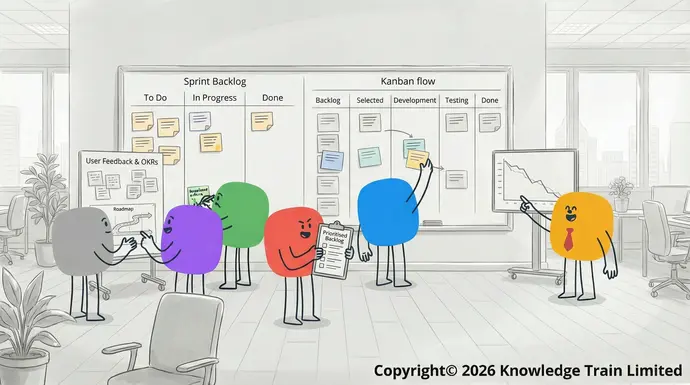
What is Agile project management?
Agile project management is an iterative approach to planning, executing, and delivering projects by breaking work into small, manageable increments known as iterations or sprints. Rather than following a strict linear plan, Agile focuses on adaptability, team collaboration, and continuous delivery of value to stakeholders. Agile principles emphasise close communication, incremental progress, and regular feedback cycles to enhance quality and meet customer needs.
The Agile Manifesto: Values and principles
The Agile Manifesto underpins Agile project management, defining four core values and twelve guiding principles. These foster a culture of collaboration, adaptability, and response to change.
Agile Manifesto core values
- Individuals and interactions over processes and tools
- Working software (or product) over comprehensive documentation
- Customer collaboration over contract negotiation
- Responding to change over following a plan
Twelve principles of Agile
- Customer satisfaction through early and continuous delivery
- Welcome changing requirements, even late in development
- Deliver working products frequently
- Close, daily cooperation between business people and developers
- Build projects around motivated individuals
- Face-to-face conversation as the best form of communication
- Working product as the primary measure of progress
- Sustainable development pace
- Continuous attention to technical excellence and good design
- Simplicity – the art of maximising the amount of work not done – is essential
- Self-organising teams produce the best results
- Regular reflections for continuous improvement
Key Agile frameworks and methodologies
Agile encompasses various frameworks, each with its own practices and terminology. The most widely used Agile frameworks were designed for more efficient product delivery, rather than
Comparison: Scrum, Kanban, Lean, XP
| Framework | Main focus | Key practice | Team structure | Best use case |
|---|---|---|---|---|
| Scrum | Time-boxed iterations (Sprints) | |||
| XP | Technical best practices | Pair programming, TDD | Small, tech-focused teams | Software projects needing quality |
Agile vs traditional (waterfall) project management
The waterfall model is a sequential, plan-driven approach where phases follow one another with minimal overlap. Agile project management contrasts this with its focus on flexible planning, iterative progress, and stakeholder feedback throughout: Request a quote
| Aspect | Agile | Waterfall[email protected] |
|---|---|---|
| Approach | Iterative and incremental +44 (0)207 148 5985 | Sequential and linearCourses |
| FlexibilityPROJECT MANAGEMENT | Highly adaptive to changePRINCE2 | Change-resistant® |
| Customer InvolvementFoundation | Continuous collaborationLearn the fundamentals of the PRINCE2 method. | Primarily at start/endPractitioner |
| Risk managementIncludes Foundation & Practitioner combined option. | Early and ongoing detectionAssociation for Project Management (APM) | Late-stage identificationProject Fundamentals Qualification (PFQ) |
| DeliveryStart your APM project management career. | Work delivered frequentlyProject Management Qualification (PMQ) | Single final deliveryAdvance your APM project management expertise. |
| Suitable forProject Risk Single Certificate Level 1 | Complex, evolving Enhance your project risk management skills.projectsAgilePM | Clear, fixed requirements® |
Key roles and concepts in Agile projects – Agile Project Management
- Product Owner:Foundation Represents stakeholders, manages product backlog, prioritises featuresLearn the key principles of Agile Project Management.
- Scrum MasterPractitioner :Includes Foundation & Practitioner combined option. Facilitates PRINCE2Scrum® process, removes impediments Agile
- User storiesFoundation :Learn the fundamentals of the PRINCE2 Agile method. Short, simple descriptions of a feature told from the perspective of the userPractitioner
- Backlog:Includes Foundation & Practitioner combined option. Ordered list of project tasks and featuresAI Project Governance Framework (AIPGF)
- Sprint/Iteration:Foundation Short, time-boxed development cyclesLearn the fundamentals of the governance framework.
- Stakeholders:Practitioner Individuals or groups with interests in project outcomesIncludes Foundation & Practitioner combined option.
- Retrospectives:Better Business Cases