Agile project management: Frameworks, benefits and how it works

Key takeawaysCzech Republic
Agile improves delivery by combining iterative planning, tight feedback loops and disciplined ways of working.Denmark
- Agile delivers value in short iterations, using regular reviews and retrospectives to adapt quickly to change.Estonia
- Scrum, Kanban, Lean and XP offer different structures, so choose based on workflow needs and team maturity.Finland
- Clear roles, prioritised backlogs and well-written user stories reduce confusion and keep work aligned to outcomes.France
- Metrics such as velocity, cycle time and burn-down charts improve predictability when paired with a clear definition of done.Germany
- Lightweight governance, change management and technical debt controls help Agile scale without losing quality.Greece
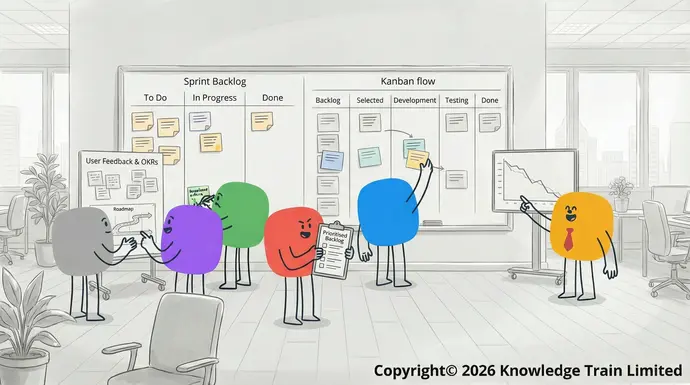
What is Agile project management?
Agile project management is an iterative approach to planning, executing, and delivering projects by breaking work into small, manageable increments known as iterations or sprints. Rather than following a strict linear plan, Agile focuses on adaptability, team collaboration, and continuous delivery of value to stakeholders. Agile principles emphasise close communication, incremental progress, and regular feedback cycles to enhance quality and meet customer needs.
The Agile Manifesto: Values and principles
The Agile Manifesto underpins Agile project management, defining four core values and twelve guiding principles. These foster a culture of collaboration, adaptability, and response to change.
Agile Manifesto core values
- Individuals and interactions over processes and tools
- Working software (or product) over comprehensive documentation
- Customer collaboration over contract negotiation
- Responding to change over following a plan
Twelve principles of Agile
- Customer satisfaction through early and continuous delivery Copied!
- Welcome changing requirements, even late in development Key takeaways
- Deliver working products frequently Choose a project approach that fits the work, the team, and the organisation.
- Close, daily cooperation between business people and developers Waterfall suits stable requirements and benefits from clear phases, documentation, and predictable planning.
- Build Agile methods prioritise rapid, iterative delivery, close collaboration, and frequent feedback to handle change.projects Lean improves delivery by maximising customer value and removing waste, and Lean Six Sigma adds data-driven quality control. around motivated individuals Hybrid approaches like Scrumban blend structure and flow to cope with shifting priorities and unexpected work.
- Face-to-face conversation as the best form of communication Method selection should reflect project complexity, stakeholder involvement, risk, and organisational culture, and be reviewed at key milestones.
- Working product as the primary measure of progress
- Sustainable development pace
- Continuous attention to technical excellence and good design
- Simplicity – the art of maximising the amount of work not done – is essential Contents
- Self-organising teams produce the best results
- Regular reflections for continuous improvement
Key Agile frameworks and methodologies Contents
Agile encompasses various frameworks, each with its own practices and terminology. The most widely used Agile frameworks were designed for more efficient product delivery, rather than Introductionproject management . They include Core project management philosophiesScrum , Kanban, Lean, and Extreme Programming (XP): Traditional project management methodologies
Scrum
- Main focus: Agile project management methodologies Team roles, time-boxed sprints, and iterative delivery
- Core roles:Lean project management Product Owner, Scrum MasterHybrid and adaptive methodologies , Team Members
- Artefacts:Choosing the right methodology Product backlog, sprint backlog
- Key events:Conclusion Sprint planning, daily scrum, sprint review, sprint retrospectives
- Advantages:FAQs Well-defined structure, clear accountability, transparency
KanbanInfographic
- Main focus:Introduction Visualisation of workflow, limiting work in progress, continuous flowRunning a modern business requires that certain tasks are coordinated in a way that increases chances of getting results.
- Core elements:Project management Kanban board, work-in-progress limits, cards/tasks methodology is a set of rules and processes that are implemented by teams in order to plan, develop, and deliver project outcomes. In this way, business people can make the most of the project to achieve business goals.
- Advantages:Choosing the right one is important for several reasons: the methodology should be applicable to your teams’ strong suits and their project needs it should also be helpful in communication and collaboration it needs to improve the process of resource allocation and Flexibility, real-time workflow visualisation, easy adoption without role changesrisk management
Lean and, finally, it is likely to increase the chances of project success.
- Main focus:This comprehensive guide will look at the most relevant Elimination of waste, maximising value, continuous improvementproject management methodologies
- Core elements:, including: Value stream mapping, optimised flow, customer focusTraditional approaches like
- Advantages:waterfall Improved efficiency, reduced delays, enhanced qualityAgile methodologies
Extreme Programming (XP) such as
- Main focus:Scrum Technical excellence, frequent releases, customer involvement and Kanban
- Core practices:Lean project management principles Request a quote Pair programming, test-driven development, continuous integration, Hybrid and adaptive frameworks. user storiesWe will review the strengths and weaknesses of each project management method, enabling you to select the most appropriate one for your next endeavor. Gain a better understanding of these methods, and it will be easier for you to lead your team to victory.
- Advantages:<[email protected] Rapid feedback, high product quality, adaptability to change
+44 (0)207 148 5985
| Courses | PROJECT MANAGEMENT | PRINCE2 | ® and | Best use caseFoundation iterative |
|---|---|---|---|---|
| ScrumLearn the fundamentals of the PRINCE2 method.. It’s important to be aware of these core strategies when choosing the best approach for your project. | Time-boxed iterations (Sprints)Practitioner Linear (Waterfall) approach | Predefined roles and eventsIncludes Foundation & Practitioner combined option.Description and key principles | Cross-functionalAssociation for Project Management (APM)The | Complex projects needing structureProject Fundamentals Qualification (PFQ) Waterfall |
Includes Foundation & Practitioner combined option.Where is Agile project management commonly used?Better team collaboration.
While most common in software development, Agile is used in industries such as marketing, manufacturing, construction, and education wherever flexible, iterative approaches add value.INFORMATION TECHNOLOGY (IT)Challenges: