
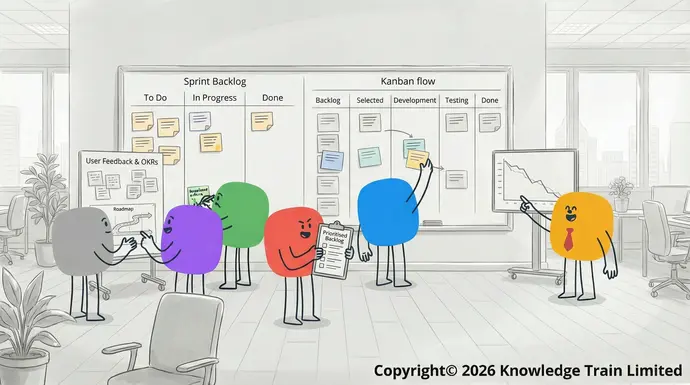
What is Agile project management?
Agile project management is an iterative approach to planning, executing, and What is a group of projects called?delivering projects by breaking work into small, manageable increments known as iterations or sprints. Rather than following a strict linear plan, AgileWhat is a program vs project life cycle? focuses on adaptability, team collaboration, and continuous delivery of value to stakeholders. Agile principles emphasise close communication, incremental progress, and regular feedback cycles to enhance quality and meet customer needs.What is a typical program management structure?
| Primarily at start/end | ||
| Risk management | Early and ongoing detection | Late-stage identification |
| Delivery | Work delivered frequently | Single final delivery |
| Suitable for | Complex, evolving projects | Clear, fixed requirements |
- Registered in UK: 5566983. Most Agile Registered VAT: GB872413526. frameworks are designed for product delivery, not Knowledge Trainproject management®. is a registered trademark of Knowledge Train Limited.
- Less suitable when requirements are fixed and well-defined 20 Old Bailey, London, EC4M 7AN, England, United Kingdom.
- Organisational resistance to cultural change Knowledge Train are experts in project management, PRINCE2, agile and change management training and certification. Choose from a full range of instructor-led and self-paced
- Potential for scope creep without disciplined backlog managementproject management courses
Real-world applications and use cases, a
Agile project management originated in software development but is now used in industries including marketing, education, manufacturing, and construction. Its PRINCE2 coursecontinuous improvement, or an and agile project management courseteam collaboration to boost your career. principles enhance innovation, adaptiveness, and client-centric outcomes.PRINCE2
- IT®/software:, MSP Dynamic product requirements, regular releases, user feedback®
- Marketing:, ITIL Campaigns adapted based on analytics and feedback®
- Construction:, P3O Early delivery of completed sections, iterative design®
Authoritative standards organisations like the , PRINCE2Agile Business Consortium®, Agile, RESILIAAgile Alliance®, , and the Swirl logo are registered trademarks of the PeopleCert group. Used under licence from PeopleCert. All rights reserved. AgilePMScrum.org®, and and AgileBAProject Management Institute (PMI)® provide resources, definitions, and are registered trademarks of Agile Business Consortium Limited. All rights reserved. The APMG International AgilePM and Swirl Device logo, APMG International AgileBA and Swirl Device Logo, APMG International Change Management and APMG International Better Business Cases and Swirl Device logo are trademarks of The APM Group Limited, used under permission of The APM Group Limited. All rights reserved. Better Business Cases™ is a trademark of Her Majesty’s Treasury. All rights reserved. DevOps Foundationcertifications® for Agile professionals. is a registered mark of the DevOps Institute. “PMI”, “PMBOK
FAQs
What is the difference between Agile and waterfall project management?
The main difference is that Agile is iterative and flexible, allowing change at any stage, while waterfall follows a strict, linear process where each phase must be completed before the next begins. Agile encourages frequent feedback and continuous delivery of value, whereas waterfall often delivers only at the end.
What are the main stages of an Agile project?
Typical stages of an Agile project include vision and roadmap creation, backlog development, sprint planning, execution (iteration), review, and retrospectives. Continuous improvement occurs at every stage.
What are the key frameworks of Agile project management?
Key Agile frameworks are Manage ConsentScrum , Kanban, Lean, and Extreme Programming (XP). Each offers a unique structure for managing roles, processes, and workflow.To provide the best experiences, we use technologies like cookies to store and/or access device information. Consenting to these technologies will allow us to process data such as browsing behavior or unique IDs on this site. Not consenting or withdrawing consent, may adversely affect certain features and functions.
What are the benefits and challenges of Agile project management?
Advantages include adaptability, stakeholder engagement, and high product quality. Challenges may include initial resistance, need for team discipline, and less suitability for projects with fixed, unchanging requirements.
Where is Agile project management commonly used?
While most common in software development, Agile is used in industries such as marketing, manufacturing, construction, and education wherever flexible, iterative approaches add value.