Agile project management: Frameworks, benefits and how it works

Key takeaways
Agile improves delivery by combining iterative planning, tight feedback loops and disciplined ways of working.
- Agile delivers value in short iterations, using regular reviews and retrospectives to adapt quickly to change.
- Scrum, Kanban, Lean and XP offer different structures, so choose based on workflow needs and team maturity.
- Clear roles, prioritised backlogs and well-written user stories reduce confusion and keep work aligned to outcomes.
- Metrics such as velocity, cycle time and burn-down charts improve predictability when paired with a clear definition of done.
- Lightweight governance, change management and technical debt controls help Agile scale without losing quality.
What is Agile project management?
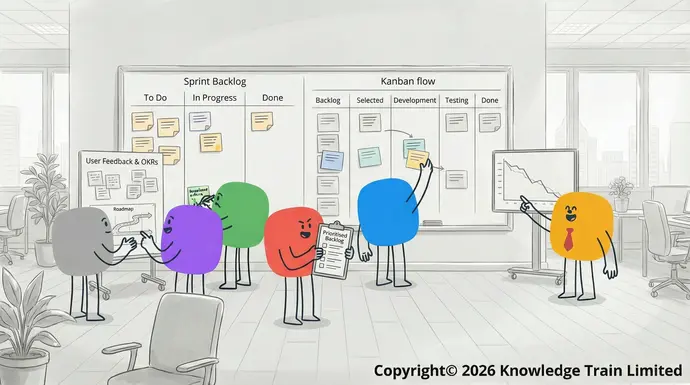
Agile project management is an iterative approach to planning, executing, and delivering projects by breaking work into small, manageable increments known as iterations or sprints. Rather than following a strict linear plan,
- process, removes impediments
- User stories: Short, simple descriptions of a feature told from the perspective of the user
Benefits of Agile project management
- Accelerated delivery of value through iterative increments
- Improved team collaboration and transparency
- Quick response to customer feedback and market changes
- Reduced project risks and higher stakeholder satisfaction
- High-quality deliverables due to continuous review
Challenges and limitations
- Requires experienced, self-organising teams
- Most Agile frameworks are designed for product delivery, not project management .
- Less suitable when requirements are fixed and well-defined
- Organisational resistance to cultural change
- Potential for scope creep without disciplined backlog management
Real-world applications and use cases
Agile project management originated in software development but is now used in industries including marketing, education, manufacturing, and construction. Its continuous improvement and team collaboration principles enhance innovation, adaptiveness, and client-centric outcomes.
- IT /software: Dynamic product requirements, regular releases, user feedback
- Marketing: Campaigns adapted based on analytics and feedback
- Construction: Early delivery of completed sections, iterative design
Authoritative standards organisations like the Agile Business Consortium , Agile Alliance , Scrum.org , and Project Management Institute (PMI) provide resources, definitions, and certifications for Agile professionals.
FAQs
What is the difference between Agile and waterfall project management?
The main difference is that Agile is iterative and flexible, allowing change at any stage, while waterfall follows a strict, linear process where each phase must be completed before the next begins. Agile encourages frequent feedback and continuous delivery of value, whereas waterfall often delivers only at the end.
What are the main stages of an Agile project?
Typical stages of an Agile project include vision and roadmap creation, backlog development, sprint planning, execution (iteration), review, and retrospectives. Continuous improvement occurs at every stage.
What are the key frameworks of Agile project management?
Key Agile frameworks are Scrum , Kanban, Lean, and Extreme Programming (XP). Each offers a unique structure for managing roles, processes, and workflow.
What are the benefits and challenges of Agile project management?
Advantages include adaptability, stakeholder engagement, and high product quality. Challenges may include initial resistance, need for team discipline, and less suitability for projects with fixed, unchanging requirements.
Where is Agile project management commonly used?
While most common in software development, Agile is used in industries such as marketing, manufacturing, construction, and education wherever flexible, iterative approaches add value.