How to become an Agile project manager19 Feb 2026

Key takeawaysPractitioner validates the ability to tailor PRINCE2 controls for agile delivery and suits character roles managing projects.
Agile leadership shifts from directing work to enabling teams to deliver and improve.The Foundation exam is 60 minutes with 50 questions and a 55% pass mark.
- Move from task allocation to facilitation, helping self-organising teams remove blockers and access the right information.The Practitioner exam is 2.5 hours, open-book using the manual only, with a 60% pass mark.
- Use existing project management experience, but adapt it with lighter agile tools like Kanban or lean agile before full framework changes.Training options range from classroom and virtual classroom to eLearning and low-cost self-study.
- In Scrum or SAFe, the focus becomes servant leadership, coaching, and communication rather than authority over tasks.Certification can improve employability, skills, earnings potential, confidence, and global mobility.
- Plan in rolling waves, keeping scope high-level early and adding detail only when needed.
- Reduce waste such as excessive documentation, long meetings, and multitasking, while using feedback, retrospectives, and velocity to forecast and improve.
IntroductionIntroduction
The key difference is that Though PRINCE2 dominates as the foremost project managersproject management certification generally act as just that – ‘managers.’ They allocate tasks and duties. in the UK and Europe, its Agile counterpart remains relatively specialized, with fewer candidates opting for the PRINCE2 Agile exams compared to the conventional Agile methodsPRINCE2 exams and frameworks generally don’t define a manager role because the expectation is that a team is self-organizing. The team members decide how best to complete the tasks prioritized by the business..
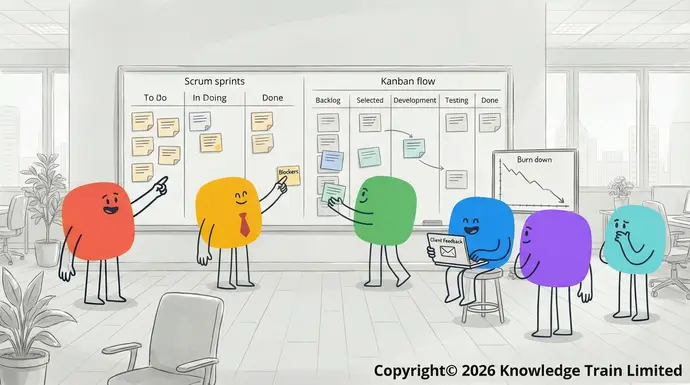
Agile team leaders act more as ‘facilitators.’ They don’t tell people what to do, they make sure that teams and developers have all the tools and information they need to do their jobs. They also unblock the blockages i.e. they fix problems so that the team can concentrate on doing its work.PRINCE2 certification
Regardless of your background or experience, the ability to successfully implement agile methodologies or integrate oneself into an agile environment requires training and an understanding of Agile. has a legacy dating back to 1996 when it was first launched. In contrast, PRINCE2 Agile is a more recent addition to the best practice Portfolio, Programme and Project management suite of qualifications from PeopleCert, being introduced only in 2015.
To help you transition from traditional to agile project management you can choose from either a classroom PRINCE2 Agile certificationAgile Project Management course features two qualifications: Foundation and Practitioner. or an Pursuing a Agile Project Management online coursePRINCE2 Agile certification. is an important decision for those aspiring to a successful
Moving into Agile project managementcareer in project management
Agile within an agile framework. The commitment and resources channelled towards earning this credential can enhance an individual’s career trajectory, unlocking job prospects otherwise unavailable. comes in many shapes and forms. One of the great features of Agile is that it can be adapted to suit almost any context.PRINCE2 Agile Foundation certification
Not every The agile methodPRINCE2 Agile Foundation requires a complete overhaul of existing systems. Some approaches (such as lean agile) aim to take existing ‘traditional’ certification is designed to validate a candidate’s grasp of both the project management frameworksPRINCE2 methodology and rework certain aspects to improve workflow and development. and fundamental
Because of this, knowledge and experience gained as a Agileproject manager concepts. Earning this certification – by successfully passing the within a traditional project management environment can still be applied to projects within an agile context.PRINCE2 Agile Foundation exam
Agile roles
Not every agile project management role requires complete retraining. Some agile mythologies simply help refine pre-existing ‘best-practice’ project management methodologies. One such example is lean agile.
Lean agile is a management philosophy that began in the automotive manufacturing industry. But, because it focuses primarily on aiding the productivity of workers and developers, its’ principles can be applied to any industry.
Lean agile focuses on waste reduction while creating a better, less stressful workplace through investing in and respecting employees.Self-paced
Lean agile improves productivity and profitability by eliminating slow and wasteful procedures like excessive documentation, micromanagement, lengthy meetings, avoidable mistakes, overreliance on predetermined product requirements, and unproductive multitasking.PRINCE2 Agile Practitioner (with Foundation) self-paced online
Aside from lean agile approaches, there are also other ‘light’ agile approaches. Traditional project management environments can still benefit from employing individual agile tools such as Kanban to improve workflows with little/no interruption to normal operations.
Because many £1,399 +vatagile methods are radically different from traditional project management, with a little training, project managers can successfully transition into an agile environment.
Dedicated Agile roles
Comprehensive agile approaches such as Instructor-ledScrumPRINCE2 Agile Foundation course or SAFe® agile (Scaled Agile Framework ®£1,299 +vat), generally do away with project managers, substituting them for Scrum Masters or an equivalent role.
If you want to transition into a dedicated agile role, you will require extensive See all datesagile trainingChoosing between certifications.The choice between PRINCE2 Agile Foundation and Practitioner certifications hinges on an individual’s professional objectives.
Project managersFor those looking to merely familiarize themselves with the fundamentals of assign tasks, enforce deadlines, and control multiple aspects of development to ensure that a project meets its goals on time and within budget.PRINCE2
Scrum Masters however, focus their attention solely on the application of the Scrum. They help developers understand their role within the agile framework, facilitate cooperative efforts and communication, but have no authority to allocate tasks to developers. and
Your primary goal as a dedicated agile manager is as much about utilizing your soft skills as it is about your hard skills which you may have acquired in your career as a traditional project manager.Agile methods
Scrum Masters are ‘servant leaders.’ Occasionally, you might be asked to guide with authority based on your knowledge and experience, at other times you must learn to step aside and allow others to do the same., the Foundation certification is enough. It’s also suitable for individuals aiming to contribute to agile projects at a team member level.
How to work effectively as an Agile project managerHowever, if one aspires to manage projects utilizing
Becoming effective in your agile role requires training, understanding, empathy, and the correct mindset. Here are just a few practical examples of how agile managers operate within an agile environment:PRINCE2
- Highlight issues and ask the right questions. If the team expresses an interest in the topic being raised or the issue being addressed, offer advice, or suggest solutions. Work collectively with the team to decide a course of action. within an agile framework, the Practitioner certification is the preferred certification. Additionally, for those holding or targeting elevated roles, such as a programme manager, the Practitioner certification is recommended because of its more comprehensive and advanced guidance.
- If you’re working with a team that is new to agile and agile practices, consider how to best introduce them to the framework. Do you throw them into the deep-end, so to speak, and address issues as they arise, or do you roll out one new practice at a time? Understanding which would be less time-consuming requires you to know the limitations and abilities of those involved.Training to get certified
- If you see someone making a mistake, highlight the issue and suggest alternatives. Alternatively, if you recognize a mistake that has already been made, educate your team on how to avoid repeating it.The four ways to become certified with PRINCE2 Agile are described below. Before choosing the best way to become certified, it would be useful to read
- Build a reputation as a source of knowledge and advice. Encourage the team to come to you for guidance rather than having to seek out opportunities to offer advice. You shouldn’t have to force change. Good agile managers teach teams to welcome change.how to choose a good PRINCE2 training provider
- Teach developers to rely on client feedback. Find new ideas and new sources of information that can help teams gauge and assess their work..
- Plan your growth within your role. Pursue continuous improvement by creating a regular system of feedback on your own performance.Classroom-based training (physical classroom)
- Connect with others that you can learn from, be it trainers, coaches, or mentors. Use this experience as leverage, pass it on freely and use it to demonstrate your value as an The conventional agile project managerPRINCE2 Agile classroom training. You need to embody agile values and show others ‘how it’s done,’ so that they can follow your example. involves face-to-face sessions, usually spanning consecutive days. This approach facilitates direct engagement, allowing students to interact personally with both the instructor and their peers.
Understanding the Agile mindsetproject management skills
If you are considering moving into an agile environment, the tailored for agile settings.Agile ManifestoIncreased earnings is a great way to understand the agile mindset and how it differs from other On average, professionals with PRINCE2 Agile certification command higher salaries than their counterparts without such credentials in the project management arena.project management methodologiesConfidence boost.Acquiring PRINCE2 Agile certification can instil candidates with a greater level of confidence in their ability to contribute to the organization’s agile projects.
If you want some practical examples of how to make the move into Agile, here are a few tips:Global recognition
- Understand that an agile project manager is no longer the primary authority of the project. Responsibility is now decentralized as everyone in the project is accountable for its success. While the project may have control points, responsibility is shared.PRINCE2 Agile
- Agile projects start with a high-level scope. Planning is done in ‘rolling waves’ i.e. higher-level plans and scope are progressively broken down into more details as the project progresses. Detailed requirements are added by product owners if/when needed. stands as a universally acknowledged agile project management methodology, enabling professionals to employ their skills on an international scale.
- Agile project managers should ensure that documentation is kept to the minimum required for the team to do its job properly. Teams need documentation to help them understand what they must deliver, but also to help them reflect on past progress and make improvements.Enhance your skills with our expert-led courses
- Proactively look out for risks in the development processes and make continuous improvements. Retrospective meetings are a good source of lessons to learn to identify areas that can be improved. You’ll need to implement regular improvements to the development process.
- Make forecasts using the current development speed. Work with the product owners to understand the scope and with developers to understand their development speed.
- Leverage the flexibility of Agile: Monitor project risks, address them as early as possible. Work proactively, not reactively.
- Communication is critical for the success of a project. It is also essential to the agile approach. Utilize low-tech communication methods such as whiteboards or burn-down charts and keep everyone informed about the status of the project.Instructor-led
- Keep upper-management away from your developers by mediating the project-level issues across the teams.PRINCE2 Agile Practitioner (with Foundation) course
- Foster a collaborative environment that doesn’t punish small errors and rather encourages learning from mistakes.