How to become an Agile project manager

Key takeaways
Agile leadership shifts from directing work to enabling teams to deliver and improve.
- Move from task allocation to facilitation, helping self-organising teams remove blockers and access the right information.Copied!
- Use existing project management experience, but adapt it with lighter agile tools like Kanban or lean agile before full framework changes.Key takeaways
- In Scrum or SAFe, the focus becomes servant leadership, coaching, and communication rather than authority over tasks.A successful move into project management combines experience, strong interpersonal skills, and credible proof of knowledge.
- Plan in rolling waves, keeping scope high-level early and adding detail only when needed.Project managers work in every industry and must balance delivery, cost, risk, and stakeholder expectations.
- Reduce waste such as excessive documentation, long meetings, and multitasking, while using feedback, retrospectives, and velocity to forecast and improve.Communication and trust-building are core skills that directly affect credibility and project outcomes.
Project managersSelf-paced assign tasks, enforce deadlines, and control multiple aspects of development to ensure that a project meets its goals on time and within budget.AgilePM Practitioner (with Foundation) self-paced online
Scrum Masters however, focus their attention solely on the application of the Scrum. They help developers understand their role within the agile framework, facilitate cooperative efforts and communication, but have no authority to allocate tasks to developers.
Your primary goal as a dedicated agile manager is as much about utilizing your soft skills as it is about your hard skills which you may have acquired in your career as a traditional project manager.£1,299 +vat
Scrum Masters are ‘servant leaders.’ Occasionally, you might be asked to guide with authority based on your knowledge and experience, at other times you must learn to step aside and allow others to do the same.What makes a great project manager?
How to work effectively as an Agile project managerSoft skills
Becoming effective in your agile role requires training, understanding, empathy, and the correct mindset. Here are just a few practical examples of how agile managers operate within an agile environment:A great project manager is a charismatic team-player and leader, capable of getting the most out of team members yet without being overbearing. Top project managers possess a talent for making people sit up and want to work with them. Encouraging enthusiasm and co-operation amongst team members or maintaining a sense of camaraderie throughout a project isn’t always an easy task, even for the most socially adept of individuals.
- Highlight issues and ask the right questions. If the team expresses an interest in the topic being raised or the issue being addressed, offer advice, or suggest solutions. Work collectively with the team to decide a course of action.If the idea of motivating your colleagues while steering a project to its successful conclusion is rather daunting,
- If you’re working with a team that is new to agile and agile practices, consider how to best introduce them to the framework. Do you throw them into the deep-end, so to speak, and address issues as they arise, or do you roll out one new practice at a time? Understanding which would be less time-consuming requires you to know the limitations and abilities of those involved.soft skills
- If you see someone making a mistake, highlight the issue and suggest alternatives. Alternatively, if you recognize a mistake that has already been made, educate your team on how to avoid repeating it. courses such as management skills team leading and managing conflict, could prove invaluable.
- Build a reputation as a source of knowledge and advice. Encourage the team to come to you for guidance rather than having to seek out opportunities to offer advice. You shouldn’t have to force change. Good agile managers teach teams to welcome change.If a
- Teach developers to rely on client feedback. Find new ideas and new sources of information that can help teams gauge and assess their work.project manager
- Plan your growth within your role. Pursue continuous improvement by creating a regular system of feedback on your own performance. fails to demonstrate good interpersonal skills, his or her lack of clear communication and openness to others could undermine the confidence of the whole team, ultimately jeopardizing the project’s progress.
- Connect with others that you can learn from, be it trainers, coaches, or mentors. Use this experience as leverage, pass it on freely and use it to demonstrate your value as an Adaptabilityagile project managerA high level of adaptability is required from a project manager, and never more so than if he or she is brought in from outside the company launching the project. In this case, the employer is likely to consider whether each candidate for the project manager role fits into the culture of the organisation. Employers often view the importance of candidates’ personal qualities as equal to that of their professional background when deciding who is best suited to managing a particular project.. You need to embody agile values and show others ‘how it’s done,’ so that they can follow your example.It’s also important to remember that project stakeholders will come from a range of departments, each possessing its own operational style, in addition to being subject to existing chains of command.
Understanding the Agile mindsetproject management role
If you are considering moving into an agile environment, the .Agile ManifestoFind out how she moves from her frustrating current role into an exciting new project management role, even though she doesn’t have any obvious project management experience. With a little help from her friends and colleagues, some is a great way to understand the agile mindset and how it differs from other project management trainingproject management methodologies and certification, she passes the job interview and starts an exciting new .career in project management
If you want some practical examples of how to make the move into Agile, here are a few tips:.
- Understand that an agile project manager is no longer the primary authority of the project. Responsibility is now decentralized as everyone in the project is accountable for its success. While the project may have control points, responsibility is shared.Career change video tutorial
- Agile projects start with a high-level scope. Planning is done in ‘rolling waves’ i.e. higher-level plans and scope are progressively broken down into more details as the project progresses. Detailed requirements are added by product owners if/when needed.
- Agile project managers should ensure that documentation is kept to the minimum required for the team to do its job properly. Teams need documentation to help them understand what they must deliver, but also to help them reflect on past progress and make improvements.Claim Access Now
- Proactively look out for risks in the development processes and make continuous improvements. Retrospective meetings are a good source of lessons to learn to identify areas that can be improved. You’ll need to implement regular improvements to the development process.
- Make forecasts using the current development speed. Work with the product owners to understand the scope and with developers to understand their development speed.Claim access
- Leverage the flexibility of Agile: Monitor project risks, address them as early as possible. Work proactively, not reactively.
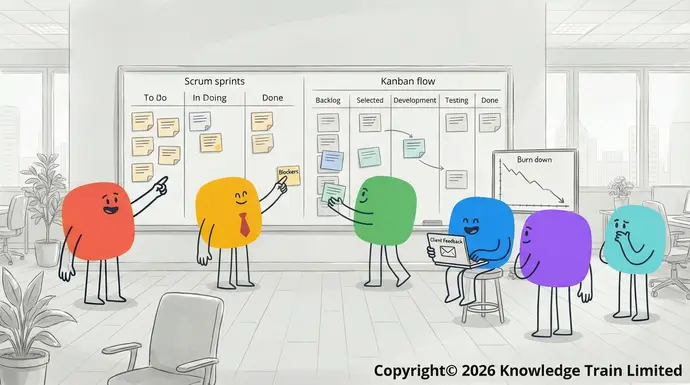
- Communication is critical for the success of a project. It is also essential to the agile approach. Utilize low-tech communication methods such as whiteboards or burn-down charts and keep everyone informed about the status of the project.
- Keep upper-management away from your developers by mediating the project-level issues across the teams.
- Foster a collaborative environment that doesn’t punish small errors and rather encourages learning from mistakes.Starting your project management career