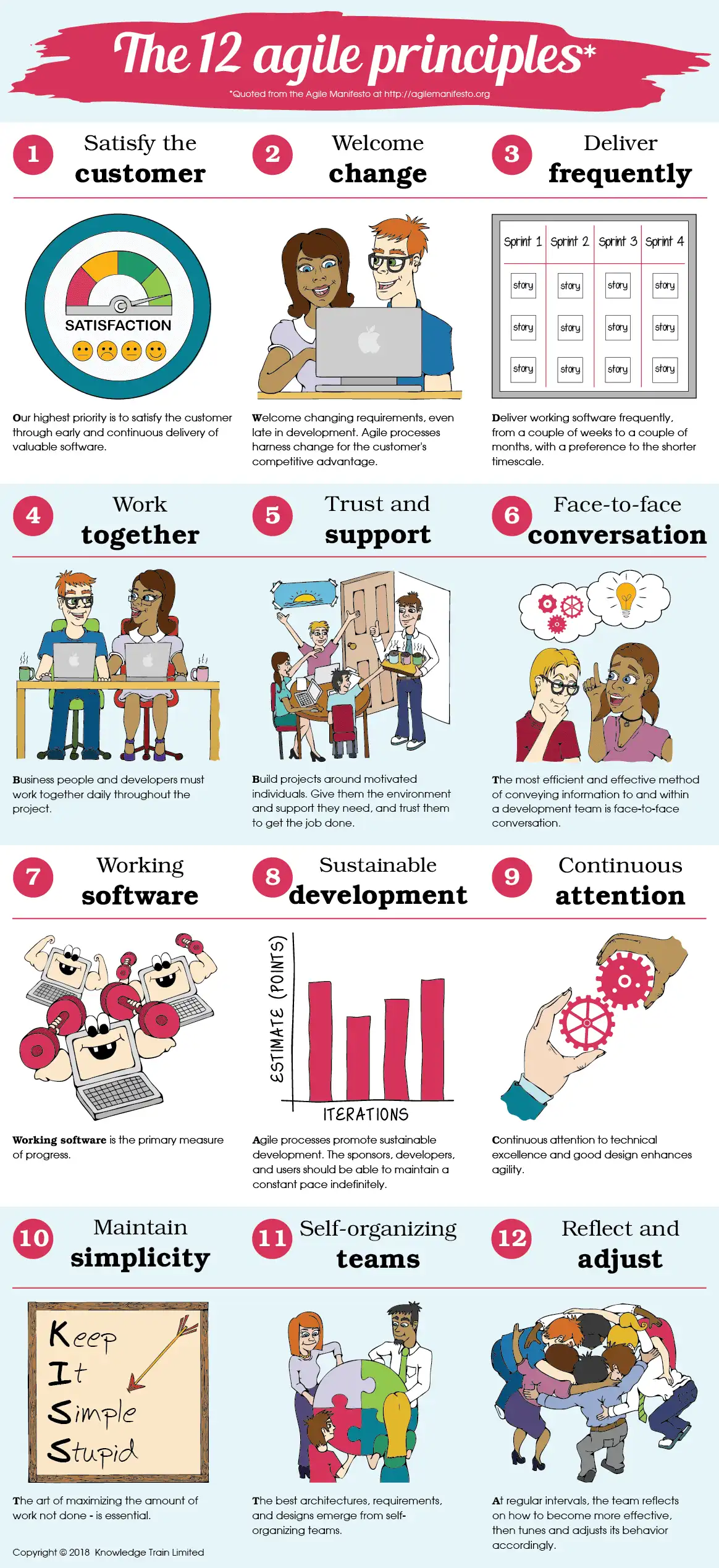
Agile principles

Key takeawaysStrong delivery comes from choosing and combining techniques that fit your project’s uncertainty, scale, and stakeholders.
Agile principles focus on delivering value early, learning fast, and supporting people to do their best work.Use a Work Breakdown Structure to define scope clearly and create reliable estimates and ownership.Understanding the project triangle
- Deliver a usable product early and improve it through frequent, small releases.Use Gantt charts and network diagrams to visualise sequencing, dependencies, and progress.
- Welcome changing requirements and use feedback to protect business value and relevance.Apply CPM and PERT to identify critical work, quantify schedule risk, and test scenarios.Benefits of the project triangle
- Keep business stakeholders and developers working together daily to reduce misalignment and rework.Use Kanban to manage flow, limit work in progress, and surface blockers early.
- Measure progress by working software, not by documents, plans, or partial outputs.Prioritise uncertainty with a risk matrix and stakeholder mapping to guide action and communication.Managing the project triangle
- Maintain a sustainable pace, prioritise technical excellence, and simplify processes to stay adaptable.Track delivery health with EVM and cost-benefit analysis to support timely, evidence-based decisions.
- Use self-organising teams and regular retrospectives to continuously adjust how work is done. Strategies for balancing constraints
2. Embrace changeRegularly review and update the diagram as the project progresses.. This is possible because this will help the team to predict potential problems earlier in the process, have a contingency plan, and balance the risks in all three constraints.
Project development is becoming increasingly unpredictable. Markets are becoming more complex and the number of diverse products available to consumers grows every day. It’s nearly impossible to predict what the final requirements of a project will be and as such, development projects are an increasingly risky.Utilise color-coding to highlight critical paths or high-risk activities.The use of the project management triangle allows for
’re very likely to fail. That’s not the fault of developers, it’s the fault of management.Calculating the earliest and latest start and finish times for each task should include:
Owners and managers need to create an environment that rewards success, fosters healthy working relationships and helps improve employees’ work/life balance. Give developers the tools and motivation to succeed and you’ll be rewarded with easier project development and better returns on investment.Identifying the critical path and the float time for non-critical tasks.Identification of risks that could impact any of the constraints
6. Better communicationThe critical path represents the sequence of tasks that directly affects the project’s overall duration. Any delay in a critical path task will result in a delay in the project completion date, unless the delay is addressed through corrective action.Risk scoring based on probability and impact
Technology provides businesses a hundred different ways to communicate with employees, but none will ever be as good as face-to-face communication. 2020 has drastically changed the way we work, with more employees working remotely than ever before, businesses are becoming reliant on communication tools such as Skype and Microsoft Teams. While these might be just good enough, the changes of error do increase when teams lack fact-to-face communication. Information gets lost in translation, emails and memos get buried in inboxes etc.CPM offers several benefits:Detailed contingency plans for high-priority risks
7. Working softwareCommon pitfallsthe project scope.
Replace ‘software’ with ‘products’ and you’ll find a fairly self-explanatory principles applicable to every project every developed. This principle came about in response to excessive documentation and procedures in the Overreliance on extreme (optimistic or pessimistic) estimatesMonitor for scope creepITNeglecting task dependencies: Regularly review project requirements to ensure they align with the defined scope. industry that slowed development.Failing to update analysis as the project progressesPrioritisation
In other industries, this principle might be summarized as such: “A working product is more valuable than a checklist.” Requirements analysis documents, models and mock-ups may be useful, but they aren’t very useful if you can’t convert this information into a working product. are a visual project management tool that originated in Toyota’s lean manufacturing system and have since become popular in various industries, particularly in software development and When managing project time, you can try these tips:
Project managers and business owners alike need to focus on minimizing paperwork and maximizing productivity. Unfinished products are inventory and inventory is an expense that provides no value.Agile project Critical path
8. Stable work environmentsmanagement: Identify the tasks that must be completed on time for the project to stay on schedule.
Agile promotes the idea of sustainable development. In short, this means that with the correct implementation of agile methods, there should never be the need for developers to work ridiculous hours just to meet deadlines..Resource leveling
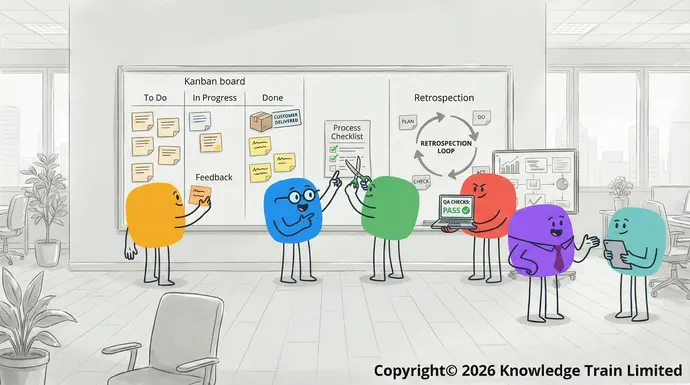
Agile requires stakeholders, customers and developers to act as one coherent team. When everyone involved feeds information into an agile framework, it becomes very easy to create accurate forecasts, budgets and timelines.A Kanban board is a visual tool that helps teams manage their work using Kanban methodology. The board is divided into columns that represent the stages of a workflow, for example, “To Do”, “In Progress”, and “Done”. Cards or sticky notes are placed on the board to represent the work items or tasks, and they are moved from one column to another as the work progresses. This way, the team can:: Optimise the use of resources to avoid overloading or underutilisation.
Risk management matrix
A
Probability: The chance of a risk happening (typically rated as low, medium, high)Impact: The severity of the outcome if the risk occurs (usually ranked from minor to major)Risk score: A value obtained by multiplying the probability and impact assessments.
Advantages of employing a Risk Management Matrix:
Facilitates a clear, visual summary of potential project risks.
Assists in prioritising risk responses.
Engage the whole project team in risk identification and evaluation.
Formulate specific mitigation or contingency plans for prioritised risks.
Periodically review and revise risk ratings and assumptions.
By systematically identifying, evaluating, and addressing risks, project managers can proactively manage potential challenges and opportunities, thereby enhancing the project’s chances of success.