Agile principles

Key takeaways
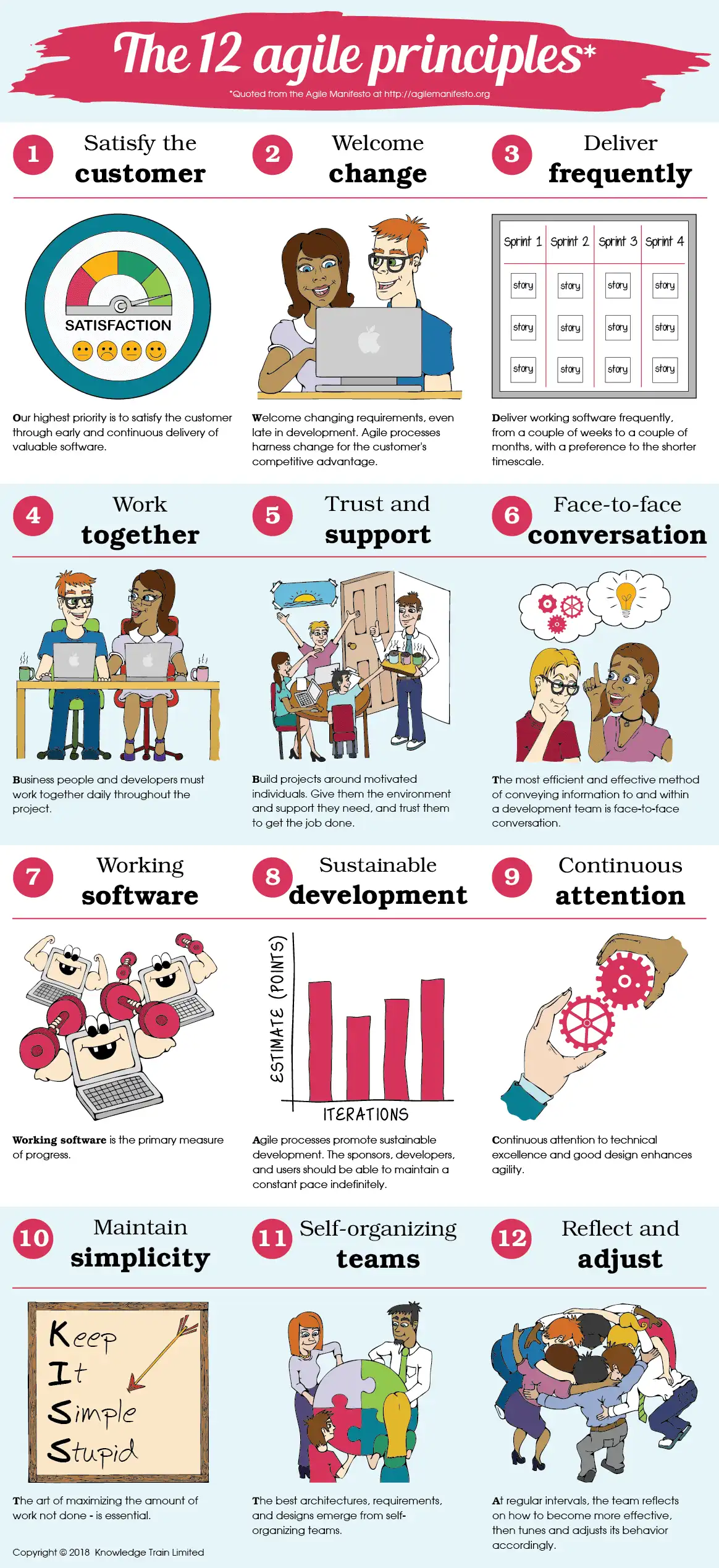
Agile principles focus on delivering value early, learning fast, and supporting people to do their best work.
- Deliver a usable product early and improve it through frequent, small releases.
- Welcome changing requirements and use feedback to protect business value and relevance.
- Keep business stakeholders and developers working together daily to reduce misalignment and rework.
- Measure progress by working software, not by documents, plans, or partial outputs.Knowledge Train is an Agile BA Accredited Training Organization.
- Maintain a sustainable pace, prioritise technical excellence, and simplify processes to stay adaptable.
- Use self-organising teams and regular retrospectives to continuously adjust how work is done.BCS accredited training partner for Business Analysis.
IntroductionWHAT YOU WILL GET
AgileOur courses and workshops include: is based on 4 key values and 12 key principles. While the agile values provide project managers and developers with a very general overview of what it means to be ‘agile,’ and help guide the agile process, the 12 agile principles give examples of how agile should be implemented.Certification exam(s) where applicable
The 12 agile principles underpin every successful agile project and can inspire even non-agile teams. They form a core part of any Accredited training course materialsagile project management courseExpert, experienced trainers to support you.Course manual where applicable.
1. Early and continuous delivery of valuable software
When developing a product, speed and precision is key. Should development take too long, there is an increasing risk that the final product will no longer satisfy rapidly changing market demands and consumer needs.SELF-PACED ONLINE TRAINING COURSES
Traditional methods may often develop a product in a vacuum, following a strict development plan with no deviation which results in delivering a final product that is already obsolete.Self-paced online training courses (e-learning) include:
Agile aims to deliver a functioning product in the very first development iteration. It will be a long way from being finished; but it just has to give the customer enough of an idea so that developers can receive valuable feedback. In doing so, agile projects can tailor the product as it is being developed to deliver something that satisfies customers’ needs.BUSINESS SOLUTIONS
Agile takes large tasks and breaks them up into smaller, more manageable chunks. The interactive nature of agile not only improves project development but also service delivery.
Agile requires that stakeholders, customers and developers work in unison (often in the same room) to achieve project goals. This reduces the risk inherent to project development, by helping improve communication and cooperation. In addition, the more closely management is involved with development, the easier it is for them to understand the challenges faced by developers and the ramifications of changes made to development.AWARDS
5. Autonomy and motivationWe don’t go seeking awards, but here are two of the awards we have received for our training.
Excessive meddling by management rarely benefits project development. Managers have to trust their development teams to get the work done without constant micro-management. Given the correct agile training , tools and resources, developers should otherwise be given total autonomy to complete tasks in whichever way they see fit. Request a quote
Too often, business owners forget that their employees are professionals who take pride in their work (this is especially true in any creative role). If you build your +44 (0)207 148 5985projects