Agile principles

Key takeaways
Agile principles focus on delivering value early, learning fast, and supporting people to do their best work.
- Deliver a usable product early and improve it through frequent, small releases.
- Welcome changing requirements and use feedback to protect business value and relevance.
- Keep business stakeholders and developers working together daily to reduce misalignment and rework.
- Measure progress by working software, not by documents, plans, or partial outputs.
- Maintain a sustainable pace, prioritise technical excellence, and simplify processes to stay adaptable.
- Use self-organising teams and regular retrospectives to continuously adjust how work is done.
Project development is becoming increasingly unpredictable. Markets are becoming more complex and the number of diverse products available to consumers grows every day. It’s nearly impossible to predict what the final requirements of a project will be and as such, development projects are an increasingly risky.
’re very likely to fail. That’s not the fault of developers, it’s the fault of management.
Owners and managers need to create an environment that rewards success, fosters healthy working relationships and helps improve employees’ work/life balance. Give developers the tools and motivation to succeed and you’ll be rewarded with easier project development and better returns on investment.
6. Better communication
Technology provides businesses a hundred different ways to communicate with employees, but none will ever be as good as face-to-face communication. 2020 has drastically changed the way we work, with more employees working remotely than ever before, businesses are becoming reliant on communication tools such as Skype and Microsoft Teams. While these might be just good enough, the changes of error do increase when teams lack fact-to-face communication. Information gets lost in translation, emails and memos get buried in inboxes etc.
10. Simplicity
This principle is like number 7: working software. But while the focus of that principle was about removing unnecessary documentation, this principle focuses more on processes.
This principle can be achieved in several ways. Firstly, you can remove bloated processes that do not contribute to the overall quality or progress of a project. Secondly, you can rely on automation to complete repetitive or time-consuming tasks. Or thirdly, you might use pre-existing assets from past projects rather than creating ones from scratch each time you begin something new.
This principle should be an ongoing effort. Agile teams need to recognize that there is always room for improvement. Technology provides us more varied, easier ways of doing things. Project management[email protected] research helps managers and business continuously improve their practices to suit modern trends etc.
Being agile requires businesses hold weekly or even daily meetings. A large part of these should be dedicated towards finding new and better ways of accomplishing tasks. +44 (0)207 148 5985
11. Self-organizing teamsCourses
This principle is similar to number 5: autonomy and motivation. The difference here lies in the comparison between agile teams and traditional development teams. Traditional methods often compartmentalize their development teams. For example, ‘Team A’ completes one task, then passes it on to ‘Team B’ who layers their contribution on top of this etc.PROJECT MANAGEMENT
Agile teams however, are comprised of multiple individuals, who share a wide variety of skills in several disciplines. Furthermore, agile development teams often include stakeholders, managers and consumers as core team-members. This allows them to work independently as a unit without the need to look to others for assistance.Practitioner
This not only minimizes the need for upper management to micro-manage development but also ensures that processes such as quality assurance and adaptation are an inherent part of agile development and thus occur naturally and autonomously.Includes Foundation & Practitioner combined option.
12. Reflection and adjustmentAssociation for Project Management (APM)
This final principle is almost a proof-of-concept principle that indicates whether or not Project Fundamentals Qualification (PFQ) agile methodologiesStart your APM project management career. have been adequately incorporated into business strategy. Reflection on past success or failures and responsibly changing approaches to compensate is what makes agile so successful.Project Management Qualification (PMQ)
Doing so requires communication, feedback, an understanding of agile methods and an environment that encourages both innovation and learning from mistakes.®
No team acts perfectly but a mature, informed and responsible team can improve itself by taking both pro-active and reactive measures to improve development. – Agile Project Management
Why agile principles matterPractitioner
Although the 12 agile principles were developed almost 2 decades ago, they are still relevant and will likely remain relevant for a long time to come.Includes Foundation & Practitioner combined option.
That is because the key agile principles are WorkshopsanthropocentricIntroduction to Project Management . That is to say, they are based on human values and helps improve the quality of life in the workspace. Agile aims to improve the well-being of workers just as much as it aims to deliver high-quality products.1-day workshop to learn the basics of project management.
Better, smoother, more efficient development means happier, less stressed workers and more satisfied customers.Project Management Essentials
Infographic2-day workshop to learn how to manage projects without getting certified.
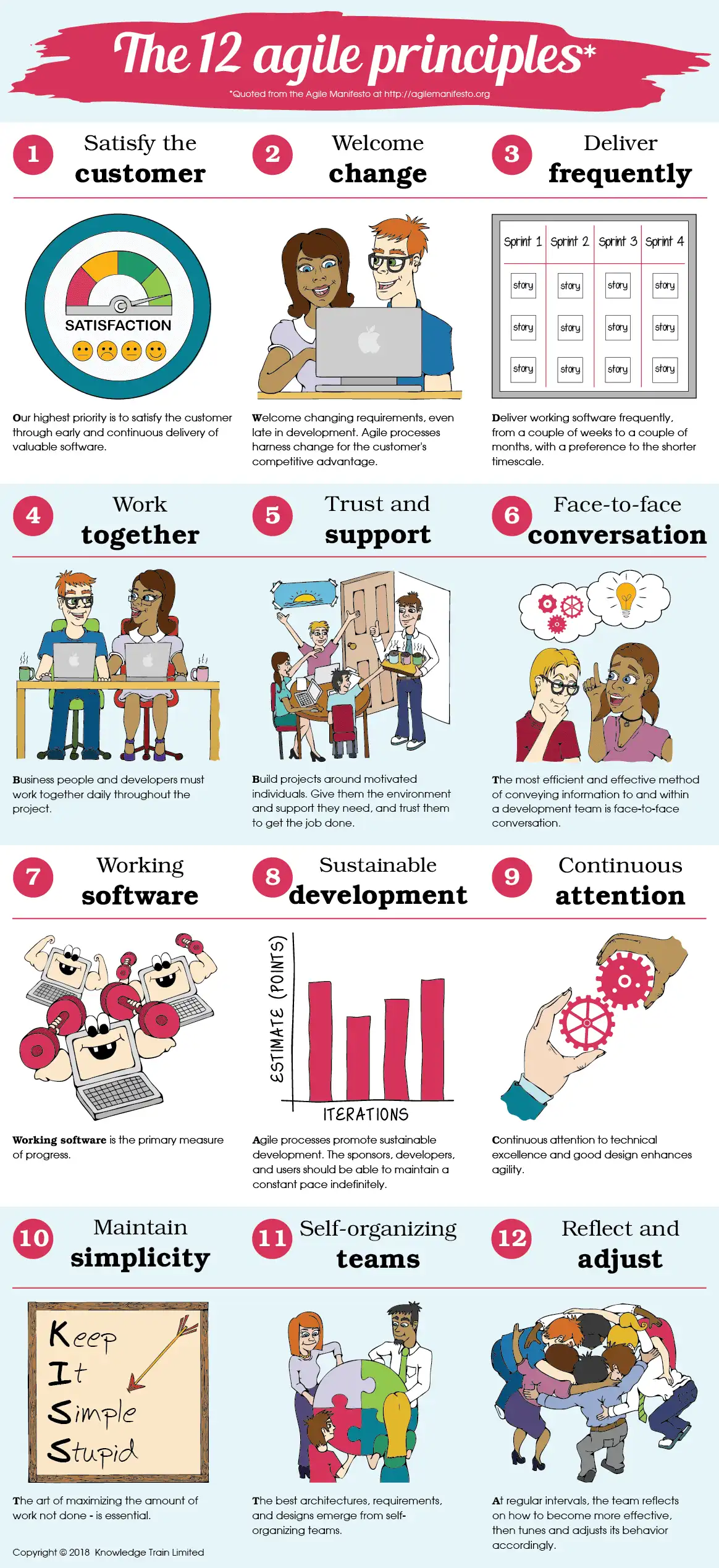
Below is our beautifully illustrated infographic detailing the agile principles. Perfect for anyone working on agile projects!Writing Business Cases
Download and print your free poster hereHalf-day workshop to learn to write robust business cases.. Put it on the wall in your workplace to help your team learn the 12 agile principles.AI in Project Management
Feel free to use either of these graphics on your website, but please link back to this page so others can enjoy our free resources.Learn how to use AI tools in everyday project work.