Agile principlesSelect your preferred training course below:

IntroductionPROGRAMME MANAGEMENT COURSES
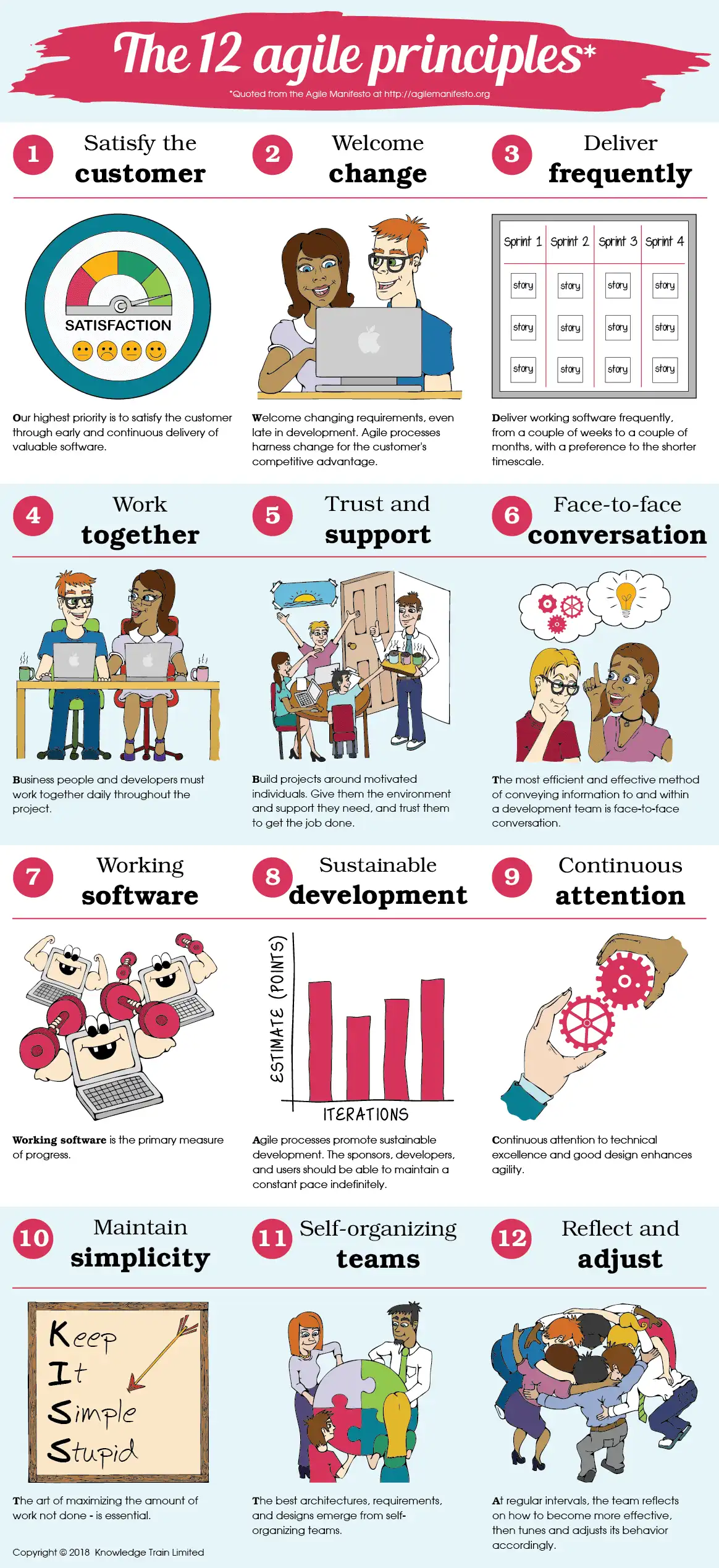
AgileSelect your self-paced training course topic. is based on 4 key values and 12 key principles. While the agile values provide project managers and developers with a very general overview of what it means to be ‘agile,’ and help guide the agile process, the 12 agile principles give examples of how agile should be implemented.
The 12 agile principles underpin every successful agile project and can inspire even non-agile teams. They form a core part of any MSP COURSESagile project management courseSelect your preferred training course below:.
1. Early and continuous delivery of valuable softwareIT QUALIFICATIONS
When developing a product, speed and precision is key. Should development take too long, there is an increasing risk that the final product will no longer satisfy rapidly changing market demands and consumer needs.Select your preferred qualification.
Traditional methods may often develop a product in a vacuum, following a strict development plan with no deviation which results in delivering a final product that is already obsolete.
AgileSelect your preferred qualification. aims to deliver a functioning product in the very first development iteration. It will be a long way from being finished; but it just has to give the customer enough of an idea so that developers can receive valuable feedback. In doing so, agile projects can tailor the product as it is being developed to deliver something that satisfies customers’ needs.
Agile takes large tasks and breaks them up into smaller, more manageable chunks. The interactive nature of agile not only improves project development but also service delivery.ITIL COURSES
2. Embrace changeKnowledge Train is a Better Business Cases Accredited Training Organization.
Project development is becoming increasingly unpredictable. Markets are becoming more complex and the number of diverse products available to consumers grows every day. It’s nearly impossible to predict what the final requirements of a project will be and as such, development projects are an increasingly risky.
Most businesses don’t like risk, but what is even less desirable is wasting time and resources developing a product that’s no longer relevant by the time it’s finally completed. By welcoming change and actively seeking to make improvements through consumer feedback, businesses can gain a competitive edge – their products will satisfy the immediate needs of consumers and their products will be guaranteed to provide business value.Knowledge Train is a PRINCE2 Agile Accredited Training Organization.
People change, times change, markets change. Trying to fight it is pointless. Traditional project management usually sees change as a problem to be solved, but agile embraces change and uses it to the customer’s advantage.
3. Frequent deliveryKnowledge Train is an Agile BA Accredited Training Organization.
This principle may closely mirror the first, but while the first states that products should be delivered earlyBCS accredited training partner for Business Analysis., this principle goes a little more into detail as to why products should be delivered continuouslyKnowledge Train is an Agile BA Accredited Training Organization..
Smaller, more frequent releases mean less chance of error. Frequent releases give consumers more opportunity to provide feedback which, in turn, aids developers in correcting errors that might otherwise have derailed a project. If developers only receive feedback every few months, any errors made early in development may have since become much more difficult and costly to fix.Knowledge Train is a PRINCE2 Accredited Training Organization.
Many businesses apply this principle so that they deliver new iterations of software or products every few days. This just goes to show the importance of frequent delivery, which is arguably one of the most defining agile principlesKnowledge Train is an AgilePM Accredited Training Organization..
4. CooperationKnowledge Train is a PRINCE2 Agile Accredited Training Organization.
In traditional management, the work business owners and stakeholders is usually kept distinct from the work of developers. Analysist are put in place to ‘translate’ business needs into development plans and project managers simply help mediate the demands of owners in a way that doesn’t negatively affect product development.
Agile requires that stakeholders, customers and developers work in unison (often in the same room) to achieve project goals. This reduces the risk inherent to project development, by helping improve communication and cooperation. In addition, the more closely management is involved with development, the easier it is for them to understand the challenges faced by developers and the ramifications of changes made to development.Knowledge Train is a PRINCE2 Agile Accredited Training Organization.
5. Autonomy and motivation
Excessive meddling by management rarely benefits project development. Managers have to trust their development teams to get the work done without constant micro-management. Given the correct Knowledge Train is a Lean Six Sigma Accredited Training Organization.agile training , tools and resources, developers should otherwise be given total autonomy to complete tasks in whichever way they see fit.BCS accredited training partner for Business Analysis.
Too often, business owners forget that their employees are professionals who take pride in their work (this is especially true in any creative role). If you build your projectsAXELOS Peoplecert accredited training organisation for ITIL (IT Infrastructure Library).
In other industries, this principle might be summarized as such: “A working product is more valuable than a checklist.” Requirements analysis documents, models and mock-ups may be useful, but they aren’t very useful if you can’t convert this information into a working product.
Project managers and business owners alike need to focus on minimizing paperwork and maximizing productivity. Unfinished products are inventory and inventory is an expense that provides no value.OUR VALUES
8. Stable work environmentsOur 6 core values are everything we do. They include:
Agile promotes the idea of sustainable development. In short, this means that with the correct implementation of agile methods, there should never be the need for developers to work ridiculous hours just to meet deadlines.Integrity
Agile requires stakeholders, customers and developers to act as one coherent team. When everyone involved feeds information into an agile framework, it becomes very easy to create accurate forecasts, budgets and timelines.Diversity
Customers tell developers what they need, stakeholders understand how changes may affect development and teams can make informed decisions as to how progress is to be made. No one is left out of the loop and no one is taken by surprise by unexpected developments.
This helps reduce stress and avoids employee ‘burn out.’SOCIAL RESPONSIBILITY
9. Quality assuranceSome of the charities we have helped over the years:
Many businesses prioritize speed or quantity over quality. In some cases, this makes a lot of sense. Sometimes customers don’t care as much for quality so whether or not a product works.
But, if development teams neglect quality for too long, their ability to adapt the product to suit current consumer demands diminishes and it becomes less agile.
10. SimplicityAWARDS
This principle can be achieved in several ways. Firstly, you can remove bloated processes that do not contribute to the overall quality or progress of a project. Secondly, you can rely on automation to complete repetitive or time-consuming tasks. Or thirdly, you might use pre-existing assets from past projects rather than creating ones from scratch each time you begin something new.
This principle should be an ongoing effort. Agile teams need to recognize that there is always room for improvement. Technology provides us more varied, easier ways of doing things. Project management+44 (0)207 148 5985 research helps managers and business continuously improve their practices to suit modern trends etc.
Being agile requires businesses hold weekly or even daily meetings. A large part of these should be dedicated towards finding new and better ways of accomplishing tasks.[email protected]
11. Self-organizing teams
This principle is similar to number 5: autonomy and motivation. The difference here lies in the comparison between agile teams and traditional development teams. Traditional methods often compartmentalize their development teams. For example, ‘Team A’ completes one task, then passes it on to ‘Team B’ who layers their contribution on top of this etc.
Agile teams however, are comprised of multiple individuals, who share a wide variety of skills in several disciplines. Furthermore, agile development teams often include stakeholders, managers and consumers as core team-members. This allows them to work independently as a unit without the need to look to others for assistance.
This not only minimizes the need for upper management to micro-manage development but also ensures that processes such as quality assurance and adaptation are an inherent part of agile development and thus occur naturally and autonomously.United Kingdom
12. Reflection and adjustment
This final principle is almost a proof-of-concept principle that indicates whether or not agile methodologies have been adequately incorporated into business strategy. Reflection on past success or failures and responsibly changing approaches to compensate is what makes agile so successful.
Doing so requires communication, feedback, an understanding of agile methods and an environment that encourages both innovation and learning from mistakes.
No team acts perfectly but a mature, informed and responsible team can improve itself by taking both pro-active and reactive measures to improve development.