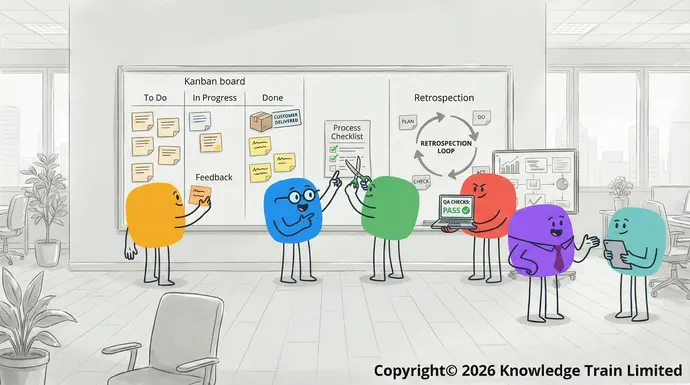
IntroductionProject management principles are the guiding concepts that contribute to successful project delivery. Some of the most important principles include setting up a strong project foundation, defining roles and responsibilities, and managing the project scope and changes. Effective risk management, KPI and baseline tracking, communication and collaboration, and a focus on value delivery and continuous improvement are also crucial. These principles are not exhaustive, and as the field of project management continues to evolve, it is important to remain committed to ongoing learning and improvement. By consistently applying these principles and continuously enhancing
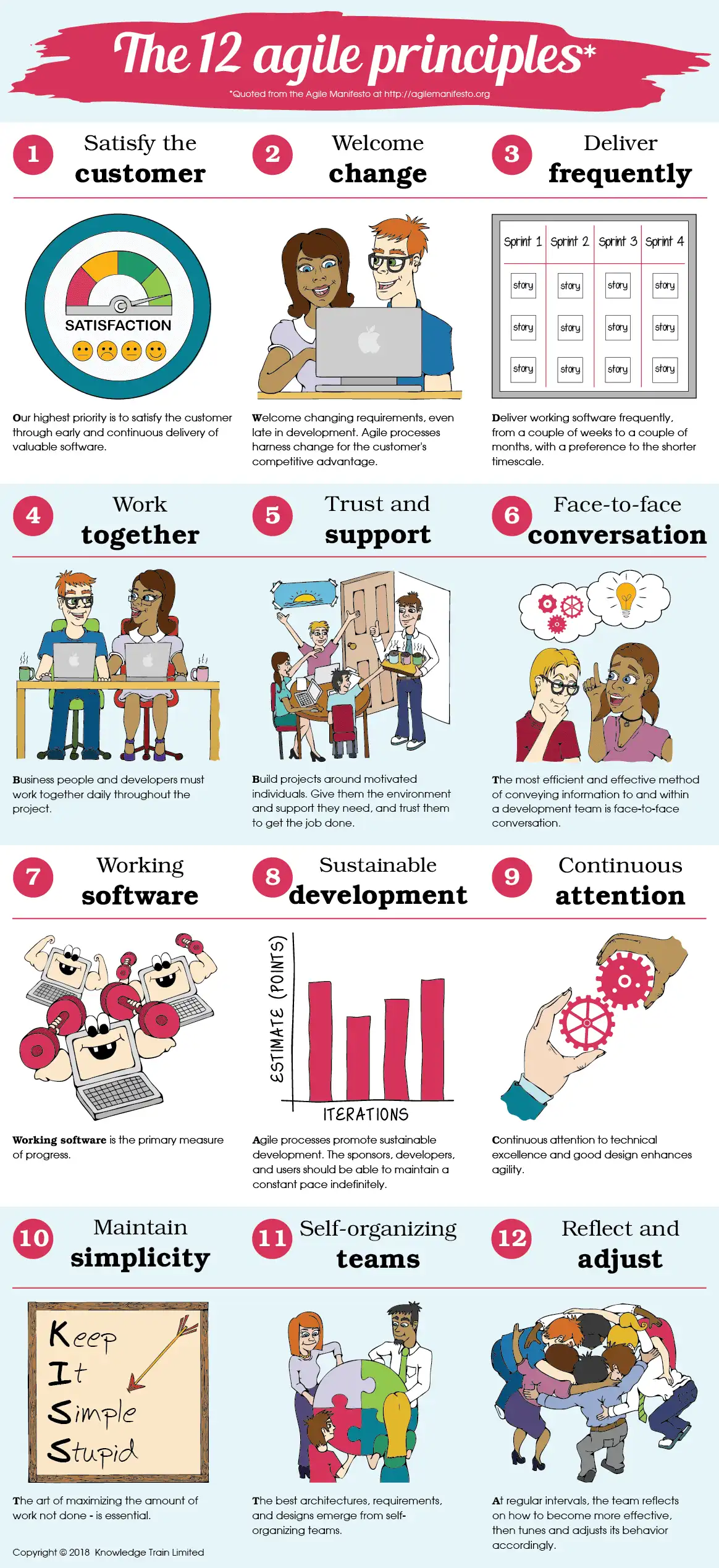
Agileproject management is based on 4 key values and 12 key principles. While the agile values provide project managers and developers with a very general overview of what it means to be ‘agile,’ and help guide the agile process, the 12 agile principles give examples of how agile should be implemented. skills and knowledge, practitioners can successfully overcome challenges and achieve exceptional outcomes in an ever-changing business environment.
The 12 agile principles underpin every successful agile project and can inspire even non-agile teams. They form a core part of any agile project management courseEnhance your skills with our expert-led courses.
1. Early and continuous delivery of valuable software
When developing a product, speed and precision is key. Should development take too long, there is an increasing risk that the final product will no longer satisfy rapidly changing market demands and consumer needs.
Traditional methods may often develop a product in a vacuum, following a strict development plan with no deviation which results in delivering a final product that is already obsolete.Self-paced
Agile aims to deliver a functioning product in the very first development iteration. It will be a long way from being finished; but it just has to give the customer enough of an idea so that developers can receive valuable feedback. In doing so, agile projects can tailor the product as it is being developed to deliver something that satisfies customers’ needs.
Agile takes large tasks and breaks them up into smaller, more manageable chunks. The interactive nature of agile not only improves project development but also service delivery.Self-paced
2. Embrace change
Project development is becoming increasingly unpredictable. Markets are becoming more complex and the number of diverse products available to consumers grows every day. It’s nearly impossible to predict what the final requirements of a project will be and as such, development projects are an increasingly risky.{"@context":"https://schema.org","@type":"ImageObject","contentUrl":"https://www.knowledgetrain.co.uk/training-courses/project-management-principles-infographic-v1.0.webp ","description":"Project management principles infographic ","license":"https://www.knowledgetrain.co.uk/license","acquireLicensePage":"https://www.knowledgetrain.co.uk/license","creditText":"Knowledge Train","uploadDate":"2024-10-18T09:00:53.000Z","copyrightNotice":"© 2024 Knowledge Train Limited. All rights reserved.","creator":{"@type":"Organization","name":"Knowledge Train","url":"https://www.knowledgetrain.co.uk"}}
Most businesses don’t like risk, but what is even less desirable is wasting time and resources developing a product that’s no longer relevant by the time it’s finally completed. By welcoming change and actively seeking to make improvements through consumer feedback, businesses can gain a competitive edge – their products will satisfy the immediate needs of consumers and their products will be guaranteed to provide business value.
People change, times change, markets change. Trying to fight it is pointless. Traditional project management usually sees change as a problem to be solved, but agile embraces change and uses it to the customer’s advantage.
3. Frequent delivery
This principle may closely mirror the first, but while the first states that products should be delivered early , this principle goes a little more into detail as to why products should be delivered continuously .
Smaller, more frequent releases mean less chance of error. Frequent releases give consumers more opportunity to provide feedback which, in turn, aids developers in correcting errors that might otherwise have derailed a project. If developers only receive feedback every few months, any errors made early in development may have since become much more difficult and costly to fix.Simon Buehring
Too often, business owners forget that their employees are professionals who take pride in their work (this is especially true in any creative role). If you build your projects ’re very likely to fail. That’s not the fault of developers, it’s the fault of management.
Owners and managers need to create an environment that rewards success, fosters healthy working relationships and helps improve employees’ work/life balance. Give developers the tools and motivation to succeed and you’ll be rewarded with easier project development and better returns on investment.
6. Better communication
Technology provides businesses a hundred different ways to communicate with employees, but none will ever be as good as face-to-face communication. 2020 has drastically changed the way we work, with more employees working remotely than ever before, businesses are becoming reliant on communication tools such as Skype and Microsoft Teams. While these might be just good enough, the changes of error do increase when teams lack fact-to-face communication. Information gets lost in translation, emails and memos get buried in inboxes etc.
7. Working software28 Apr 2026
Replace ‘software’ with ‘products’ and you’ll find a fairly self-explanatory principles applicable to every project every developed. This principle came about in response to excessive documentation and procedures in the ITUnderstand the costs of PRINCE2 Agile courses and what to expect beyond the course fee. Read on to plan your budget effectively. industry that slowed development.
In other industries, this principle might be summarized as such: “A working product is more valuable than a checklist.” Requirements analysis documents, models and mock-ups may be useful, but they aren’t very useful if you can’t convert this information into a working product.
Project managers and business owners alike need to focus on minimizing paperwork and maximizing productivity. Unfinished products are inventory and inventory is an expense that provides no value.
8. Stable work environmentsInterview with Sasha Martin
Agile promotes the idea of sustainable development. In short, this means that with the correct implementation of agile methods, there should never be the need for developers to work ridiculous hours just to meet deadlines.
Agile requires stakeholders, customers and developers to act as one coherent team. When everyone involved feeds information into an agile framework, it becomes very easy to create accurate forecasts, budgets and timelines.Sevcan Yasa
Customers tell developers what they need, stakeholders understand how changes may affect development and teams can make informed decisions as to how progress is to be made. No one is left out of the loop and no one is taken by surprise by unexpected developments.
This helps reduce stress and avoids employee ‘burn out.’
9. Quality assurance
Many businesses prioritize speed or quantity over quality. In some cases, this makes a lot of sense. Sometimes customers don’t care as much for quality so whether or not a product works.
But, if development teams neglect quality for too long, their ability to adapt the product to suit current consumer demands diminishes and it becomes less agile.
10. SimplicityKnowledge Train
This principle is like number 7: working software. But while the focus of that principle was about removing unnecessary documentation, this principle focuses more on processes.19 Feb 2026
This principle can be achieved in several ways. Firstly, you can remove bloated processes that do not contribute to the overall quality or progress of a project. Secondly, you can rely on automation to complete repetitive or time-consuming tasks. Or thirdly, you might use pre-existing assets from past projects rather than creating ones from scratch each time you begin something new.