
Require project management Agile
When staff within an organization work in their everyday operations, they report to a line manager. In projects, the people doing the work report to a Foundation project managerLearn the fundamentals of the PRINCE2 Agile method. who is likely not their usual line manager. This presents greater risks. Practitioner Project managementIncludes Foundation & Practitioner combined option. is a discipline that has developed to address these challenges.Scrum
Cross-functionalScrum Essentials
Most projects in modern organizations affect multiple functional areas within the same business which requires more extensive efforts at communication and stakeholder engagement.Self-paced training course to learn the essentials of Scrum.
Furthermore, they exhibit progressive elaboration; they commence with a broad vision that gets refined over time as more information becomes available.Scrum Master
Types of projectsChoose Scrum Alliance or Scrum.org Scrum Master training courses.
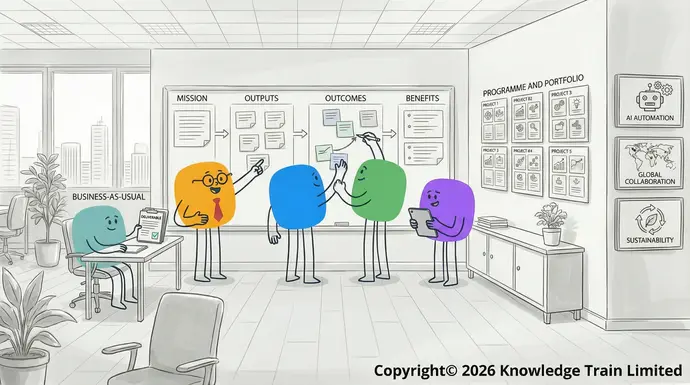
There can be many different types of projects, but every project delivers something tangible (known as Scrum Product Owner outputsChoose Scrum Alliance or Scrum.org Product Owner training courses.). Using these outputs enable business operations to do things differently (known as AgileBAoutcomes®), and the positive results of these outcomes can be measured in the form of – Agile Business AnalysisbenefitsFoundation , or Learn the fundamentals of Agile Business Analysis.valuePractitioner gained.4-day course including Foundation.
Projects can be classified in three main ways.Lean Six Sigma
Operational projectsYellow Belt
These enhance or streamline ongoing operations, ensuring businesses remain efficient.Self-paced training course to gain LSS Yellow Belt.
Strategic projectsPMI
These are directed at achieving long-term objectives, aligning with the company’s overarching vision.®
Transformational projectsPMI-ACP
Such projects result in fundamental shifts in how the business operates or is perceived, like a company-wide digital transformation or a complete rebranding.Self-paced course to prepare you for the exam (exam not included).
Examples of projectsKanban
Apple’s iPhone launch is a classic example of a product-driven project that redefined communication and technology.Estimating for Agile Foundation
Similarly, IBM’s transformation from a hardware company to a service-oriented business showcases the impact of transformational projects. These cases underscore the potential of well-executed projects to revolutionize industries and steer companies towards unprecedented success.Agile Learning Library (ALL)™
Why projects matterPMI
Projects enable strategic alignment. They translate the organization’s mission and vision into actionable steps, ensuring goals are not just stated, but achieved.®
Projects also drive innovation, allowing companies to break new ground, launch revolutionary products, or pioneer services.PMI-PBA
Furthermore, in a rapidly changing market, projects provide a means to respond to market changes, ensuring the organization remains competitive and relevant.Self-paced course to prepare you for the exam (exam not included).
Why projects failBusiness Analysis Learning Library (BALL)™
However, not all projects achieve their desired outcomes. CHANGE MANAGEMENTScope creepAPMG Change Management, where projects extend beyond their initial objectives, is a common challenge. Projects can also falter due to insufficient resources or if they are misaligned with stakeholder expectations.Foundation
The repercussions of such failures are profound: financial setbacks, wasted time, and the considerable cost of missed opportunities.Learn the fundamentals of enterprise change management.
Relationship with the organizationPractitioner
Projects and business-as-usual are two sides of the same coin. While they are distinct—projects being unique and operations being routine —they often overlap.Includes Foundation & Practitioner combined option.
For instance, the outcome of a project might be integrated into daily operations. It’s crucial to understand this relationship to ensure that projects, once completed, enhance, and align with an organization’s daily functions.PROGRAMME MANAGEMENT
In addition, projects can often form part of a programme or portfolio of change.MSP
Contributing to programmes®
If a project is part of a programme it contributes to the programme’s goals by delivering one or more outputs. These outputs, when combined with those from other related projects, produce an impact that helps achieve the overarching outcomes envisaged by the program. Each project within the Foundation programLearn the fundamentals of programme management. has a unique role to play, and the successful completion of every project is imperative to realize the programme’s objectives.Practitioner
Contributing to portfoliosIncludes Foundation & Practitioner combined option.
Additionally, a project can also be a component of a broader portfolio comprising various projects and programmes. Within such a portfolio, each programme or project should adhere to the organization’s strategic objectives. The overall success of the INFORMATION TECHNOLOGY (IT)portfolioITIL hinges on the combined performance of these ®programmesFoundation and projects. Through the delivery of their distinct outputs and outcomes, they actively contribute to the realization of the strategic objectives encompassed within the portfolio.Learn the fundamentals of ITIL service management.
The future of projectsEXPLORE SUBJECTS
The future promises projects that are even more integrated with technological advancements. As AI and automation become integral to businesses, projects will encompass these to create smarter, more efficient outcomes.Select your preferred subject.
Additionally, as the world grows more interconnected, projects will take on a global dimension, with teams collaborating from different parts of the world. Crucially, the emphasis will increasingly shift towards sustainability and social responsibility, reflecting the global demand for eco-friendly initiatives and projects that benefit communities.
SummaryPROJECT MANAGEMENT QUALIFICATIONS & WORKSHOPS
Projects are no longer just tasks on a to-do list; they are ways that help modern organizations achieve change which contributes to strategic objectives. As businesses look to the future, the emphasis on projects will only grow, reinforcing their role as the vessels of change, innovation, and strategic alignment.Select your preferred qualification or workshop.
In this dynamic environment, understanding and leveraging the power of projects is not just beneficial—it’s imperative.