
Key differences between project managers and product managers office to help it decide which projects will contribute to the organisation’s strategic goals. That way, they can filter out the bad ideas for projects, and only fund projects which will contribute to strategic goals.
Role focus and scopeA business case is also often used by a project sponsor or project executive to help it decide if they should invest in a specific project.
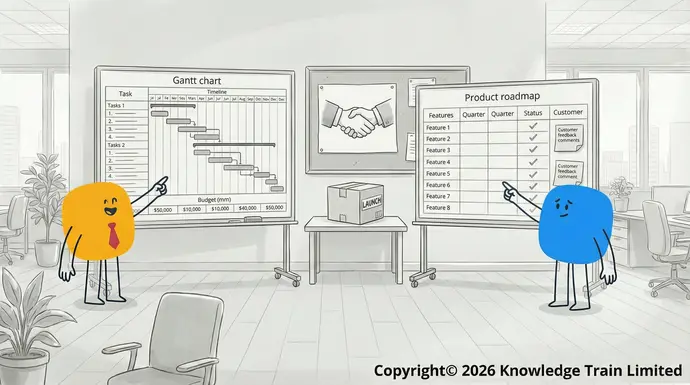
Project managersIn all cases, the business case must be written and approved prior to any major commitment of resources. are primarily focused on execution and delivery. They drive the implementation of specific projects and are responsible for managing the team to deliver project goals within constraints. Project managers focus on getting the job done.What form does a business case take?
Product managersBusiness cases can take many forms – digital or analogue. The tools you use to create one are also many and varied. Common business tools such as Microsoft Office might be used. Rather than being a document or slide deck however, it could equally be in the form of an email., on the other hand, are responsible for strategy and vision. They are tasked with defining what should be built and why, shaping the product roadmap and ensuring alignment with business objectives. In essence, product managers think about the product’s life cycle and market position, while project managers are more concerned with the day-to-day activities.Equally, a business case could be written by hand on a whiteboard or flipchart, or on the back of a cigarette packet!
Timeline and lifecycle involvementWhat you should always remember is that a business case does not have to be a huge long document. In fact, it should be as short as possible, and only include the most important information. That way it cuts out the noise and provides decision-makers with just the right information to enable them to take sensible decisions.
Project managersFor those of you interested in work within defined start and end dates, whereas product managers are involved in a product’s lifecycle indefinitely. A project manager guides a project from initiation to closure and then transitions to the next project or opportunity. On the other hand, a product manager’s responsibilities continue as long as the product exists in the market. They manage updates, improvements and adapt to market needs, so their involvement is ongoing.project management
Decision-making authority, the project management methodology known as
Project managers are tactical decision-makers, operating within project constraints. They are responsible for decisions about task prioritisation, resource allocation, and risk management, but they typically don’t have authority to make decisions about the overall project’s scope or direction. In contrast, product managers have strategic decision-making power. They decide what features the product should have, how it should be positioned in the market, and when to pivot based on customer feedback or market changes. Product managers make decisions that have long-term implications for the product.PRINCE2
Stakeholder management focuses its decision-making on a project on having a viable business case.
Project managers primarily work with internal teams and stakeholders directly involved in project execution. They coordinate between team members, manage project-related communication, and report to project sponsors or department heads. Product managers interact with a wider range of stakeholders. This includes not only internal teams like engineering, design, marketing and sales but also external ones. They gather insights from customers, understand market trends and work with multiple departments to ensure product-market fit.Business case examples
These differences in roles, responsibilities and operational focus highlight the unique contributions of both project managers and product managers to an organisation. While project managers are essential for executing specific initiatives, product managers play a pivotal role in setting strategic direction, thus guiding the overall product development and market success.We will now give you 2 business case examples. The first example is one which you might find useful for taking decisions in your personal life. The 2nd business case example is more business focused project.
Skills and qualificationsBusiness case example 1: Moving home
Project manager skillsSuppose you and your spouse are considering moving to a new home. You will need to weigh up the pros and cons of moving. This is done using a business case. You might not call it that, but that’s what it is. Let’s look at an example.
Project managersReason need to possess a range of skills to lead As you can see from the example, the first thing to be clear about in a business case is the reason for doing the project or activity. In this example, the couple has answered the question projectsWhy? effectively. Some of the key skills include: In fact, there are two problems here – the local school and John’s long commute.
- Planning and schedulingOptions considered: Project managers should be skilled in developing realistic timelines, managing project milestones, and keeping projects on track.A business case should weigh up the competing options which have been considered. After all, there is usually more than one option. Perhaps an alternative option would have been for John to change his job to one nearer their current house. However, this wouldn’t solve the issue with the school.
- Risk managementBenefits: Identifying and proactively addressing potential risks and developing strategies to mitigate them.The benefits of a project or activity are the positive things you’re going to get back in return for your investment of time and money. In this case, the kids will get a better education, and John will save time each day.
- Resource allocationTimescales: Ensuring optimal use of team members, budget, and materials throughout the project.It’s also important to understand how long the investment of resources will take. This is so that the organisation (or family in this case) knows when the resources will be freed up to work on other
- Communication and leadershipprojects: Project managers should be able to clearly communicate project goals, delegate tasks, and motivate team members to achieve objectives. These skills also help with stakeholder management and reporting. or activities.
Product manager skillsThere are usually 2 timescales to consider. First, the timescale of the project or activity – in this case 3 months to find a new house and move there. Second, the time over which the benefits shall be realized. In this case it’s 5 years until the kids leave school.
Product managersCosts, on the other hand, require a different skill set to guide product development and strategy. Key skills for product managers include:The costs of doing the project or activity is the next important bit of information. On this project, the costs of moving to a new house will be £5,000. These are the project costs.
- Market research and analysisHowever, the couple will spend an additional £2,000/year for every year over which the business case is calculated. For a project in an organisation, this is usually referred to as the operational costs of maintaining and operating the projects outputs e.g. an IT system. At this point, the couple knows the total costs over the timescales when the benefits shall be realized.: Product managers should be able to conduct thorough market research, identify customer needs, and understand market trends.Risks
- Strategic thinkingFor any activity or project, it’s also important to understand the major risks involved. Risks are the uncertain things which may or may not happen during the period of the investment. There is only one risk identified here, which is the risk that the couple might lose touch with friends who live close to them right now.
- Communication: The ability to convey complex information clearly, facilitate collaboration, and present ideas persuasively to various stakeholders is crucial for both project and product managers.
The contexts in which these skills are applied might be different between project and product management, but those skills are useful and necessary in both roles. If you are working as a professional in either of these areas, the skills required might form part of a pathway to moving from one to another.Instructor-led
Tools and methodologiesBetter Business Cases Practitioner (with Foundation) course
Project management tools and frameworks
Project managers£2,400 +vat use a variety of tools and frameworks to plan, execute, and monitor projects effectively. Some common tools and frameworks include:
- Gantt charts : Visual representations of project timelines, dependencies, and milestones. Project management softwareSelf-paced like Microsoft Project or Asana can provide comprehensive solutions for task assignment, progress tracking, and resource management.Better Business Cases Practitioner (with Foundation) self-paced online
- Agile and £1,199 +vatScrum : Agile and Scrum methodologies have become increasingly popular in project management, particularly in software development. These approaches emphasise flexibility, iterative development, and continuous improvement. Scrum boards and Sprint planning tools are commonly used to support these methodologies.
Product management tools and frameworks
Product managersSelf-paced utilise specialised tools to define and communicate product strategy effectively. Some tools and frameworks commonly used by product managers include:Better Business Cases Foundation self-paced online
- Product road mapping software : Tools like ProductPlan or Aha! help create visual roadmaps that outline product vision, features, and timelines. These tools are used to align stakeholders and guide development efforts.£699 +vat
- User story mapping and prioritisationLet’s now look at this example business case.: Techniques such as the Executive summaryMoSCoWThis sample business case contains an executive summary. This section briefly describes the selected option and the key benefits it will bring.
and data analysis{"@context":"https://schema.org","@type":"ImageObject","contentUrl":"https://www.knowledgetrain.co.uk/training-courses/how-to-write-a-business-case-890x501.webp","description":"How To Write a Business Case","license":"https://www.knowledgetrain.co.uk/license","acquireLicensePage":"https://www.knowledgetrain.co.uk/license","creditText":"Knowledge Train","uploadDate":"2023-05-18T08:21:15.000Z","copyrightNotice":"© 2023 Knowledge Train Limited. All rights reserved.","creator":{"@type":"Organization","name":"Knowledge Train","url":"https://www.knowledgetrain.co.uk"}}. Additionally, they will need to be proficient in integrating AI-driven project management tools into their workflows. Product managers, on the other hand, will need to develop a deeper technical literacyRelated articles, particularly in AI and data science. They will also require more advanced skills in user experience design and ethical product development .
It is expected that there will be an increased overlap between the skills required for both project and product managers. Professionals in both roles will need to possess a cross-functional expertise that enables them to adapt to the rapidly changing business environment. Adaptability, continuous learning, and technological proficiency will be crucial for success in both project and product management. The ability to navigate complex digital ecosystems while focusing on human-centric outcomes will be a key success factor for both roles.
Conclusion
Project management and product management are two different but equally important skills and roles for any organisation. Project managers are focused on execution, timeline, and resource management, while product managers are focused on strategy, market fit, and long-term vision for a product. Both roles require strong communication skills and the ability to manage stakeholders.
While project and product managers have different responsibilities, they work towards the same goal of delivering value to the organisation. Collaboration between project and product managers is essential to ensure that the product vision is translated into a successful outcome. In today’s fast-paced and complex digital landscape, the importance of both project and product management is becoming increasingly critical, and organisations that can effectively leverage the strengths of both roles are more likely to innovate, adapt, and succeed in competitive markets.
FAQsPRINCE2 Agile certification
Can a project manager become a product manager?
Yes. With additional training in market analysis, strategy, and user experience, project managers can transition into product management roles. Their organisational and leadership skills are valuable assets in product management.Simon Buehring
What are the main challenges faced by project managers and product managers?19 Feb 2026
Project managers commonly face challenges such as scope creep and resource constraints. Product managers often grapple with prioritising features and balancing stakeholder expectations with user needs.
How do Agile methodologies impact the roles of project and product managers?Considering PRINCE2 Agile certification? Discover how it integrates PRINCE2 with Agile concepts to advance your project management skills.
Agile methodologies blur the traditional boundaries of project and product managers. Project managers may take on the role of Scrum Masters, focusing on team processes. Product managers often assume the responsibilities of Product Owners, managing the product backlog.
What industries typically employ both project managers and product managers?
Technology, software development, manufacturing, and finance are common industries that hire both roles. Any industry with complex products or services can benefit from having both project and product managers.
How do project managers and product managers handle conflicts in priorities?
Open communication and data-driven decision-making are essential. They should align on overall goals, negotiate trade-offs, and escalate to senior leadership when necessary.
What certifications are valuable for project managers and product managers?
For project managers, Project management examplesAPM PMQ (Project Management Qualification) is highly respected in the UK. Product managers can benefit from certifications such as AIPMM (Association of International Product Marketing and Management) or Pragmatic Institute’s product management certifications.Knowledge Train
How do project managers and product managers collaborate on a product launch?19 Feb 2026
Product managers define launch requirements and success criteria, while project managers create and execute the launch plan, coordinating cross-functional teams. Both roles work closely to ensure timely delivery and alignment with the product vision.