
- Clear role boundaries, shared documentation, and regular touchpoints reduce conflict and keep delivery aligned to product value.How can I start a career in project management?
Introduction
Project management and product management are two essential aspects of any business that are often used interchangeably, even though they are distinct from each other. Both play a critical role in the success of any organisation, but they have different functions and responsibilities.Project management kick-off meetings
Knowledge Train
19 Feb 2026 Planning and conducting a project management kick-off meeting doesn't have to be complicated. Check out this helpful guide and make sure your team has a great start!
Book review: Applied Software Project Management Simon Buehring
19 Feb 2026
Explore the practical applications of software project management in 'Applied Software Project Management'. Read our review for insights.
Learn about the hidden costs associated with APM courses, including typical exam and material fees. Read on to plan your budget effectively.
Simon Buehring
19 Feb 2026
Explore challenges and opportunities for women in project management through our interview series. Gain insights into industry experiences and advice.
- PRINCE2 templates (PDF)
- Simon Buehring
- 19 Feb 2026
- Access recommended templates for PRINCE2 management products. Essential tools to support your project management practices.
- PRINCE2 Agile cost
- Simon Buehring
- 28 Apr 2026
Understand the costs of PRINCE2 Agile courses and what to expect beyond the course fee. Read on to plan your budget effectively.
Project management steps
Knowledge Train
19 Feb 2026
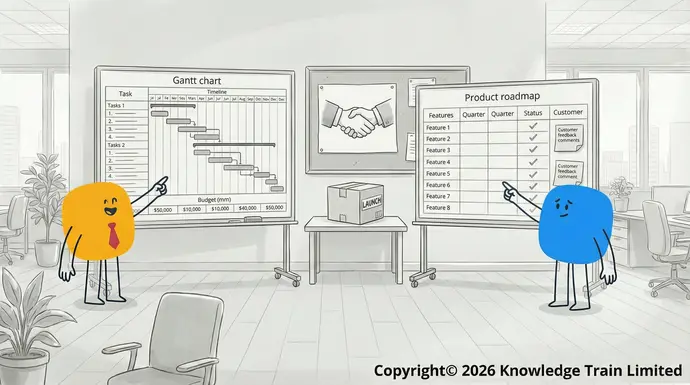
- Gantt chartsProject management is crucial for success. Discover the essential phases and elevate your skills to ensure projects from start to finish deliver exceptional outcomes. : Visual representations of project timelines, dependencies, and milestones. Project management software like Microsoft Project or Asana can provide comprehensive solutions for task assignment, progress tracking, and resource management.
- Agile and Scrum : Agile and Scrum methodologies have become increasingly popular in project management, particularly in software development. These approaches emphasise flexibility, iterative development, and continuous improvement. Scrum boards and Sprint planning tools are commonly used to support these methodologies.
Product management tools and frameworksPRINCE2 training course reviews
Product managers utilise specialised tools to define and communicate product strategy effectively. Some tools and frameworks commonly used by product managers include:Simon Buehring
- Product road mapping software19 Feb 2026 : Tools like ProductPlan or Aha! help create visual roadmaps that outline product vision, features, and timelines. These tools are used to align stakeholders and guide development efforts.
- User story mapping and prioritisationWatch video reviews from students who attended a PRINCE2 training course with Knowledge Train. Click through to hear about their experiences. : Techniques such as the MoSCoW method or story mapping workshops can assist product managers in organising and prioritising features based on user needs and business value. These approaches ensure that product development focuses on delivering maximum value to customers.
Shared tools and methodologies
Project managers and product managers both rely on collaboration and communication platforms such as Slack, Microsoft Teams, or Zoom to facilitate real-time communication and information sharing among team members and stakeholders. These tools allow both types of managers to keep everyone aligned and informed, and to quickly address any issues that may arise.
Data analysis and reporting tools such as Tableau or Power BI are also valuable for both project managers and product managers. These tools allow managers to analyse performance metrics, create visualisations, and generate reports for stakeholders. They help both types of managers to make data-driven decisions and to demonstrate the impact of their work.
By leveraging the appropriate tools and methodologies, both project and product managers can enhance their effectiveness, improve team collaboration, and drive successful outcomes in their respective domains.
Career paths and progression
Project management career trajectory
Project management careers often start with entry-level positions like project coordinator or project assistant. In these roles, individuals could learn the basics of project execution and team coordination. As they gain experience, project managers can progress to managing more complex and high-stakes projects.
Senior project managers are responsible for overseeing multiple projects or programs and may also take on mentoring roles for junior team members. Career advancement opportunities include roles such as portfolio manager or director of project management . These positions involve more strategic planning and the allocation of organisational resources.
Product management career trajectory
Product management careers typically begin with associate product manager or junior product manager positions. These roles are focused on supporting senior product managers and gaining experience with market research and product development processes. As professionals develop their skills, they can advance to product manager positions, where they take ownership of specific products or features.
Senior product managers often have responsibility for leading product lines or portfolios. Career advancement may lead to roles like director of product management or chief product officer. These executive positions are focused on shaping the overall product strategy and contributing to company-wide decision-making.
Transitioning between project and product management
Transitioning between project and product management is possible and can open additional career opportunities. Project managersGive us a call looking to move into product roles should emphasise their strategic thinking abilities and customer-focused skills. Product managers transitioning into project management should highlight their organisational and execution capabilities.
Both career paths offer opportunities for professional growth and leadership development, with success in either field depending on continuous learning, adaptability, and a strong understanding of business objectives.
How project managers and product managers work together+44 (0)207 148 5985
Collaborative aspects of the roles
Project managersOr chat with us using the link at the bottom of the screen. and Contact us with questions about the courses on this page, or about which project management certification or training is best for you. product managersFinance FAQs can often work closely together to achieve success in developing and delivering products. Their skills and focus areas are generally seen as complementary, and they can provide different but overlapping perspectives. Product managers are typically responsible for providing the overall vision and market understanding for a product, while project managers focus on planning and execution to deliver the product on time and within budget.Contact
Typical interactions and touchpointsCookies
The primary touchpoints between these roles are throughout the product lifecycle. For example, during product planning, product managers communicate feature requirements and priorities with project managers. Project managers then create detailed Privacy
Future trends and evolving roles1-day workshop to learn the basics of project management.
Impact of digital transformation on both rolesProject Management Essentials
Digital transformation2-day workshop to learn how to manage projects without getting certified.Request a quote is redefining both project and product management roles. Project managers are increasingly adopting Writing Business Cases Agile methodologiesHalf-day workshop to learn to write robust business cases. and remote collaboration tools to manage distributed teams and resources more effectively. On the other hand, product managers are prioritising data-driven decision-making and continuous product iteration based on real-time user feedback.AI in Project Management
Emerging technologies and their influenceLearn how to use AI tools in everyday project work.
Artificial intelligenceARTIFICIAL INTELLIGENCE (AI) and BCS AI machine learningFoundation are two emerging technologies that are impacting both roles. Project managers are leveraging AI-powered project management tools for optimising resource allocation and predicting project risks. Product managers are utilising ML algorithms to create personalised user experiences and predictive analytics for product development.Learn the fundamentals of artificial intellegence.Manage Consent
Predictions for future skill requirementsAI Project Governance Framework (AIPGF)
In the future, project managers will require stronger skills in managing Foundation To provide the best experiences, we use technologies like cookies to store and/or access device information. Consenting to these technologies will allow us to process data such as browsing behavior or unique IDs on this site. Not consenting or withdrawing consent, may adversely affect certain features and functions.virtual teams Learn the fundamentals of the governance framework. and Practitioner data analysisIncludes Foundation & Practitioner combined option. . Additionally, they will need to be proficient in integrating AI-driven project management tools into their workflows. Product managers, on the other hand, will need to develop a deeper Workshops AI in Project Management