
Introduction Select your preferred training course below:
Project management and product management are two essential aspects of any business that are often used interchangeably, even though they are distinct from each other. Both play a critical role in the success of any organisation, but they have different functions and responsibilities. P3O COURSES
Project managers are typically responsible for the successful delivery of specific projects within a defined timeframe. Product managers, on the other hand, oversee the entire lifecycle of a product, from inception to delivery, and are responsible for driving its success. Select your preferred training course below:
It is important to understand the differences between the two to make informed decisions regarding resource allocation, optimise decision-making processes, and foster effective collaboration across teams.
As MarketingWORKSHOPSproject Select your preferred workshop below: and product management become increasingly important in today’s business environment, it is critical to understand their respective roles and how they complement each other to tackle complex challenges effectively. This article will explore the key differences between the two, including specific responsibilities, skills and traits required, career paths, and other aspects.
By understanding these distinctions, individuals and organisations can make informed decisions about how to best leverage both disciplines to achieve their objectives and drive success. AGILE QUALIFICATIONS
Defining project management and product managementMarketingSelect your preferred qualification.
What is project management?
Project management AGILE PROJECT MANAGEMENT COURSES is a discipline of planning, implementing, and controlling a project with specific goals and a timeline. Select your preferred training course below:Project managers oversee various tasks, including planning and scheduling the project tasks, allocating resources, PRINCE2 AGILE COURSESrisk Select your preferred training course below: and issue management , and ensuring the project is delivered on time and within budget. The key objectives of project management are to meet the project’s deadlines and milestones, ensure quality control, promote team collaboration, and report on the progress to stakeholders.The technical storage or access is required to create user profiles to send advertising, or to track the user on a website or across several websites for similar marketing purposes.SCRUM COURSES
What is product management? Select your preferred training course below:
Product management, on the other hand, is responsible for the entire lifecycle of a product, from its initial concept to its retirement. The role of a Manage options product managerManage servicesAGILE BUSINESS ANALYSIS COURSES includes defining the product’s vision and strategy, conducting market research and analysis, prioritising product features and improvements, and working with cross-functional teams to ensure the successful delivery of the product. Product management’s main objectives are to understand customer needs and pain points, align product development with business objectives, optimise product value and market fit, and drive product adoption and revenue growth.Select your preferred training course below:Manage {vendor_count} vendors
Common misconceptions and overlaps Read more about these purposes
While project and product management serve different functions, there are overlaps that can lead to misunderstandings. Some common misconceptions include believing that BUSINESS ANALYSIS QUALIFICATIONS
Key differences between project managers and product managersSelect your preferred training course below:
Role focus and scope
Project managersAPM COURSES are primarily focused on execution and delivery. They drive the implementation of specific projects and are responsible for managing the team to deliver project goals within constraints. Project managers focus on getting the job done.Select your preferred training course below:
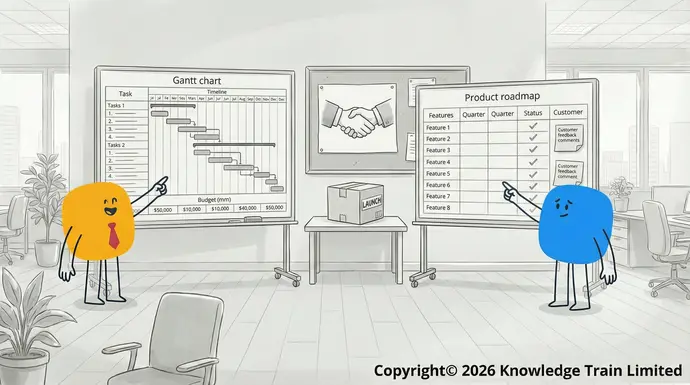
Product managers , on the other hand, are responsible for strategy and vision. They are tasked with defining what should be built and why, shaping the product roadmap and ensuring alignment with business objectives. In essence, product managers think about the product’s life cycle and market position, while project managers are more concerned with the day-to-day activities.AGILE PROJECT MANAGEMENT COURSES
Timeline and lifecycle involvementSelect your preferred training course below:
- Gantt chartsSelect your preferred qualification.: Visual representations of project timelines, dependencies, and milestones. Project management softwareITIL COURSES like Microsoft Project or Asana can provide comprehensive solutions for task assignment, progress tracking, and resource management.Select your preferred training course below:
- Agile and LEARNING LIBRARIESScrumSelect your preferred training course topic.: Agile and Scrum methodologies have become increasingly popular in project management, particularly in software development. These approaches emphasise flexibility, iterative development, and continuous improvement. Scrum boards and Sprint planning tools are commonly used to support these methodologies.
Product management tools and frameworksAI QUALIFICATIONS & WORKSHOPS
Product managersSelect your preferred qualification or workshop. utilise specialised tools to define and communicate product strategy effectively. Some tools and frameworks commonly used by product managers include:
- Product road mapping softwareAIPGF COURSES: Tools like ProductPlan or Aha! help create visual roadmaps that outline product vision, features, and timelines. These tools are used to align stakeholders and guide development efforts.Select your preferred training course below:
- User story mapping and prioritisation : Techniques such as the BCS AI COURSESMoSCoWSelect your preferred training course below: method or story mapping workshops can assist product managers in organising and prioritising features based on user needs and business value. These approaches ensure that product development focuses on delivering maximum value to customers.
Shared tools and methodologiesAIPGF COURSES
Project managers and product managers both rely on collaboration and communication platforms such as Slack, Microsoft Teams, or Zoom to facilitate real-time communication and information sharing among team members and stakeholders. These tools allow both types of managers to keep everyone aligned and informed, and to quickly address any issues that may arise.Select your preferred training course below:
Data analysis and reporting tools such as Tableau or Power BI are also valuable for both project managers and product managers. These tools allow managers to analyse performance metrics, create visualisations, and generate reports for stakeholders. They help both types of managers to make data-driven decisions and to demonstrate the impact of their work.
By leveraging the appropriate tools and methodologies, both project and product managers can enhance their effectiveness, improve team collaboration, and drive successful outcomes in their respective domains.AI WORKSHOPS
Career paths and progression
Project management career trajectoryKnowledge Train is an Agile BA Accredited Training Organization.
Project management careersKnowledge Train is a Change Management Accredited Training Organization. often start with entry-level positions like project coordinator or project assistant. In these roles, individuals could learn the basics of project execution and team coordination. As they gain experience, project managers can progress to managing more complex and high-stakes projects.
Senior project managers are responsible for overseeing multiple projects or programs and may also take on mentoring roles for junior team members. Career advancement opportunities include roles such as portfolio manager or director of Knowledge Train is an MSP Accredited Training Organization.project management . These positions involve more strategic planning and the allocation of organisational resources.Knowledge Train is a PRINCE2 Accredited Training Organization.
Product management career trajectory
Product managementKnowledge Train is an AgilePM Accredited Training Organization. careers typically begin with associate product manager or junior product manager positions. These roles are focused on supporting senior product managers and gaining experience with market research and product development processes. As professionals develop their skills, they can advance to product manager positions, where they take ownership of specific products or features.
Senior product managers often have responsibility for leading product lines or portfolios. Career advancement may lead to roles like director of product management or chief product officer. These executive positions are focused on shaping the overall product strategy and contributing to company-wide decision-making.Knowledge Train is a PRINCE2 Agile Accredited Training Organization.
Transitioning between project and product management
Transitioning between project and product management is possible and can open additional career opportunities. Knowledge Train is a Better Business Cases Accredited Training Organization.Project managers looking to move into product roles should emphasise their strategic thinking abilities and customer-focused skills. Product managers transitioning into project management should highlight their organisational and execution capabilities.Knowledge Train is an AgilePM Accredited Training Organization.
Both career paths offer opportunities for professional growth and leadership development, with success in either field depending on continuous learning, adaptability, and a strong understanding of business objectives.
How project managers and product managers work togetherKnowledge Train is a PRINCE2 Agile Accredited Training Organization.
Collaborative aspects of the roles
Project managersKnowledge Train is a Lean Six Sigma Accredited Training Organization. and product managersBCS accredited training partner for Business Analysis. can often work closely together to achieve success in developing and delivering products. Their skills and focus areas are generally seen as complementary, and they can provide different but overlapping perspectives. Product managers are typically responsible for providing the overall vision and market understanding for a product, while project managers focus on planning and execution to deliver the product on time and within budget.
Typical interactions and touchpointsKnowledge Train is a Change Management Accredited Training Organization.
The primary touchpoints between these roles are throughout the product lifecycle. For example, during product planning, product managers communicate feature requirements and priorities with project managers. Project managers then create detailed project plansKnowledge Train is an MSP Accredited Training Organization., timelines, and resource allocations. Throughout the development phase, they have frequent communication to troubleshoot, manage scope changes, and ensure alignment with product objectives.
Project managers may also be involved in product strategy meetings to gain a better understanding of the larger context for their projects. Likewise, product managers may be present in project status updates to track progress and provide input on feature prioritisation or implementation. This ongoing interaction helps to ensure that project execution stays aligned with product vision and market demands.AXELOS Peoplecert accredited training organisation for ITIL (IT Infrastructure Library).
Challenges and best practices for effective collaboration
Collaboration can be challenged by differing priorities and viewpoints. Project managers might prioritise deadlines and budgets, whereas product managers focus on market fit and customer satisfaction. Conflicts can occur when deciding on resource allocation and trade-offs.AXELOS Peoplecert accredited training organisation for ITIL (IT Infrastructure Library).
Guidelines for effective collaboration are as follows:
Digital transformation Phone
How can we help? Submit
OUR VALUESOur 6 core values are everything we do. They include:IntegrityDiversityFairnessQualityInnovationSocial responsibility SOCIAL RESPONSIBILITY
Some of the charities we have helped over the years: