Project management vs product managementSlovakia

Key takeawaysPMP®
Project and product management are distinct roles that work best as a coordinated pair..
- Project management focuses on delivering defined work on time, within budget, and to agreed quality.Last edited on: 02 Jun 2026
- Product management owns product vision, market fit, and lifecycle decisions from concept to retirement.
- Project managers make tactical trade-offs inside constraints, while product managers make strategic scope and positioning calls.
- Both roles rely on shared skills like communication, problem-solving, and stakeholder management, but apply them differently.Project management certification FAQs
- Clear role boundaries, shared documentation, and regular touchpoints reduce conflict and keep delivery aligned to product value.
Introduction
Project management and product managementWhat are the qualifications of a project manager? are two essential aspects of any business that are often used interchangeably, even though they are distinct from each other. Both play a critical role in the success of any organisation, but they have different functions and responsibilities.
Project managers are typically responsible for the successful delivery of specific projects within a defined timeframe. Product managers, on the other hand, oversee the entire lifecycle of a product, from inception to delivery, and are responsible for driving its success.
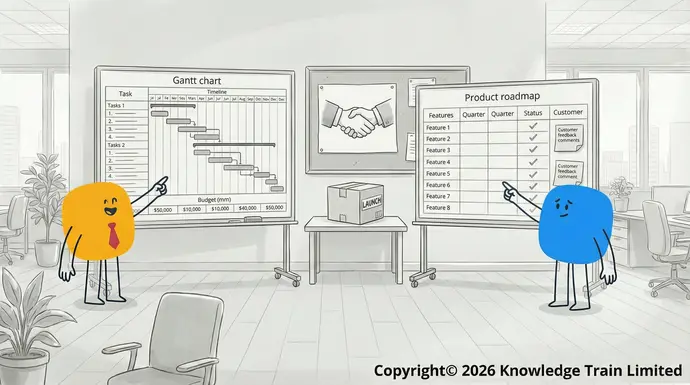
- Gantt charts : Visual representations of project timelines, dependencies, and milestones. Project management software like Microsoft Project or Asana can provide comprehensive solutions for task assignment, progress tracking, and resource management.
- Agile and 11 essential project management techniquesScrum : Agile and Scrum methodologies have become increasingly popular in project management, particularly in software development. These approaches emphasise flexibility, iterative development, and continuous improvement. Scrum boards and Sprint planning tools are commonly used to support these methodologies.Knowledge Train
Product management tools and frameworks19 Feb 2026
Product managers utilise specialised tools to define and communicate product strategy effectively. Some tools and frameworks commonly used by product managers include:Enhance your project management skills with these 11 essential techniques. From project planning and visualisation to quality assurance and risk assessment, our ultimate guide will help you learn the art of managing projects for excellent results.
- Product road mapping software : Tools like ProductPlan or Aha! help create visual roadmaps that outline product vision, features, and timelines. These tools are used to align stakeholders and guide development efforts.
- User story mapping and prioritisation : Techniques such as the MoSCoW method or story mapping workshops can assist product managers in organising and prioritising features based on user needs and business value. These approaches ensure that product development focuses on delivering maximum value to customers.
Shared tools and methodologies
Project managers and product managers both rely on collaboration and communication platforms such as Slack, Microsoft Teams, or Zoom to facilitate real-time communication and information sharing among team members and stakeholders. These tools allow both types of managers to keep everyone aligned and informed, and to quickly address any issues that may arise.PRINCE2 Agile resources
Data analysis and reporting tools such as Tableau or Power BI are also valuable for both project managers and product managers. These tools allow managers to analyse performance metrics, create visualisations, and generate reports for stakeholders. They help both types of managers to make data-driven decisions and to demonstrate the impact of their work.
By leveraging the appropriate tools and methodologies, both project and product managers can enhance their effectiveness, improve team collaboration, and drive successful outcomes in their respective domains.Simon Buehring
product managersSimon Buehring can often work closely together to achieve success in developing and delivering products. Their skills and focus areas are generally seen as complementary, and they can provide different but overlapping perspectives. Product managers are typically responsible for providing the overall vision and market understanding for a product, while project managers focus on planning and execution to deliver the product on time and within budget.19 Feb 2026
Typical interactions and touchpoints
The primary touchpoints between these roles are throughout the product lifecycle. For example, during product planning, product managers communicate feature requirements and priorities with project managers. Project managers then create detailed Uncover how social media can enhance project management and professional growth. Discover the platforms and techniques that can aid your career.project plans , timelines, and resource allocations. Throughout the development phase, they have frequent communication to troubleshoot, manage scope changes, and ensure alignment with product objectives.
Project managers may also be involved in product strategy meetings to gain a better understanding of the larger context for their projects. Likewise, product managers may be present in project status updates to track progress and provide input on feature prioritisation or implementation. This ongoing interaction helps to ensure that project execution stays aligned with product vision and market demands.
Challenges and best practices for effective collaboration
Collaboration can be challenged by differing priorities and viewpoints. Project managers might prioritise deadlines and budgets, whereas product managers focus on market fit and customer satisfaction. Conflicts can occur when deciding on resource allocation and trade-offs.
Guidelines for effective collaboration are as follows:
- Set up clear communication channels and regular meetings
- Explicitly define roles and responsibilities to prevent overlap or gapsProject management methods: a guide to modern approaches
- Create shared documentation for product requirements and project plansKnowledge Train
- Cultivate a culture of respect and appreciation for the value each role brings.23 Feb 2026
By following these guidelines, organisations can harness the strengths of both roles and work together toward successful product outcomes.
Measuring success: Metrics and KPIsLearn about popular project management methods and choose
Project management success metrics
Project managers often define success using a mix of quantitative and qualitative metrics: the one that will work best for your team and result in greater efficiency. In this comprehensive guide, you will find the most relevant approaches explained.
- On-time delivery : This is a critical measure, indicating whether a project meets its milestones and deadlines. It can often be linked to efficient planning and risk management .
- Budget adherence : Staying within the pre-planned budget is a common KPI for project managers . It reflects efficient resource allocation and the ability to handle unforeseen expenses. Deviations from the budget should be minimal and justified.How to write a business case
- Stakeholder satisfaction : This is a more qualitative metric but is just as important. It includes the satisfaction of team members, clients, and any other stakeholders. High levels of satisfaction can often be a sign of well-executed project management and communication.Simon Buehring
Product management success metrics19 Feb 2026
Product managers , on the other hand, often use different metrics to measure success:Master the art of writing a compelling business case to secure project investment. Learn essential skills on business analyst courses by reading further.
- User adoption and engagement : These metrics help understand how well a product is meeting customer needs and how often it’s being used. They can include daily active users, feature usage, or time spent on the product.
- Revenue and market share : For a product manager, these are key indicators of a product’s commercial success. They show the product’s financial contribution and its position in the market relative to competitors. Growth in these areas can indicate a successful product strategy and a good market fit.
- Customer satisfaction and retention : These metrics offer insights into a product’s long-term viability. Measures like Net Promoter Score (NPS) or churn rate fall into this category. High satisfaction and retention rates suggest that the product continues to meet users’ needs over time.
In conclusion, while there are some overlaps, project and product managers often focus on different success metrics that are specific to their roles and responsibilities.
Future trends and evolving rolesSimon Buehring
Impact of digital transformation on both roles19 Feb 2026
Digital transformation is redefining both project and product management roles. Project managers are increasingly adopting Confused between PRINCE2, Agile, or PRINCE2 Agile? Discover their distinctions and how they can be effectively combined in projects by reading on.Agile methodologies