What is PRINCE2?

Key takeaways
PRINCE2 is a governance-led method for running projects with clear decision rights and controls.
- PRINCE2 separates governance from day to day management through defined roles such as the project board and project manager.
- Projects stay justified by keeping the business case current and stopping work when value can no longer be shown.
- Work is planned and authorised in stages, with decisions made at stage boundaries using stage plans and reports.
- Management by exception uses tolerances so issues are escalated only when limits are forecast to be exceeded.
- Standard management products such as risk and issue registers support consistent control without excessive paperwork when tailored well.
PRINCE2
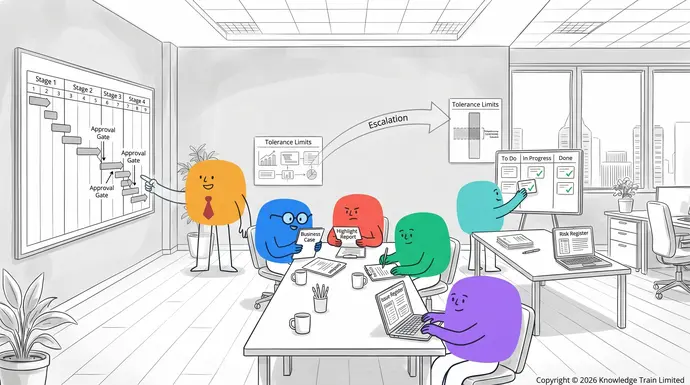
PRINCE2 meaning refers to a process based project management method that defines how to organise, manage and control a project from start to finish. It focuses on governance and accountability, requiring clear roles (such as the project board and project manager), continued business justification, and management by stages with a stage plan.
In practice, PRINCE2 helps teams answer: why are we doing this (business case), who makes decisions (project board), what are we delivering (scope and products), how will we control risks (risk management), and how do we handle change (change control).
Origin and governance
PRINCE2 originated in the UK as a standard for managing projects, evolving from earlier PRINCE guidance and becoming widely adopted beyond information systems into general project management. The method is associated with the Portfolio, Programme, and Project best practice portfolio, and PRINCE2 examinations and certifications are delivered by PeopleCert.
For governance and official updates, refer to the organisations that manage the framework and qualification delivery:
- PeopleCert (exam institute delivering PRINCE2 certifications)
- Reference overview for history, terminology and structure
Who should use PRINCE2?
PRINCE2 is designed for organisations that want a repeatable approach to project control and governance. It can be tailored to suit different sizes and levels of complexity, but it is especially common where transparency, auditability and decision rights matter.
Job roles that commonly use PRINCE2
- Project manager: runs day to day management, reporting and stage control.
- Project board: provides direction and decision making across business, user and supplier interests.
- PMO (Project Management Office): supports standards, assurance, reporting and portfolio level governance.
- Team manager: accepts work packages and delivers specialist outputs.
- Project assurance: independently checks business, user and supplier aspects.
- Change authority: decides on certain changes within delegated limits (supports change control).
Situations where PRINCE2 is a strong fit
- Public sector projects and regulated environments requiring strong governance and traceability.
- Large or high risk initiatives needing formal risk management and stage boundaries.
- Multi supplier delivery where roles, tolerances and reporting must be explicit.
- Business change projects where continued business justification must be proven via the business case.
How PRINCE2 works
PRINCE2 structures a project into stages, with defined decision points (stage boundaries). The project board authorises the project and each stage, while the project manager controls progress within agreed tolerances and escalates by exception.
The starting up a project process leads to initiating a project, then delivery cycles through controlling a stage and managing product delivery. At the end of each stage, the managing a stage boundary prepares the next stage plan for project board approval via the directing a project process. The project ends with closing a project.
For a review of the latest edition of the PRINCE2 official guidance manual, read PRINCE2 7th Edition – What’s different?.
Key control ideas used throughout
- Business case and business justification: the project remains viable, desirable and achievable.
- Management by stages: work is authorised and reviewed stage by stage, using a stage plan.
- Management by exception: tolerances are set; exceptions are escalated to the project board.
- Defined management products: standard reports and registers enable consistent control.
PRINCE2 principles
The 7 principles are mandatory ideas that must be present for a project to be considered PRINCE2 based. They guide decisions across governance, planning, controls and learning.
- Continued business justification: keep the business case valid and up to date.
- Learn from experience: capture lessons and apply them throughout the project.
- Defined roles and responsibilities: ensure clear accountability across the project board and delivery roles.
- Manage by stages: plan and authorise work in manageable chunks using a stage plan.
- Manage by exception: set tolerances and escalate only when they are forecast to be exceeded.
- Focus on products: define, agree and verify outputs and acceptance criteria.
- Tailor to suit the project: scale controls to project size, risk and environment.
Optional detail: organisations commonly tailor the amount of documentation while keeping decision points, roles, and change control discipline intact.
For a more in-depth description, read PRINCE2 principles.
PRINCE2 practices
The 7 practices (used to be called themes) describe the project management disciplines that must be addressed continuously. They ensure the project is planned, controlled and aligned to the business case.
- Business case: define and maintain the justification and benefits profile.
- Organisation: establish the project management team structure and decision rights.
- Quality: define quality expectations, acceptance criteria and quality control activities.
- Plans: create and maintain plans (including each stage plan) to control delivery.
- Risk: identify, assess and control uncertainty through risk management.
- Change: assess and control changes via change control (issues, requests, and off spec).
- Progress: track performance, manage tolerances and report by exception.
For more, read PRINCE2 practices.
PRINCE2 processes
The 7 processes describe the lifecycle of a PRINCE2 project. Each process includes activities and recommended management products to support control and decision making.
- Starting up a project: confirm the project is viable and appoint key roles.
- Directing a project: the project board authorises initiation, stages, exceptions and closure.
- Initiating a project: establish baselines such as the business case, plans and controls.
- Controlling a stage: the project manager assigns work, monitors progress and manages issues.
- Managing product delivery: teams accept work packages and deliver agreed products.
- Managing a stage boundary: report stage results and plan the next stage plan for approval.
- Closing a project: confirm acceptance, review performance and hand over products.
For a more in-depth description, read PRINCE2 processes.
PRINCE2 people
PRINCE2 treats success as a people-centred change effort, not just processes.
- Outcomes must be embedded in business as usual; leadership and culture drive success.
- Change management moves the organisation from current to target state, protecting the investment.
- Stakeholder engagement thrives when ecosystem relationships are actively built and maintained.
- Co-creation with users improves fit, reduces handover risk, and boosts adoption.
- Temporary teams perform best with clear roles, psychological safety, and agreed ways of working for virtual or hybrid delivery.
- Delegating knowledge-based decisions near the source supports managing by exception, especially where trust is strong.
For a more about people, read people in PRINCE2.
PRINCE2 roles and responsibilities
PRINCE2 separates governance from management. The project board owns key decisions and provides direction, while the project manager manages day to day delivery.
Core governance and delivery roles
- Project board: accountable for success; sets direction; approves the business case and tolerances.
- Executive: chairs the project board and owns the business case.
- Senior User: represents users and ensures products meet needs.
- Senior Supplier: represents suppliers and ensures technical integrity.
- Project manager: plans, delegates, monitors, controls and reports.
- Team manager: manages specialist delivery within work packages.
- Project Support and PMO (Project Management Office): supports administration, reporting, configuration and standards.
How escalation works in practice
When time, cost, scope, quality, risk or benefit tolerances are forecast to be exceeded, the project manager escalates to the project board. This supports fast decisions while keeping routine control at the right level.
For a more in-depth description, read PRINCE2 roles and responsibilities.
PRINCE2 management products
Management products are the documents, registers and reports used to run and control a PRINCE2 project. They support governance, progress tracking, change control and risk management. Many organisations use templates to make these consistent across projects and the PMO.
Common management products
- Business case: documents business justification, costs, benefits, risks and value.
- Project brief: initial definition used to decide whether to initiate.
- Project initiation documentation: the baseline set of controls and plans for the project.
- Stage plan: detailed plan for a management stage, approved at each boundary.
- Risk register: captures threats and opportunities; supports risk management actions.
- Issue register: logs issues, including change requests and off spec items.
- Change control approach: defines how change will be assessed and decided.
- Highlight report: regular summary of progress for the project board.
- End stage report: stage performance summary for decision making.
- Lessons log and lessons report: capture learning to improve outcomes.
Tip: if you are implementing PRINCE2 through a PMO, standardising a minimal set of management products (business case, stage plan, risk register, issue register and highlight report) often gives most of the governance benefits without excessive documentation.
For a more in-depth description, read PRINCE2 management products.
PRINCE2 certification (Foundation vs Practitioner)
PRINCE2 certification validates knowledge of the method and how to apply it. The two most common levels are PRINCE2 Foundation and PRINCE2 Practitioner, which are often used as a baseline for project management roles in the UK and internationally.
PRINCE2 Foundation
PRINCE2 Foundation focuses on terminology, principles, themes, processes and the purpose of management products. It is suitable for people new to PRINCE2 or those supporting projects through a PMO.
PRINCE2 Practitioner
PRINCE2 Practitioner focuses on applying and tailoring PRINCE2 in scenarios, including selecting appropriate management products, applying change control, managing by exception, and maintaining business justification through the business case.
Which should you choose?
- Choose Foundation if you need to understand PRINCE2 language and structure.
- Choose Practitioner if you manage projects or need to tailor PRINCE2 controls in real settings.
For more about PRINCE2 certification options, read PRINCE2 certification.
PRINCE2 vs Agile and PRINCE2 vs PMP
PRINCE2 is a project management method focused on governance, roles, stages and management products. Agile is a family of delivery approaches focused on iterative development and rapid feedback. PMP (Project Management Professional) is a certification aligned to the PMI body of knowledge, commonly referenced through the PMBOK Guide, and it emphasises broad project management knowledge areas and practices.
Comparison table
| Aspect | PRINCE2 | Agile | PMP (PMBOK Guide) |
|---|---|---|---|
| Primary focus | Governance and control across the project lifecycle | Iterative delivery and adaptability | Broad professional standard and best practice knowledge |
| Structure | 7 principles, 7 themes, 7 processes | Framework dependent (for example Scrum) | Domains, principles, and practice guidance (PMBOK Guide aligned) |
| Decision rights | Project board governance and management by exception | Team centred decision making varies by framework | Organisation dependent; certification is role agnostic |
| Documentation | Defined management products, tailored to suit the project | Prefers working product and lightweight artefacts | Varies by organisation; emphasises comprehensive planning and control options |
| Best fit | Regulated environments, governance heavy programmes, supplier ecosystems | Uncertain requirements, product development, rapid learning | Global credential for project managers across industries |
Can PRINCE2 be used with Agile?
Yes. Many organisations combine PRINCE2 governance (business case, stage boundaries, tolerances, change control) with Agile delivery inside stages. The key is to keep the PRINCE2 principles and themes, while tailoring management products so delivery teams can work iteratively.
For more about how PRINCE2 differs from Agile, read PRINCE2 vs Agile.
For a more detailed comparison of PRINCE2 and PMP, read PMP vs PRINCE2.
FAQs
What is PRINCE2 used for?
PRINCE2 is used for managing projects in a controlled way, with defined roles, decision points and documentation. It helps organisations maintain business justification through a business case, manage by stages using a stage plan, and apply consistent risk management and change control.
Is PRINCE2 still relevant?
Yes. PRINCE2 remains widely used where governance, accountability and auditability are important, including public sector and regulated environments. It is also commonly tailored to work alongside Agile delivery methods, keeping PRINCE2 controls while enabling iterative delivery.
What are the 7 principles of PRINCE2?
The 7 principles are: continued business justification, learn from experience, defined roles and responsibilities, manage by stages, manage by exception, focus on products, and tailor to suit the project.
What are the 7 processes of PRINCE2?
The 7 processes are: starting up a project, directing a project, initiating a project, controlling a stage, managing product delivery, managing a stage boundary, and closing a project.
PRINCE2 vs PMP, what is the difference?
PRINCE2 is a prescriptive project management method with defined roles, stages and management products. PMP (Project Management Professional) is a certification based on PMI standards and the PMBOK Guide body of knowledge, focusing on a broad set of project management practices that can be applied in different ways depending on the organisation.
How long does PRINCE2 certification take?
Time varies by experience and study approach. Many learners prepare for PRINCE2 Foundation in a few days of focused study, and PRINCE2 Practitioner typically requires additional preparation to practise application and tailoring in scenario questions.
Is PRINCE2 certification hard?
Difficulty depends on familiarity with project management concepts and exam technique. Foundation tests knowledge of terms and structure, while Practitioner is more challenging because it tests applying the method in context, including tolerances, management products, change control and the business case.
What is the difference between Foundation and Practitioner?
PRINCE2 Foundation verifies you understand PRINCE2 concepts, principles, themes and processes. PRINCE2 Practitioner verifies you can apply and tailor PRINCE2 to a scenario, using appropriate controls, roles, management products, and stage based planning.