Business case: definition, purpose, structure, and examplesITIL COURSES

Key takeaways
A strong business case turns a proposal into a decision by making value, costs, and risk explicit.Knowledge Train is a PRINCE2 Accredited Training Organization.
- Use a business case when resources are limited and there are credible alternatives, including a do-nothing baseline.
- Make roles clear: an author drafts, finance and risk challenge, and an executive sponsor owns benefits and alignment.Knowledge Train is an AgilePM Accredited Training Organization.
- Anchor the case in a measurable baseline, defined objectives, and KPIs so outcomes can be tracked after delivery.
- Compare options transparently using full costs, quantified benefits, and appraisal methods such as ROI, NPV, IRR, and payback.Knowledge Train is a PRINCE2 Agile Accredited Training Organization.
- Separate risks, assumptions, constraints, and dependencies, and include mitigations and a post-implementation review plan.
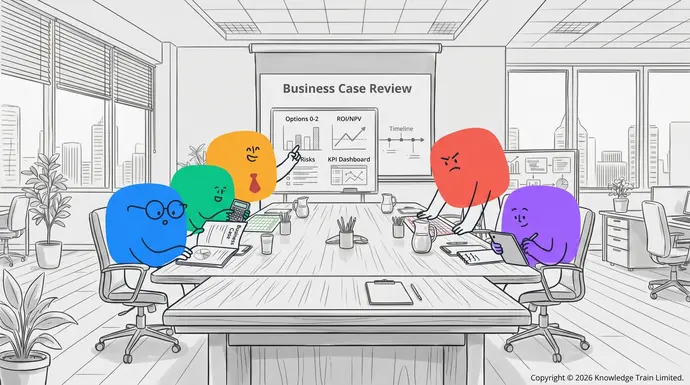
- Accredited training course materials (what you give up by choosing one option) is material.Support from expert, experienced trainers
Many organisations require a business case before progressing from idea to funded delivery, particularly where governance frameworks and portfolio management are in place.Latest educational technology.
Who creates and who approves a business case
Ownership and approvals vary by organisation, but a typical model looks like this:BUSINESS SOLUTIONS
- Author : a project manager, product manager, business analyst, or subject matter expert drafts the business case with input from finance and operational teams.
- Accountable ownerTO HELP ORGANISATIONS IMPROVE: the We offer solutions to help improve team performance including:executive sponsorConsultancy services (often a senior stakeholder) is accountable for the case, ensuring it aligns with strategy and that benefits are owned.Staff development
- ReviewersCompliance training: finance teams validate costs and investment appraisal; risk and compliance functions challenge Apprenticeship trainingrisksCustom e-Learning development and controls; procurement validates supplier assumptions.
- Approvers : a steering group, investment committee, portfolio board, or senior leadership approves the recommended option and budget.Find out more
Clear stakeholder roles reduce rework and ensure that assumptions, constraints, and delivery responsibilities are agreed early.
Key components of a business case
A well-structured business case is easy to scan and trace from problem to recommendation. Most high-performing cases include the following components:
- Problem or opportunity : what is happening now, why it matters, and what will happen if nothing changes (the baseline).
- ObjectivesCONTACT US: what success looks like, including measurable targets and timeframes.
- Scope and constraints : what is included and excluded, plus constraints such as time, budget, technical limitations, and regulatory requirements.
- Stakeholders : who is affected, who must contribute, and who will own benefits.
- Options analysis (alternatives)Name: a shortlist of credible options, including a do-nothing or do-minimum baseline where appropriate.
- Recommended option : which option is proposed and why it is preferred.Email
- Benefits : quantified and non-quantified benefits, and how they support strategy.
- CostsPhone: one-off and ongoing costs (capital and operational), including training, support, and change management.
- Investment appraisal : methods such as How can we help?return on investment (ROI) , net present value (NPV)Submit, internal rate of return (IRR) , and OUR VALUESpayback periodOur 6 core values are everything we do. They include:.Integrity
- RisksDiversity: key risks, mitigations, and residual risk.Fairness
- Assumptions and dependenciesQuality: what must be true for the case to succeed and what it relies on (for example, data quality or supplier delivery).Innovation
- Implementation planSocial responsibility: phases, milestones, resourcing approach, and indicative timeline.
- Metrics and KPIsSOCIAL RESPONSIBILITY: how progress and outcomes will be measured, including benefits tracking.Some of the charities we have helped over the years:
- Governance and approval : decision points, review cadence, and post-implementation review plan.
How to write a business case
- Define the decision to be made : state what approval is requested (funding, people, procurement authority) and by when.
- Describe the current state and baseline : quantify today’s performance, costs, cycle times, or risks so improvement can be measured.AWARDS
- Set objectives and success criteriaWe don’t go seeking awards, but here are two of the awards we have received for our training.: define outcomes and KPIs, including benefits ownership and expected timing.
- Identify feasible options : include at least a baseline option and 1 to 3 credible alternatives; capture key constraints. Request a quote
- Estimate benefits : quantify savings, revenue uplift, risk reduction, or service improvements; link to benefits realisation plans.
- Estimate full costs : include acquisition, implementation, training, transition, and ongoing running costs; note opportunity cost where relevant.
- Run financial appraisal+44 (0)207 148 5985: calculate ROI, NPV, IRR, and payback period; document discount rate and major assumptions.
- Assess risks, assumptions, and dependencies[email protected]: rate likelihood and impact, define mitigations, and identify decision-critical unknowns.
- Recommend the preferred option : provide a clear recommendation and explain trade-offs (value, risk, feasibility, timing).
- Outline the implementation plan and governance : include timeline, milestones, responsibilities, and a post-implementation review to validate outcomes.
A more detailed guide to writing a business case is on our web site.United Kingdom
Financial analysis methods
Business cases often combine narrative justification with investment appraisal. Common methods include:
- Return on investment (ROI) : a simple ratio comparing net benefits to costs. It is easy to communicate, but can hide timing and risk.
- Payback period : how long it takes for cumulative benefits to repay the initial investment. Useful for liquidity constraints, but ignores value after payback and time value of money.
- Net present value (NPV)Search: discounts future cash flows back to today using a discount rate, reflecting the time value of money. A positive NPV indicates value creation under the model assumptions.
- Internal rate of return (IRR) : the discount rate at which NPV equals zero. It supports comparison between investments, but can be misleading with non-standard cash flows.
Background explanations for these appraisal concepts are available from reference sources for cost–benefit analysis , United Kingdomnet present valueAustria, and Belgiuminternal rate of returnBulgaria.Croatia
Benefits vs costs (simple structure)Cyprus
| CategoryCzech Republic | ExamplesDenmark | How to quantifyEstonia |
|---|---|---|
| BenefitsFinland | Time saved, fewer errors, faster sales cycle, improved complianceFrance | Labour cost reduction, avoided rework, revenue uplift, avoided penaltiesGermany |
| CostsGreece | Licences, implementation, training, change management, supportIreland | Quotes, internal day rates, vendor contracts, total cost of ownershipItaly |
| Opportunity costLatvia | Delay to another project, diverted staff timeLithuania | Estimate value of displaced work and include in narrative or sensitivityLuxemburg |
Risks, assumptions, constraints and dependenciesMalta
Decision-makers need to understand what could undermine delivery or benefits. Good business cases separate:Netherlands
- AssumptionsPoland: statements treated as true for planning (for example, adoption rates or volume growth).Portugal
- ConstraintsRomania: fixed limits (for example, deadlines, budget caps, mandated technology).Slovakia
- DependenciesSlovenia: external items required for success (for example, data migration readiness, vendor delivery, approvals).Spain
- RisksSweden: uncertain events that could harm outcomes (for example, low user adoption, security gaps, scope creep).Other countries
Risks and mitigations (example)Home
| RiskProject Management | ImpactBusiness Cases | MitigationFive Case Model | Owner |
|---|---|---|---|
| Low user adoption{"@context":"http://schema.org","@type":"BreadcrumbList","itemListElement":[{"@type":"ListItem","position":1,"name":"Home","item":"https://www.knowledgetrain.co.uk/"},{"@type":"ListItem","position":2,"name":"Project Management","item":"https://www.knowledgetrain.co.uk/project-management"},{"@type":"ListItem","position":3,"name":"Business Cases","item":"https://www.knowledgetrain.co.uk/project-management/business-cases"},{"@type":"ListItem","position":4,"name":"Five Case Model","item":"https://www.knowledgetrain.co.uk/project-management/business-cases/five-case-model"}]} | Benefits not realised, process rework | Change management plan, training, champions, KPI tracking | Executive sponsor and operations lead |
| Data quality issuesFive Case Model for business cases | Errors, low trust in reporting | Data profiling, cleansing, acceptance criteriaSimon Buehring | Data owner19 Feb 2026 |
| Supplier delivery delay | Timeline slippage, higher costs | Milestone-based contract, contingency, parallel workstreams | Project manager |
Example business case
Scenario: A mid-sized service business proposes implementing a CRM to reduce manual admin, improve sales follow-up, and increase conversion rates.
Assumptions and baseline
- 40 sales and service users.
- Current admin time lost to manual updates: 2 hours per user per week.
- Average loaded labour cost: GBP 35 per hour.
- Expected time saving after rollout: 60% of current admin time.
- Revenue uplift from better follow-up: GBP 60,000 per year (conservative estimate).
- Discount rate for NPV: 8% per year (illustrative only).
Estimated costs
| Cost item | Timing | Amount |
|---|---|---|
| Implementation and configuration | Year 0 (one-off) | GBP 45,000 |
| Training and change managementCopied! | Year 0 (one-off)Key takeaways | GBP 10,000The Five Case Model tests an investment proposal from five connected angles to support robust public value decisions. |
| Licences and supportDefine the BAU baseline and a small set of SMART objectives to clarify the need and desired outcomes. | AnnualAppraise a longlist and shortlist of options using social cost benefit or cost effectiveness analysis, including risk and optimism bias. | GBP 24,000Align procurement strategy and specifications to the strategic and economic cases, and feed cost and risk updates back into the analysis. |
Estimated annual benefitsSeparate social value from affordability by treating economic and financial cases as complementary, not interchangeable.
- Time saving:Prove deliverability with clear governance, milestones, resources, and live risk and benefits registers with monitoring plans. 40 users x 2 hours/week x 52 weeks x 60% x GBP 35/hour = GBP 87,360 per year.
- Revenue uplift: GBP 60,000 per year.
- Total benefits:Contents GBP 147,360 per year.
- Net annual benefit after licences: GBP 147,360 minus GBP 24,000 = GBP 123,360 per year.Contents
Simple ROI, payback and NPV illustration
- Initial investment (year 0):Introduction GBP 55,000.
- Payback period:What is the Five Case Model? GBP 55,000 divided by GBP 123,360 is about 0.45 years (about 5 to 6 months).
- Simple ROI (year 1):Benefits of using the Five Case Model (GBP 123,360 minus GBP 55,000) divided by GBP 55,000 is about 124%.
- NPV (3 years, 8% discount, simplified):Real-world examples of the Five Case Model NPV = -55,000 + 123,360/(1.08) + 123,360/(1.08^2) + 123,360/(1.08^3) = approximately GBP 262,000.
Interpretation:Conclusion Under the stated assumptions, the business case supports approval because value is positive, payback is short, and risks can be mitigated through adoption and data-quality controls. In practice, include sensitivity analysis (best case, expected, worst case) for decision confidence.
Further Referencesbusiness case examplesIntroduction are available on our web site.The
Business case template5 Case Model
Use this template as a starting point. Keep language factual and include sources for material numbers. is part of the best practice guidance issued by HM Treasury on behalf of the United Kingdom government. It is recommended to be used by the guidance issued in
Download a HMT Green Bookbusiness case template (central government guidance on appraisal and evaluation) from our web site.[1]
1. Summary and decision request.
- Decision requiredThe 5 Case Model consists of 5 key dimensions: the Strategic Case, Economic Case, Commercial Case, Financial Case, and Management Case. These dimensions work together to provide a comprehensive analysis of a business problem, making it an effective tool for decision-makers.
- Recommended optionThis article provides an overview of the 5 Case Model, its benefits, and how it can be applied in real-world business cases. To learn in detail how to use the 5 Case Model develop business cases,
How long should a business case be?
Length depends on complexity and risk. Many internal business cases are 2 to 10 pages plus appendices for calculations and evidence. The key is that decision-makers can understand the recommendation, numbers, risks, and obligations quickly.
Who approves a business case?
Approval is usually given by a governance body such as a steering group, investment committee, portfolio board, or senior leadership team. The executive sponsor is typically accountable for endorsing the case and ensuring benefits owners and stakeholders commit to delivery and measurement.
What is the difference between a business case and a business plan?
A business case justifies a specific initiative and asks for approval, focusing on options, value, and risk. A business plan describes how an organisation, product, or business unit will operate and grow, covering market approach, operating model, and broader financial forecasts.