Business case: definition, purpose, structure, and examples

Key takeaways
A strong business case turns a proposal into a decision by making value, costs, and risk explicit.
- Use a business case when resources are limited and there are credible alternatives, including a do-nothing baseline.
- Make roles clear: an author drafts, finance and risk challenge, and an executive sponsor owns benefits and alignment.
- Anchor the case in a measurable baseline, defined objectives, and KPIs so outcomes can be tracked after delivery.
- Compare options transparently using full costs, quantified benefits, and appraisal methods such as ROI, NPV, IRR, and payback.
- Separate risks, assumptions, constraints, and dependencies, and include mitigations and a post-implementation review plan.
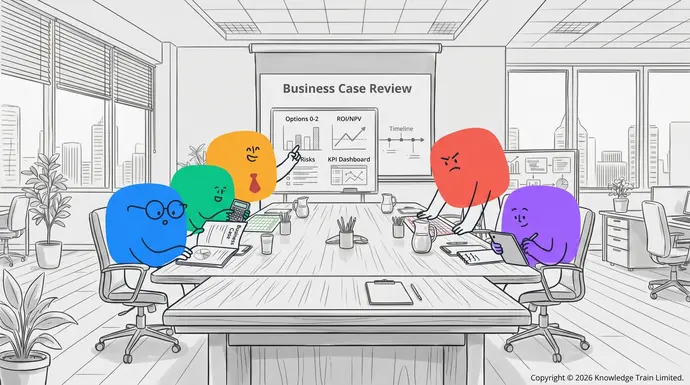
Definition
In project and investment contexts, a business case is a documented rationale for undertaking a course of action. It typically sets out the problem or opportunity, defines measurable objectives, evaluates options analysis (alternatives), and recommends a preferred option supported by evidence. It is commonly used to obtain approval for resources and funding and to establish a baseline for benefits realisation and performance measurement using key performance indicators (KPIs).
For a general definition and background, see the reference overview of the concept of a business case on Wikipedia.
When to use a business case
A business case is most useful when there is a meaningful decision to be made and competing ways to allocate limited resources. Common situations include:
- New investments such as software, equipment, facilities, or hiring.
- Change initiatives such as process improvement, automation, or organisational redesign.
- Project approval when funding depends on demonstrating value and feasibility.
- Regulatory or risk-driven work where costs are clear but benefits are mainly risk reduction.
- Competing priorities where opportunity cost (what you give up by choosing one option) is material.
Many organisations require a business case before progressing from idea to funded delivery, particularly where governance frameworks and portfolio management are in place.
Who creates and who approves a business case
Ownership and approvals vary by organisation, but a typical model looks like this:
- Author: a project manager, product manager, business analyst, or subject matter expert drafts the business case with input from finance and operational teams.
- Accountable owner: the executive sponsor (often a senior stakeholder) is accountable for the case, ensuring it aligns with strategy and that benefits are owned.
- Reviewers: finance teams validate costs and investment appraisal; risk and compliance functions challenge risks and controls; procurement validates supplier assumptions.
- Approvers: a steering group, investment committee, portfolio board, or senior leadership approves the recommended option and budget.
Clear stakeholder roles reduce rework and ensure that assumptions, constraints, and delivery responsibilities are agreed early.
Key components of a business case
A well-structured business case is easy to scan and trace from problem to recommendation. Most high-performing cases include the following components:
- Problem or opportunity: what is happening now, why it matters, and what will happen if nothing changes (the baseline).
- Objectives: what success looks like, including measurable targets and timeframes.
- Scope and constraints: what is included and excluded, plus constraints such as time, budget, technical limitations, and regulatory requirements.
- Stakeholders: who is affected, who must contribute, and who will own benefits.
- Options analysis (alternatives): a shortlist of credible options, including a do-nothing or do-minimum baseline where appropriate.
- Recommended option: which option is proposed and why it is preferred.
- Benefits: quantified and non-quantified benefits, and how they support strategy.
- Costs: one-off and ongoing costs (capital and operational), including training, support, and change management.
- Investment appraisal: methods such as return on investment (ROI), net present value (NPV), internal rate of return (IRR), and payback period
- Risks: key risks, mitigations, and residual risk.
- Assumptions and dependencies: what must be true for the case to succeed and what it relies on (for example, data quality or supplier delivery).
- Implementation plan: phases, milestones, resourcing approach, and indicative timeline.
- Metrics and KPIs
Example business case
Scenario: A mid-sized service business proposes implementing a CRM to reduce manual admin, improve sales follow-up, and increase conversion rates.
Assumptions and baseline
- 40 sales and service users.
- Current admin time lost to manual updates: 2 hours per user per week.
- Average loaded labour cost: GBP 35 per hour.
- Expected time saving after rollout: 60% of current admin time.
| GBP 10,000 | ||
| Licences and support | Annual | GBP 24,000 |
Estimated annual benefits
- Time saving: 40 users x 2 hours/week x 52 weeks x 60% x GBP 35/hour = GBP 87,360 per year.
- Revenue uplift: GBP 60,000 per year.
- Total benefits: GBP 147,360 per year.
- Net annual benefit after licences: GBP 147,360 minus GBP 24,000 = GBP 123,360 per year.
Simple ROI, payback and NPV illustration
- Initial investment (year 0): GBP 55,000.
- Payback period: GBP 55,000 divided by GBP 123,360 is about 0.45 years (about 5 to 6 months).
- Simple ROI (year 1): (GBP 123,360 minus GBP 55,000) divided by GBP 55,000 is about 124%.
- NPV (3 years, 8% discount, simplified): NPV = -55,000 + 123,360/(1.08) + 123,360/(1.08^2) + 123,360/(1.08^3) = approximately GBP 262,000.
Interpretation: Under the stated assumptions, the business case supports approval because value is positive, payback is short, and risks can be mitigated through adoption and data-quality controls. In practice, include sensitivity analysis (best case, expected, worst case) for decision confidence.
Further business case examples are available on our web site.
Business case template
Use this template as a starting point. Keep language factual and include sources for material numbers.
Download a business case template from our web site.
1. Summary and decision request
- g/resources requested
- Target decision date
2. Background and context
- Current situation and baseline performance
- Problem/opportunity statement
- Strategic alignment
3. Objectives and success measures
- Objectives
- KPIs and targets
- Benefits owners and timing (benefits realisation)
4. Scope, constraints and dependencies
- In scope
- Out of scope
- Constraints (budget, time, technology, compliance)
- Dependencies (data, suppliers, approvals)
5. Stakeholders and governance
- Executive sponsor
- Key stakeholders
- Decision-making forum (board/committee)
- Reporting cadence
6. Options analysis (alternatives)
- Option 0: do nothing / do minimum
- Option 1
- Option 2
- Evaluation criteria (value, risk, feasibility, time to benefit)
7. Recommended option and rationale
- Why this option is preferred
- Trade-offs accepted
8. Benefits, costs and investment appraisal
- Benefits (quantified and qualitative)
- Costs (one-off and ongoing)
- Opportunity cost considerations
- ROI
- NPV (discount rate and period)
- IRR
- Payback period
9. Risks and mitigations
- Top risks
- Mitigations and owners
- Residual risk
10. Implementation plan
- Approach and phases
- High-level timeline and milestones
- Resourcing plan
- Change management
11. Review plan
- How KPIs will be tracked
- Post-implementation review date and method
Business case vs business plan
These documents are related but serve different purposes. Clarifying the difference helps prevent rework and mismatched expectations.
Business case vs business plan
| Business case | Business plan |
|---|---|
| Justifies a specific investment, change, or project. | Explains how a business or product will operate and grow over time. |
| Centres on options analysis, investment appraisal, and approval. | Centres on market, strategy, operations, and financial forecasts. |
| Often used for internal governance and funding decisions. | Often used for external funding, partners, or internal planning. |
| Includes KPIs for benefits realisation and post-implementation review. | Includes broader performance targets and business milestones. |
Business case vs project charter
| Business case | Project charter |
|---|---|
| Explains why the work should be done and whether it is worth doing. | Authorises the project to start and defines roles, scope, and high-level plan. |
| Focuses on value, options, costs, benefits, and decision-making. | Focuses on delivery authority, governance, and initial project boundaries. |
Business case vs feasibility study
| Business case | Feasibility study |
|---|---|
| Recommends an option and seeks approval based on value and risk. | Assesses whether an option can be done, and under what conditions. |
| May include feasibility findings as evidence. | Often precedes or feeds into the business case. |
Governance and lifecycle
Business cases commonly follow a lifecycle so that approvals are controlled and benefits are validated:
- Draft : initial rationale, early estimates, and a shortlist of options.
- Review : finance and subject experts challenge costs, benefits, and assumptions; risks and constraints are refined.
- Approval : stakeholders and an executive sponsor endorse the recommendation; funding and authority are granted.
- Delivery updates : the implementation plan is tracked; changes that affect benefits or costs are assessed against the approved case.
- Post-implementation review : benefits realisation and KPIs are evaluated against the baseline; lessons learned inform future decision-making.
Strong governance improves transparency and reduces the chance that a business case becomes a one-off document that is never revisited.
FAQs
What is a business case?
A business case is a structured justification for a proposed investment, change, or project. It supports decision-making by comparing options and explaining expected benefits, costs, risks, assumptions, and the plan for implementation and measurement.