
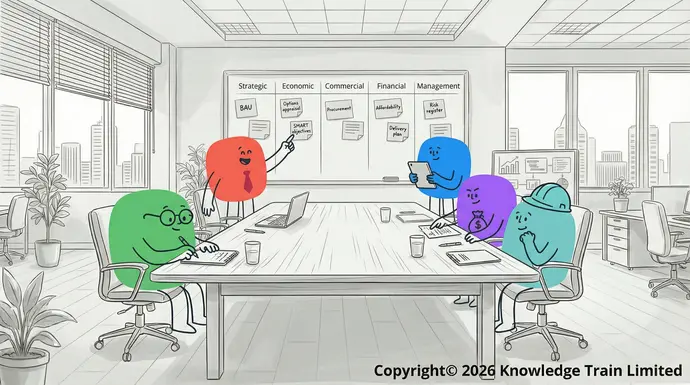
What is the Five Case Model?
The BUSINESS ANALYSIS QUALIFICATIONS 5 Case ModelSelect your preferred qualification. Statistics is a crucial framework for efficiently utilising public resources and making informed decisions. It encompasses five different perspectives or “cases” that should be considered and evaluated together, rather than in isolation, to ensure a well-rounded and thorough analysis. These 5 dimensions include policy, analytical, commercial, financial, and delivery considerations.
Effective implementation of the 5 Case Model requires collaboration between different professionals within the public service, including policy, analytical, commercial, financial, and delivery specialists. By working together from the outset, these professionals can avoid siloed thinking and ensure that all relevant perspectives are considered.BCS BUSINESS ANALYSIS COURSES
The 5 Case Model provides a comprehensive and flexible thinking framework that can accommodate the unique features of any investment or spending proposal. It accounts for a wide range of considerations, including objectives to be achieved, legal, regulatory, and ethical constraints, and more. Rather than inventing a new framework for each proposal, the Five Case Model provides a universal approach that can be tailored to suit the needs of any situation.Select your preferred training course below:
Let’s now look at each of the 5 dimensions in a little more detail. Statistics
Strategic dimensionAGILE BUSINESS ANALYSIS COURSES
The Select your preferred training course below: strategic CHANGE MANAGEMENT QUALIFICATIONS dimensionSelect your preferred qualification. of the 5 Case Model is crucial in determining the “business as usual” scenario, which provides a benchmark against which proposed changes can be compared. This understanding must be quantified and well-defined, even when continuing without changes is not a viable option.
SMART objectivesAPMG CHANGE MANAGEMENT COURSES
In the strategic dimension, external constraints and dependencies are considered, such as legal, ethical, political, and technological factors, as well as necessary infrastructure that is beyond the control of the proposal. The proposal’s expected outcome is defined by a small number of Select your preferred training course below: The technical storage or access that is used exclusively for statistical purposes.SMART objectives, which must be Specific, Measurable, Achievable, Realistic, and Time-limited. These objectives drive the rest of the model, serving as the basis for option creation and the appraisal process in the economic dimension. PROGRAMME MANAGEMENT QUALIFICATIONS The technical storage or access that is used exclusively for anonymous statistical purposes. Without a subpoena, voluntary compliance on the part of your Internet Service Provider, or additional records from a third party, information stored or retrieved for this purpose alone cannot usually be used to identify you.
Rationale Select your preferred qualification.
The objectives must reflect the rationale for the proposal and be expressed in terms of the expected change in service provision, expressed numerically. This helps in refining the objectives and enables them to be monitored and evaluated effectively. The programme objectives should directly align with the proposal’s objectives, providing a clear understanding of the expected outcomes.
Strategic assessment MSP COURSES
The first step in any proposal, whether it be strategic, portfolio, program, or project-based, is the strategic assessment. This evaluation compares the current situation, also known as “business as usual” (BAU), to the desired outcome, as outlined by the SMART objectives. The difference between BAU and the SMART objectives highlights the business needs that must be addressed. A comprehensive understanding of how these business needs can be met and the SMART objectives achieved is crucial. Select your preferred training course below:
Policy fit
The proposal must also consider its fit with public policy and any potential impacts on other public bodies’ operations, responsibilities, or budgets. Effective and efficient delivery of public services requires consultation and collaboration between public bodies to avoid waste and inefficiencies. PMI COURSES Marketing
Early research, consultation, and engagement with stakeholders provides a better understanding of the current situation and opportunities for improvement, as well as links to relevant policies. Select your preferred training course below:
Economic dimension
The PMI COURSES economic dimension Select your preferred training course below: Marketing of the 5 Case Business Model plays a crucial role in analysing and evaluating proposals. It is driven by the SMART objectives and business needs identified in the strategic dimension and estimates the social value of different options. This dimension involves detailed option development and selection through appraisal, with a focus on considering the potential impact on the UK or overseas and considering any unintended consequences.
Appraisal PRINCE2 COURSES
The longlist appraisal and selection of the shortlist options are critical steps in the process, and the preferred option is selected based on a thorough analysis using social cost-benefit analysis or social cost-effectiveness analysis. The selection considers factors such as the net social value of the option, the costs of risk and optimism bias, the whole life cost of the public resources employed, and the unquantifiable benefits of key objectives. The overall risk to the public and the public sector is also considered. Select your preferred training course below:
APM COURSES Select your preferred training course below:
AGILE PROJECT MANAGEMENT COURSES Select your preferred training course below:
PRINCE2 AGILE COURSES Select your preferred training course below:
BUSINESS CASE COURSES
Select your preferred training course below:
AGILE COURSES Select your self-paced training course topic.
AGILE PROJECT MANAGEMENT COURSES Select your preferred training course below:
PRINCE2 AGILE COURSES Select your preferred training course below:
AgilePM
®
- – Agile Project Management
- Foundation
- Learn the key principles of Agile Project Management.
- Practitioner
- Includes Foundation & Practitioner combined option.
PRINCE2
®
Agile
Foundation
Learn the fundamentals of the PRINCE2 Agile method.
Practitioner
Includes Foundation & Practitioner combined option.
AI Project Governance Framework (AIPGF)
Foundation
Learn the fundamentals of the governance framework.
Practitioner Includes Foundation & Practitioner combined option.Better Business Cases
™
Foundation
Learn the fundamentals of Better Business cases.
Practitioner