
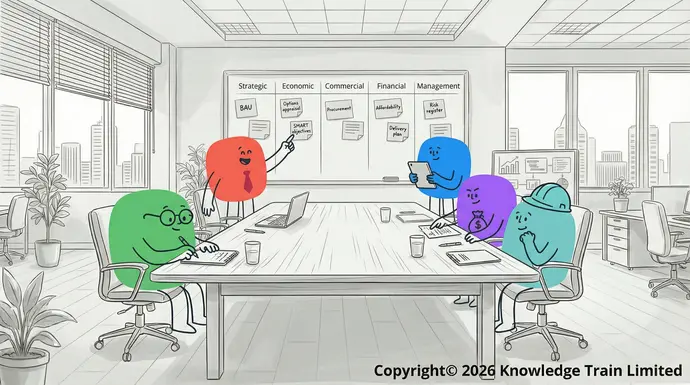
FundinBetter Business Cases training will teach you how to apply the Five Case Model in practice.
What is the Five Case Model?Option 2
The Evaluation criteria (value, risk, feasibility, time to benefit)5 Case Model7. Recommended option and rationale is a crucial framework for efficiently utilising public resources and making informed decisions. It encompasses five different perspectives or “cases” that should be considered and evaluated together, rather than in isolation, to ensure a well-rounded and thorough analysis. These 5 dimensions include policy, analytical, commercial, financial, and delivery considerations.Why this option is preferred
Effective implementation of the 5 Case Model requires collaboration between different professionals within the public service, including policy, analytical, commercial, financial, and delivery specialists. By working together from the outset, these professionals can avoid siloed thinking and ensure that all relevant perspectives are considered.Trade-offs accepted
The 5 Case Model provides a comprehensive and flexible thinking framework that can accommodate the unique features of any investment or spending proposal. It accounts for a wide range of considerations, including objectives to be achieved, legal, regulatory, and ethical constraints, and more. Rather than inventing a new framework for each proposal, the Five Case Model provides a universal approach that can be tailored to suit the needs of any situation.8. Benefits, costs and investment appraisal
Let’s now look at each of the 5 dimensions in a little more detail.Benefits (quantified and qualitative)
Strategic dimensionCosts (one-off and ongoing)
The Opportunity cost considerationsstrategicROI NPV (discount rate and period)dimensionIRR of the 5 Case Model is crucial in determining the “business as usual” scenario, which provides a benchmark against which proposed changes can be compared. This understanding must be quantified and well-defined, even when continuing without changes is not a viable option.Payback period
SMART objectives9. Risks and mitigations
In the strategic dimension, external constraints and dependencies are considered, such as legal, ethical, political, and technological factors, as well as necessary infrastructure that is beyond the control of the proposal. The proposal’s expected outcome is defined by a small number of Top risksSMARTMitigations and owners objectives, which must be Specific, Measurable, Achievable, Realistic, and Time-limited. These objectives drive the rest of the model, serving as the basis for option creation and the appraisal process in the economic dimension.Residual risk
Rationale10. Implementation plan
The objectives must reflect the rationale for the proposal and be expressed in terms of the expected change in service provision, expressed numerically. This helps in refining the objectives and enables them to be monitored and evaluated effectively. The programme objectives should directly align with the proposal’s objectives, providing a clear understanding of the expected outcomes.Approach and phases
Strategic assessmentHigh-level timeline and milestones
The first step in any proposal, whether it be strategic, portfolio, program, or project-based, is the strategic assessment. This evaluation compares the current situation, also known as “business as usual” (BAU), to the desired outcome, as outlined by the SMART objectives. The difference between BAU and the SMART objectives highlights the business needs that must be addressed. A comprehensive understanding of how these business needs can be met and the SMART objectives achieved is crucial.Resourcing plan
Policy fitChange management
The proposal must also consider its fit with public policy and any potential impacts on other public bodies’ operations, responsibilities, or budgets. Effective and efficient delivery of public services requires consultation and collaboration between public bodies to avoid waste and inefficiencies.11. Review plan
Early research, consultation, and engagement with stakeholders provides a better understanding of the current situation and opportunities for improvement, as well as links to relevant policies.How KPIs will be tracked
Economic dimensionPost-implementation review date and method
The Business case vs business planeconomic dimensionThese documents are related but serve different purposes. Clarifying the difference helps prevent rework and mismatched expectations. of the 5 Case Business Model plays a crucial role in analysing and evaluating proposals. It is driven by the SMART objectives and business needs identified in the strategic dimension and estimates the social value of different options. This dimension involves detailed option development and selection through appraisal, with a focus on considering the potential impact on the UK or overseas and considering any unintended consequences.Business case vs business plan
AppraisalBusiness case
The longlist appraisal and selection of the shortlist options are critical steps in the process, and the preferred option is selected based on a thorough analysis using social cost-benefit analysis or social cost-effectiveness analysis. The selection considers factors such as the net social value of the option, the costs of risk and optimism bias, the whole life cost of the public resources employed, and the unquantifiable benefits of key objectives. The overall risk to the public and the public sector is also considered.Business plan
It’s important to remember that all dimensions of the 5 Case Business Model are interdependent and must be considered in an integrated way, with the involvement of key stakeholders. Following the supplementary guidance on Justifies a specific investment, change, or project.business casesExplains how a business or product will operate and grow over time. is essential to ensure that the proposal is developed in a holistic and collaborative manner.Centres on options analysis, investment appraisal, and approval.
Commercial dimensionCentres on market, strategy, operations, and financial forecasts.
The Often used for internal governance and funding decisions.commercial dimensionOften used for external funding, partners, or internal planning. of a proposal focuses on the commercial strategy and procurement of services and assets needed. It is informed by the strategic and economic dimensions, and the procurement specifications are derived from them.Includes KPIs for benefits realisation and post-implementation review.
As the procurement process progresses, the commercial dimension provides updated information on costs, Includes broader performance targets and business milestones.risk managementBusiness case vs project charter and timing, which is then incorporated back into the economic and financial aspects of the proposal.Business case
This continuous feedback loop helps to develop the proposal into a fully-fledged business case.Project charter
Financial dimensionExplains why the work should be done and whether it is worth doing.
The Authorises the project to start and defines roles, scope, and high-level plan.financial dimensionFocuses on value, options, costs, benefits, and decision-making. focuses on the overall cost to the public sector of implementing a proposal, considering all financial implications and benefits. It evaluates affordability and the financial impact on the public sector, while the economic dimension evaluates the social value of the proposal.Focuses on delivery authority, governance, and initial project boundaries.
Management dimensionBusiness case vs feasibility study
The Business casemanagement dimensionFeasibility study of a proposal focuses on the practical implementation plans. It ensures that the chosen option can be executed effectively and covers the resources required, budget management, and responsible organisations. It outlines the timeline for reaching agreed milestones and completing the proposal.Recommends an option and seeks approval based on value and risk.
The management dimension includes the risk register, benefit register, monitoring and evaluation plans, and any necessary data collection before implementation. The details of the management aspect are developed further as the proposal matures into a full Assesses whether an option can be done, and under what conditions.business caseMay include feasibility findings as evidence., influencing the economic, commercial, and financial dimensions.Often precedes or feeds into the business case.
Benefits of using the Five Case ModelSubscribe to our exclusive offers and promotions
The 5 Case Business Model offers several benefits to organisations that use it for business case analysis. Some of the key benefits include:
- Improved problem-solving.The 5 Case Model provides a structured approach to problem-solving, making it easier to understand and resolve complex business problems.Subscribe now
- Enhanced decision-making.The model helps decision-makers make informed decisions by providing a comprehensive analysis of a problem and its potential solutions.
- Better communication.The 5 Case Model improves communication between stakeholders by providing a clear and consistent approach to problem-solving. This helps to reduce misunderstandings and improve collaboration.
- Increased credibility.The model provides a thorough and well-supported analysis of business problems and solutions, increasing the credibility of the decision-making process and the recommendations that are made.{"@context":"https://schema.org","@type":"WebPage","name":"Business Case Definition, Template, Steps","url":"https://www.knowledgetrain.co.uk/project-management/business-cases","description":"Learn what a business case is, what to include, how to write one, and how to calculate ROI, NPV and IRR. Includes example, tables and template.","significantLink":"https://www.knowledgetrain.co.uk/project-management/business-cases","mainEntity":{"@type":"Article","headline":"Business case: definition, purpose, structure, and examples","about":[{"@type":"DefinedTerm","name":"Business case","sameAs":["https://en.wikipedia.org/wiki/Business_case","https://www.wikidata.org/wiki/Q845323"]}],"mentions":[{"@type":"DefinedTerm","name":"Decision-making","sameAs":["https://en.wikipedia.org/wiki/Decision-making","https://www.wikidata.org/wiki/Q17762"]},{"@type":"DefinedTerm","name":"Cost–benefit analysis","sameAs":["https://en.wikipedia.org/wiki/Cost%E2%80%93benefit_analysis","https://www.wikidata.org/wiki/Q177857"]},{"@type":"DefinedTerm","name":"Return on investment (ROI)","sameAs":["https://en.wikipedia.org/wiki/Return_on_investment","https://www.wikidata.org/wiki/Q458502"]},{"@type":"DefinedTerm","name":"Net present value (NPV)","sameAs":["https://en.wikipedia.org/wiki/Net_present_value","https://www.wikidata.org/wiki/Q854451"]},{"@type":"DefinedTerm","name":"Internal rate of return (IRR)","sameAs":["https://en.wikipedia.org/wiki/Internal_rate_of_return","https://www.wikidata.org/wiki/Q772843"]},{"@type":"DefinedTerm","name":"Payback period","sameAs":["https://en.wikipedia.org/wiki/Payback_period","https://www.wikidata.org/wiki/Q784869"]},{"@type":"DefinedTerm","name":"Opportunity cost","sameAs":["https://en.wikipedia.org/wiki/Opportunity_cost","https://www.wikidata.org/wiki/Q190206"]},{"@type":"DefinedTerm","name":"Assumptions","sameAs":["https://en.wikipedia.org/wiki/Assumption","https://www.wikidata.org/wiki/Q667427"]},{"@type":"DefinedTerm","name":"Constraints","sameAs":["https://en.wikipedia.org/wiki/Constraint_(mathematics)","https://www.wikidata.org/wiki/Q193378"]},{"@type":"DefinedTerm","name":"Risk","sameAs":["https://en.wikipedia.org/wiki/Risk","https://www.wikidata.org/wiki/Q224613"]},{"@type":"DefinedTerm","name":"Stakeholder (corporate)","sameAs":["https://en.wikipedia.org/wiki/Stakeholder_(corporate)","https://www.wikidata.org/wiki/Q852306"]},{"@type":"DefinedTerm","name":"Executive sponsor","sameAs":["https://en.wikipedia.org/wiki/Project_sponsor","https://www.wikidata.org/wiki/Q7240077"]},{"@type":"DefinedTerm","name":"Benefits realisation","sameAs":["https://en.wikipedia.org/wiki/Benefits_realisation_management","https://www.wikidata.org/wiki/Q106474069"]},{"@type":"DefinedTerm","name":"Key performance indicator","sameAs":["https://en.wikipedia.org/wiki/Performance_indicator","https://www.wikidata.org/wiki/Q870504"]},{"@type":"DefinedTerm","name":"Implementation plan","sameAs":["https://en.wikipedia.org/wiki/Implementation","https://www.wikidata.org/wiki/Q1040284"]},{"@type":"DefinedTerm","name":"Feasibility study","sameAs":["https://en.wikipedia.org/wiki/Feasibility_study","https://www.wikidata.org/wiki/Q903744"]},{"@type":"DefinedTerm","name":"Business plan","sameAs":["https://en.wikipedia.org/wiki/Business_plan","https://www.wikidata.org/wiki/Q281210"]}]},"hasPart":{"@type":"FAQPage","mainEntity":[{"@type":"Question","name":"What is a business case?","acceptedAnswer":{"@type":"Answer","text":"A business case is a structured justification for a proposed investment, change, or project. It supports decision-making by comparing options and explaining expected benefits, costs, risks, assumptions, and the plan for implementation and measurement."}},{"@type":"Question","name":"What should a business case include?","acceptedAnswer":{"@type":"Answer","text":"Most business cases include: the problem or opportunity, objectives, options analysis, the recommended option, benefits and costs, ROI/NPV/IRR and payback period, risks, assumptions, constraints and dependencies, stakeholders and executive sponsor details, an implementation plan, KPIs, and governance and approval steps."}},{"@type":"Question","name":"How long should a business case be?","acceptedAnswer":{"@type":"Answer","text":"Length depends on complexity and risk. Many internal business cases are 2 to 10 pages plus appendices for calculations and evidence. The key is that decision-makers can understand the recommendation, numbers, risks, and obligations quickly."}},{"@type":"Question","name":"Who approves a business case?","acceptedAnswer":{"@type":"Answer","text":"Approval is usually given by a governance body such as a steering group, investment committee, portfolio board, or senior leadership team. The executive sponsor is typically accountable for endorsing the case and ensuring benefits owners and stakeholders commit to delivery and measurement."}},{"@type":"Question","name":"What is the difference between a business case and a business plan?","acceptedAnswer":{"@type":"Answer","text":"A business case justifies a specific initiative and asks for approval, focusing on options, value, and risk. A business plan describes how an organisation, product, or business unit will operate and grow, covering market approach, operating model, and broader financial forecasts."}},{"@type":"Question","name":"How do you calculate ROI and NPV in a business case?","acceptedAnswer":{"@type":"Answer","text":"ROI is commonly calculated as (total benefits minus total costs) divided by total costs over a defined period. NPV discounts future cash flows using a chosen discount rate and sums them with the initial investment; a positive NPV indicates value under the model."}},{"@type":"Question","name":"What makes a business case compelling?","acceptedAnswer":{"@type":"Answer","text":"A compelling business case has a clear baseline, credible options analysis, transparent assumptions and constraints, realistic costs and benefits with sources, an explicit risk and mitigation plan, and measurable KPIs with named benefits owners."}},{"@type":"Question","name":"When is a business case required?","acceptedAnswer":{"@type":"Answer","text":"A business case is often required when requesting funding, committing significant resources, changing customer-facing services, or introducing material operational or compliance risk. It is also commonly required for projects that compete for prioritisation in a portfolio."}}]}}
- Repeatable approach.The 5 Case Model provides a consistent and repeatable approach to problem-solving, reducing the risk of making poor decisions and increasing the chances of success.
The 5 Case Model offers numerous benefits to organisations that use it for business case analysis. From improved problem-solving to increased credibility, it is a valuable tool for decision-makers looking to make informed decisions and achieve their goals.Related articles
Real-world examples of the Five Case Model
The 5 Case Model has been successfully applied in a variety of industries and business situations to analyse and solve complex problems. Here are a few real-world examples:
Healthcare
In the healthcare industry, the Five Case Model has been used to analyse and resolve issues related to patient care and hospital operations. For example, it has been used to evaluate options for improving the efficiency of the discharge process and to make recommendations for reducing re-admissions.
Manufacturing
In the manufacturing industry, the Five Case Model has been used to analyse and resolve problems related to production and supply chain management. For example, it has been used to evaluate options for reducing waste and increasing efficiency in the production process.
Government
In the government sector, the Five Case Model has been used to analyse and resolve a wide range of problems, including policy issues, infrastructure planning, and resource allocation. For example, it has been used to evaluate options for improving public transportation and to make recommendations for reducing traffic congestion.