
Introduction[email protected]
The 5 Case Model +44 (0)207 148 5985 is part of the best practice guidance issued by HM Treasury on behalf of the United Kingdom government. It is recommended to be used by the guidance issued in CoursesHMT Green BookPROJECT MANAGEMENT (central government guidance on appraisal and evaluation)PRINCE2[1]®.Foundation
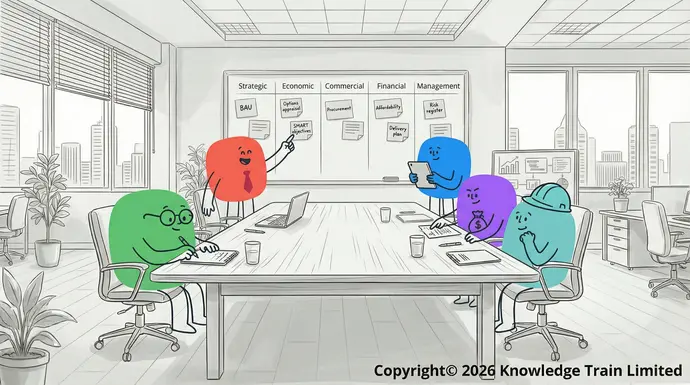
The 5 Case Model consists of 5 key dimensions: the Strategic Case, Economic Case, Commercial Case, Financial Case, and Management Case. These dimensions work together to provide a comprehensive analysis of a business problem, making it an effective tool for decision-makers.Learn the fundamentals of the PRINCE2 method.
This article provides an overview of the 5 Case Model, its benefits, and how it can be applied in real-world business cases. To learn in detail how to use the 5 Case Model develop business cases, Practitioner Better Business Cases trainingIncludes Foundation & Practitioner combined option. will teach you how to apply the Five Case Model in practice.Association for Project Management (APM)
What is the Five Case Model?Includes Foundation & Practitioner combined option.
The Better Business Cases5 Case Model™ is a crucial framework for efficiently utilising public resources and making informed decisions. It encompasses five different perspectives or “cases” that should be considered and evaluated together, rather than in isolation, to ensure a well-rounded and thorough analysis. These 5 dimensions include policy, analytical, commercial, financial, and delivery considerations.Foundation
Effective implementation of the 5 Case Model requires collaboration between different professionals within the public service, including policy, analytical, commercial, financial, and delivery specialists. By working together from the outset, these professionals can avoid siloed thinking and ensure that all relevant perspectives are considered.Learn the fundamentals of Better Business cases.
The 5 Case Model provides a comprehensive and flexible thinking framework that can accommodate the unique features of any investment or spending proposal. It accounts for a wide range of considerations, including objectives to be achieved, legal, regulatory, and ethical constraints, and more. Rather than inventing a new framework for each proposal, the Five Case Model provides a universal approach that can be tailored to suit the needs of any situation.Practitioner
Let’s now look at each of the 5 dimensions in a little more detail.Includes Foundation & Practitioner combined option.
Strategic dimensionP3O
The ®strategicFoundation Learn the fundamentals of the P3O project management office.dimensionPractitioner of the 5 Case Model is crucial in determining the “business as usual” scenario, which provides a benchmark against which proposed changes can be compared. This understanding must be quantified and well-defined, even when continuing without changes is not a viable option.Includes Foundation & Practitioner combined option.
SMART objectivesWorkshops
In the strategic dimension, external constraints and dependencies are considered, such as legal, ethical, political, and technological factors, as well as necessary infrastructure that is beyond the control of the proposal. The proposal’s expected outcome is defined by a small number of Introduction to Project Management SMART1-day workshop to learn the basics of project management. objectives, which must be Specific, Measurable, Achievable, Realistic, and Time-limited. These objectives drive the rest of the model, serving as the basis for option creation and the appraisal process in the economic dimension.Project Management Essentials
Rationale2-day workshop to learn how to manage projects without getting certified.
The objectives must reflect the rationale for the proposal and be expressed in terms of the expected change in service provision, expressed numerically. This helps in refining the objectives and enables them to be monitored and evaluated effectively. The programme objectives should directly align with the proposal’s objectives, providing a clear understanding of the expected outcomes.Writing Business Cases
Strategic assessmentHalf-day workshop to learn to write robust business cases.
The first step in any proposal, whether it be strategic, portfolio, program, or project-based, is the strategic assessment. This evaluation compares the current situation, also known as “business as usual” (BAU), to the desired outcome, as outlined by the SMART objectives. The difference between BAU and the SMART objectives highlights the business needs that must be addressed. A comprehensive understanding of how these business needs can be met and the SMART objectives achieved is crucial.AI in Project Management
Policy fitLearn how to use AI tools in everyday project work.
The proposal must also consider its fit with public policy and any potential impacts on other public bodies’ operations, responsibilities, or budgets. Effective and efficient delivery of public services requires consultation and collaboration between public bodies to avoid waste and inefficiencies.ARTIFICIAL INTELLIGENCE (AI)
Early research, consultation, and engagement with stakeholders provides a better understanding of the current situation and opportunities for improvement, as well as links to relevant policies.BCS AI
Economic dimensionFoundation
The Learn the fundamentals of artificial intellegence.economic dimensionAI Project Governance Framework (AIPGF) of the 5 Case Business Model plays a crucial role in analysing and evaluating proposals. It is driven by the SMART objectives and business needs identified in the strategic dimension and estimates the social value of different options. This dimension involves detailed option development and selection through appraisal, with a focus on considering the potential impact on the UK or overseas and considering any unintended consequences.Foundation
AppraisalLearn the fundamentals of the governance framework.
The longlist appraisal and selection of the shortlist options are critical steps in the process, and the preferred option is selected based on a thorough analysis using social cost-benefit analysis or social cost-effectiveness analysis. The selection considers factors such as the net social value of the option, the costs of risk and optimism bias, the whole life cost of the public resources employed, and the unquantifiable benefits of key objectives. The overall risk to the public and the public sector is also considered.Practitioner
It’s important to remember that all dimensions of the 5 Case Business Model are interdependent and must be considered in an integrated way, with the involvement of key stakeholders. Following the supplementary guidance on Includes Foundation & Practitioner combined option.business casesWorkshops is essential to ensure that the proposal is developed in a holistic and collaborative manner.AI in Project Management
Commercial dimensionLearn how to use AI tools in everyday project work.
The AGILEcommercial dimensionAgilePM of a proposal focuses on the commercial strategy and procurement of services and assets needed. It is informed by the strategic and economic dimensions, and the procurement specifications are derived from them.®
As the procurement process progresses, the commercial dimension provides updated information on costs, – Agile Project Managementrisk managementFoundation and timing, which is then incorporated back into the economic and financial aspects of the proposal.Learn the key principles of Agile Project Management.
This continuous feedback loop helps to develop the proposal into a fully-fledged business case.Practitioner
Financial dimensionIncludes Foundation & Practitioner combined option.
The PRINCE2financial dimension® focuses on the overall cost to the public sector of implementing a proposal, considering all financial implications and benefits. It evaluates affordability and the financial impact on the public sector, while the economic dimension evaluates the social value of the proposal. Agile
Management dimensionFoundation
The Learn the fundamentals of the PRINCE2 Agile method.management dimensionPractitioner of a proposal focuses on the practical implementation plans. It ensures that the chosen option can be executed effectively and covers the resources required, budget management, and responsible organisations. It outlines the timeline for reaching agreed milestones and completing the proposal.Includes Foundation & Practitioner combined option.
The management dimension includes the risk register, benefit register, monitoring and evaluation plans, and any necessary data collection before implementation. The details of the management aspect are developed further as the proposal matures into a full Scrumbusiness caseScrum Essentials , influencing the economic, commercial, and financial dimensions.Self-paced training course to learn the essentials of Scrum.
Benefits of using the Five Case ModelGain practitioner certificate in modelling business processes.
The 5 Case Business Model offers several benefits to organisations that use it for business case analysis. Some of the key benefits include:Business Analysis Practices
- Improved problem-solving.The 5 Case Model provides a structured approach to problem-solving, making it easier to understand and resolve complex business problems.Gain practitioner certificate in business analysis practices.
- Enhanced decision-making.The model helps decision-makers make informed decisions by providing a comprehensive analysis of a problem and its potential solutions.Requirements Engineering
- Better communication.The 5 Case Model improves communication between stakeholders by providing a clear and consistent approach to problem-solving. This helps to reduce misunderstandings and improve collaboration.Gain practitioner certificate in requirements engineering.
- Increased credibility.The model provides a thorough and well-supported analysis of business problems and solutions, increasing the credibility of the decision-making process and the recommendations that are made.Business Analysis International Diploma
- Repeatable approach.The 5 Case Model provides a consistent and repeatable approach to problem-solving, reducing the risk of making poor decisions and increasing the chances of success.All 4 courses bundled into this Diploma certification package.
The 5 Case Model offers numerous benefits to organisations that use it for business case analysis. From improved problem-solving to increased credibility, it is a valuable tool for decision-makers looking to make informed decisions and achieve their goals.AgileBA
Real-world examples of the Five Case Model®
The 5 Case Model has been successfully applied in a variety of industries and business situations to analyse and solve complex problems. Here are a few real-world examples: – Agile Business Analysis
HealthcareFoundation training
In the healthcare industry, the Five Case Model has been used to analyse and resolve issues related to patient care and hospital operations. For example, it has been used to evaluate options for improving the efficiency of the discharge process and to make recommendations for reducing re-admissions.Learn the fundamentals of Agile Business Analysis.
ManufacturingPractitioner
In the manufacturing industry, the Five Case Model has been used to analyse and resolve problems related to production and supply chain management. For example, it has been used to evaluate options for reducing waste and increasing efficiency in the production process.4-day course including Foundation.
GovernmentPMI
In the government sector, the Five Case Model has been used to analyse and resolve a wide range of problems, including policy issues, infrastructure planning, and resource allocation. For example, it has been used to evaluate options for improving public transportation and to make recommendations for reducing traffic congestion.®
FinanceSelf-paced course to prepare you for the exam (exam not included).
In the finance industry, the Five Case Model has been used to analyse and resolve problems related to investment and Business Analysis Learning Library (BALL)™risk managementCHANGE MANAGEMENT. For example, it has been used to evaluate options for managing financial risk and to make recommendations for optimising investment portfolios.APMG Change Management
The Five Case Model has been successfully applied in a variety of industries and business situations to analyse and solve complex problems. Whether it’s in healthcare, manufacturing, government, or finance, the model has proven to be a valuable tool for decision-makers looking to make informed decisions and achieve their goals.Foundation
ConclusionLearn the fundamentals of enterprise change management.
In conclusion, the 5 Case Model provides a structured and effective approach to analysing and solving complex business problems. By following the 5-step process of defining the problem, identifying objectives, evaluating options, gathering evidence, and making recommendations, decision-makers can make informed decisions and achieve their goals.Practitioner
ReferencesBusiness Analysis Learning Library (BALL)™
[1] HM Treasury. (2022). The Green Book – Central Government Guidance on Appraisal and Evaluation. Retrieved from https://assets.publishing.service.gov.uk/government/uploads/system/uploads/attachment_data/file/1063330/Green_Book_2022.pdfCompliance Learning Library (CLL)™