Five Case Model for business cases

Key takeaways
The Five Case Model tests an investment proposal from five connected angles to support robust public value decisions.
- Define the BAU baseline and a small set of SMART objectives to clarify the need and desired outcomes.
- Appraise a longlist and shortlist of options using social cost benefit or cost effectiveness analysis, including risk and optimism bias.
- Align procurement strategy and specifications to the strategic and economic cases, and feed cost and risk updates back into the analysis.
- Separate social value from affordability by treating economic and financial cases as complementary, not interchangeable.
- Prove deliverability with clear governance, milestones, resources, and live risk and benefits registers with monitoring plans.
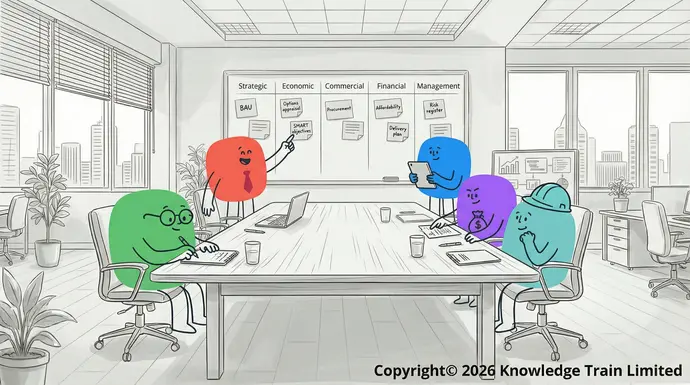
What is the Five Case Model?
The 5 Case Model is a crucial framework for efficiently utilising public resources and making informed decisions. It encompasses five different perspectives or “cases” that should be considered and evaluated together, rather than in isolation, to ensure a well-rounded and thorough analysis. These 5 dimensions include policy, analytical, commercial, financial, and delivery considerations.
Effective implementation of the 5 Case Model requires collaboration between different professionals within the public service, including policy, analytical, commercial, financial, and delivery specialists. By working together from the outset, these professionals can avoid siloed thinking and ensure that all relevant perspectives are considered.
The 5 Case Model provides a comprehensive and flexible thinking framework that can accommodate the unique features of any investment or spending proposal. It accounts for a wide range of considerations, including objectives to be achieved, legal, regulatory, and ethical constraints, and more. Rather than inventing a new framework for each proposal, the Five Case Model provides a universal approach that can be tailored to suit the needs of any situation.
Let’s now look at each of the 5 dimensions in a little more detail.
Strategic dimension
The strategic dimension of the 5 Case Model is crucial in determining the “business as usual” scenario, which provides a benchmark against which proposed changes can be compared. This understanding must be quantified and well-defined, even when continuing without changes is not a viable option.
SMART objectives
Benefits of using the Five Case Model
The 5 Case Business Model offers several benefits to organisations that use it for business case analysis. Some of the key benefits include: +44 (0)207 148 5985
- Improved problem-solving.The 5 Case Model provides a structured approach to problem-solving, making it easier to understand and resolve complex business problems.Courses
- Enhanced decision-making.The model helps decision-makers make informed decisions by providing a comprehensive analysis of a problem and its potential solutions.PROJECT MANAGEMENT
- Better communication.The 5 Case Model improves communication between stakeholders by providing a clear and consistent approach to problem-solving. This helps to reduce misunderstandings and improve collaboration.PRINCE2
- Increased credibility.The model provides a thorough and well-supported analysis of business problems and solutions, increasing the credibility of the decision-making process and the recommendations that are made.®