What is cybersecurity? Types, threats and best practices

Key takeaways
Strong cybersecurity reduces business risk by protecting data, systems, and essential services.
- Effective security balances confidentiality, integrity, and availability across systems and data.
- Prioritise low-cost controls such as multi-factor authentication, password management, and rapid patching.
- Combine prevention with detection, incident response, and tested recovery using secure backups.
- Reduce phishing and social engineering risk through regular training, simulations, and clear reporting routes.
- Governance, defined roles, and supplier oversight help turn security into a measurable programme.
- Zero trust, segmentation, logging, and monitoring limit blast radius and speed up containment.
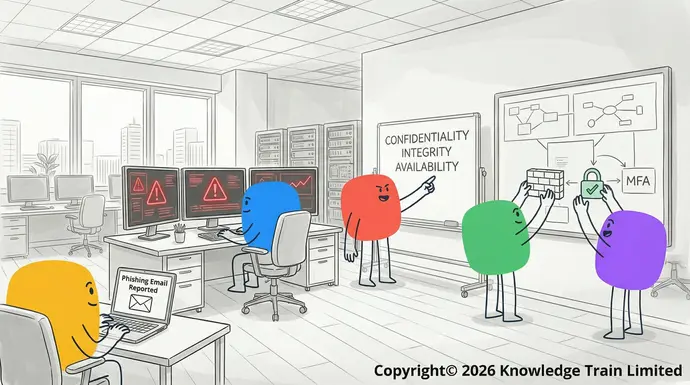
Definition of cybersecurity
Cybersecurity is the practice of protecting computer systems, networks, and data from unauthorised access, disruption, or destruction caused by cyber threats such as malware, phishing, and data breaches. According to the UK National Cyber Security Centre and the National Institute of Standards and Technology (NIST), cybersecurity employs a range of strategies, technologies, and policies to safeguard the confidentiality, integrity, and availability (CIA Triad) of digital information (NCSC Guidance, NIST Glossary).
A brief history of cybersecurity
Cybersecurity evolved alongside advances in computing, starting with early computer security measures in the 1970s. With the growth of the internet in the 1990s, threats such as viruses, worms, and hacking grew more sophisticated. Notable incidents, including the WannaCry ransomware attack (2017) and numerous high-profile data breaches, have driven global efforts to improve cyber resilience (NCSC: WannaCry insights).
Why is cybersecurity important?
- Individuals: Protects personal data, online identities, and devices from threats like identity theft and viruses.
- Businesses: Safeguards customer data, intellectual property, and operations from cyberattacks that can cause financial loss or reputational damage.
- Governments: Maintains the resilience of critical national infrastructure and protects against cyber espionage and state-sponsored attacks.
According to the UK Government’s Cyber Security Breaches Survey (2023), 32% of businesses identified cyberattacks in the previous 12 months, highlighting the increasing significance of robust cybersecurity measures (GOV.UK Survey).
Core functions and principles
- Prevention: Introducing controls such as firewalls, endpoint security, and multi-factor authentication.
- Detection: Using intrusion detection systems and monitoring to identify cyber threats quickly.
- Response: Enacting incident response plans to minimise damage during an active threat.
- Recovery: Restoring systems and data following an incident through backups and patching vulnerabilities.
The CIA Triad underpins all cybersecurity strategies: ensuring confidentiality (only authorised access), integrity (accuracy of information), and availability (information accessible when needed).
Types of cybersecurity
| Type | Description |
|---|---|
| Network security | Protects data during transfer between devices and prevents unauthorised access to networks using firewalls, intrusion detection, and encryption. |
| Application security | Ensures applications are resistant to threats by identifying and mitigating vulnerabilities in software. |
| Endpoint security | Secures devices such as computers, laptops, tablets, and mobiles from threats. |
| Cloud security | Protects data, applications, and infrastructures involved in cloud computing from breaches and leaks. |
| Information security | Protects the confidentiality, integrity and availability of data regardless of its format. |
| Operational security | Establishes policies and procedures for handling and protecting data assets. |
Common cybersecurity threats
- Malware:Programmes | Programme Definition | What is Programme? Malicious software such as viruses, worms, ransomware, and spyware.
- Phishing: Fraudulent messages designed to trick users into disclosing sensitive information.
- Social engineering: Manipulation of individuals to gain confidential data.
- Data breach: Unauthorised disclosure of sensitive information.
- Cyberattack:
What is cybersecurity in simple words?
Cybersecurity means protecting computers, networks, and data from unauthorised access and attacks to keep them secure and private.
What are the main types of cybersecurity?
The main types are network security, application security, endpoint security, cloud security, and information security.
What are the top cybersecurity threats?
Major threats include malware, phishing, ransomware, social engineering, data breaches, and zero-day exploits.
How is information security different from cybersecurity?
Information security covers protection of all types of information, while cybersecurity is focused specifically on securing digital data and systems from cyber threats.
How can individuals and organisations protect themselves?
Use unique strong passwords, enable multi-factor authentication, regularly update software, guard against phishing, use antivirus and firewalls, and maintain data backups.
What is the CIA Triad in cybersecurity?
The CIA Triad refers to the three core principles: confidentiality, integrity, and availability, which all security measures aim to protect.
What does a cybersecurity professional do?
A cybersecurity professional safeguards networks and systems from attacks, detects vulnerabilities, manages incidents, and ensures compliance with security policies.