Artificial Intelligence (AI): Definition, how it works, types, examples, benefits, and risksDenmark

Key takeaways
AI is a broad field covering multiple methods and real-world uses, with clear strengths and important trade-offs.
- Artificial intelligence is an umbrella term that includes machine learning, deep learning, large language models, and robotics in some cases.
- Most AI follows a workflow of data collection, preparation, training, inference, and continuous improvement through feedback.Programmes
- Generative AI creates new content by learning patterns from large datasets, but it can still produce confident errors.
- Nearly all practical systems today are narrow AI, not artificial general intelligence.Simon Buehring
- AI can improve speed, scale, and consistency, but it needs strong governance to manage bias, privacy, transparency, and misuse.27 Apr 2026
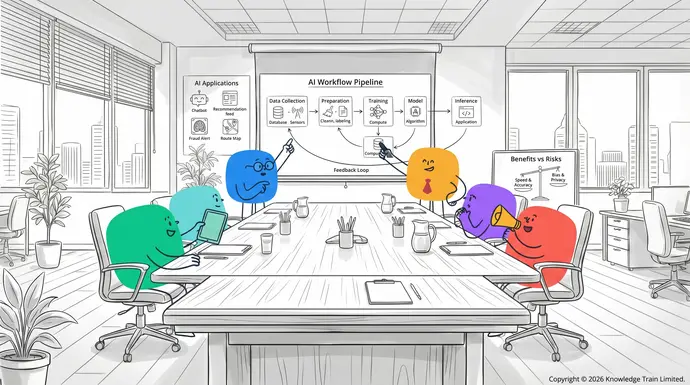
- Each programme within a or model training.portfolio
- Model creation: must align with the organization’s overarching strategic objectives. The cumulative success of the portfolio hinges on the collective performance of its constituent programmes and projects. By fulfilling their distinct deliverables and outcomes, they collectively further the strategic aims embodied in the The result is a trained model that can classify, predict, recommend, or generate outputs.portfolio
- Inference:. The model applies what it learned to new inputs.Enhance your skills with our expert-led courses
- Feedback loop: Performance is monitored, corrected, and improved with more data or fine-tuning.
Key concepts explained simply
- Algorithm:Instructor-led A set of computational rules or procedures.MSP Practitioner (with Foundation) course
- Model: The learned system produced after training.£1,899 +vat
- Neural networks: Layered mathematical systems inspired by the structure of the brain, widely used in deep learning.See all dates
- Deep learning: A machine learning approach that uses many-layered neural networks.
- Inference: The stage where a trained model is used on new data.Self-paced
- Feedback loop: A process for evaluating outputs and improving the system over time.MSP Practitioner (with Foundation) self-paced online
How generative AI works
Generative AI£1,399 +vat is designed to create new content such as text, images, audio, video, or code. Systems such as ChatGPT and other tools built on large language modelsInstructor-led are trained on very large collections of text to predict likely sequences of words. Similar techniques are used for image generation, code generation, summarisation, and content creation.MSP Foundation course
Types of artificial intelligence
Artificial intelligence can be classified in more than one way. The most common taxonomy separates AI by capability and by function.£1,299 +vat
Types of AI by capability
| TypeSee all dates | DefinitionDifferences between programmes and projects | StatusTable showing the differences between programmes and projects. | ExampleProjects |
|---|---|---|---|
| Narrow AIProgrammes | AI designed for specific tasksPurpose and objectives | Achieve a broader set of strategic outcomes by managing a group of interrelated projects. | Recommendation engines, voice assistants, fraud detectionScope and timeframe |
| Artificial general intelligenceHave a defined scope and timescale. | AI with human-level general problem-solving ability across domainsHave a broader scope, comprising multiple related projects. Their timescale continues until all the desired outcomes are achieved. | Theoretical and debatedManagement approach | No confirmed real-world exampleFocuses on the delivery of specific outputs, |
| Superintelligencemanaging risks | Hypothetical AI that exceeds human intelligence in most areas, issues, quality, and stakeholders. | SpeculativeFocuses on coordinating multiple related projects to achieve a common outcome. Also focuses on managing project interdependencies and realizing benefits. | No real-world exampleBenefits of programmes |
Narrow AIThere are multiple benefits to an organization if it manages its change initiatives as programmes. is the form used today. It can perform specific tasks very well, but it does not possess broad human understanding. Strategic alignmentArtificial general intelligenceProgramme management, often shortened to AGI, refers to a machine with flexible intelligence across many domains. ensures that all projects within a programme align with the broader organizational goals, ensuring resources are channelled towards initiatives that match the strategic vision.SuperintelligenceOptimized resource allocation is a hypothetical level beyond AGI.Resources, including time, manpower, and finances, are allocated and utilized more efficiently across various projects, preventing redundancy and waste.
Types of AI by functionRisk management
| Functional typeBy looking at a collection of projects, programme management can identify, mitigate, and manage risks that might not be visible at the individual project level. | DefinitionEnhanced stakeholder engagement | Practical statusProvides a structured framework for consistent and effective communication with all stakeholders, fostering trust and collaboration. |
|---|---|---|
| Reactive machinesManagement of interdependencies | Systems that respond to current inputs without memory of past eventsEnables efficient handling of dependencies between projects, ensuring that the progress or outcome of one project doesn’t adversely impact another. | Conceptually useful, limited in practiceImproved decision-making |
| Limited memoryOffers a holistic view of all projects, leading to better-informed decisions based on comprehensive data and insights. | Systems that use past data for decisionsBenefits realization | Common in modern AIGoes beyond just completing |
| Theory of mindprojects | Hypothetical systems that understand emotions, beliefs, and intentions deeply on time and budget, focusing on achieving the desired outcomes and ensuring that the anticipated benefits are realized and sustained. | Not achievedIncreased flexibility |
| Self-aware AIProvides a framework that can adapt to changes in the business environment or organizational strategy, ensuring projects remain relevant and aligned. | Hypothetical systems with consciousness or self-awarenessConsistency and standardization | Not achievedBy adopting a standardized approach, organizations can ensure consistency in the delivery and quality of projects across the board. |
Most modern AI systems are best described as limited memory systems. They use stored data, historical patterns, and training examples to make outputs.Continuous improvement
AI vs machine learning vs deep learningFacilitates a culture of learning and improvement by regularly reviewing performance, capturing
AI, machine learning, deep learning, and generative AI are related but not identical. AI is the broadest category, while machine learning and deep learning are increasingly specific technical approaches within it.lessons learned
| Term, and implementing best practices across all projects. | DefinitionValue for money | MethodsEnsures that investments in individual projects culminate in the desired benefits, yielding a positive return on investment for the organization. | InputsBoosted morale and team cohesion | OutputsWith clear objectives and coordinated efforts, teams have a clearer sense of purpose, leading to increased motivation and collaboration. | ExamplesIn essence, |
|---|---|---|---|---|---|
| Artificial intelligenceprogramme management | The broad field of systems performing intelligent tasks offers organizations a structured and strategic approach to managing multiple projects, ensuring not just their successful delivery but also the realization of broader business objectives and benefits. | Rules, search, optimisation, machine learning, expert systemsEnhance your skills with our expert-led courses | Data, rules, sensor signals, user input | Predictions, decisions, actions, content | Robotics, route planning, fraud detection |
| Machine learningInstructor-led | A subset of AI that learns from dataMSP Practitioner (with Foundation) course | Supervised, unsupervised, reinforcement learning | Structured and unstructured data£1,899 +vat | Classifications, predictions, recommendations | Spam filters, credit scoringSee all dates |
| Deep learning | A subset of machine learning using multilayer neural networks | Neural networks with many layers | Images, audio, text, videoSelf-paced | Recognition, translation, generationMSP Practitioner (with Foundation) self-paced online | Speech recognition, computer vision |
| Generative AI£1,399 +vat | AI focused on creating new content | Large language models, diffusion models, transformers | Prompts, text, images, code, audio | Generated text, images, code, summariesInstructor-led | Chatbots, image generation, code assistantsMSP Foundation course |
Related entities explained
- Natural language processing:£1,299 +vat AI methods that help computers understand and generate human language.
- Computer vision:See all dates AI methods that help systems interpret images and video.Summary
- Neural networks:Programmes represent unique yet interrelated aspects of strategic organizational management. Managing and integrating programmes within broader The mathematical architecture used widely in deep learning.portfolios
- Large language models: provides organizations with a competitive edge, amplifying benefits realization and enhancing investment returns. Very large neural network models trained on vast text corpora to predict and generate language.Enterprises that prioritize
AI ethics concerns the principles used to design, deploy, and monitor AI responsibly. Common themes include fairness, accountability, non-discrimination, privacy, transparency, explainability, human oversight, and security.
AI safety focuses on making systems reliable and controllable, especially in high-stakes settings. Governance may include testing, documentation, risk assessment, audit trails, model evaluation, incident reporting, and compliance with regulation.
In public policy, regulators and standards bodies increasingly examine data protection, intellectual property, product safety, discrimination law, and transparency requirements for AI systems.
History of AI
The history of artificial intelligence stretches from early theories of computation to modern generative AI. While current systems are highly capable in some tasks, the field has gone through cycles of optimism, disappointment, and rapid progress.
Key milestones in AI history
Or chat with us using the link at the bottom of the screen.What is the difference between AI and machine learning?
AI is the broad field of making machines perform intelligent tasks. Machine learning is a subset of AI that learns from data instead of relying only on explicit rules. Deep learning is a further subset of machine learning that uses neural networks with many layers.