
Introduction
Agile project management is a highly collaborative approach to project management that uses short, iterative development cycles. The popularity of Agile owes a lot to its ability to adapt to the fast-paced nature of business today.
That’s why Self-pacedAgileBetter Business Cases Foundation self-paced online, originally developed for use in the software development industry has been adopted by a wide variety of industries today, from financial services to transportation.
If you want a competitive edge in the project manager job market, a good place to start is with an £699 +vatcertification in AgileWhat is the Five Case Model?. With so many options available however, it can be difficult to find which is best for you.The
We’ve created a list of 5 Case ModelAgile qualifications is a crucial framework for efficiently utilising public resources and making informed decisions. It encompasses five different perspectives or “cases” that should be considered and evaluated together, rather than in isolation, to ensure a well-rounded and thorough analysis. These 5 dimensions include policy, analytical, commercial, financial, and delivery considerations., so you can easily pick the one most relevant to your industry, role and level of experience.Effective implementation of the 5 Case Model requires collaboration between different professionals within the public service, including policy, analytical, commercial, financial, and delivery specialists. By working together from the outset, these professionals can avoid siloed thinking and ensure that all relevant perspectives are considered.
Why get an Agile project management certificationThe 5 Case Model provides a comprehensive and flexible thinking framework that can accommodate the unique features of any investment or spending proposal. It accounts for a wide range of considerations, including objectives to be achieved, legal, regulatory, and ethical constraints, and more. Rather than inventing a new framework for each proposal, the Five Case Model provides a universal approach that can be tailored to suit the needs of any situation.
There has been a marked increase in the use of Let’s now look at each of the 5 dimensions in a little more detail.Agile methodologiesStrategic dimension in all sectors:The
- 3 of every 4 businesses report using Agile approaches on a regular basis strategic[1] .dimension
- Forbes reports that of 500 senior executives interviewed, 92% believed Agile practices to be critical to business success of the 5 Case Model is crucial in determining the “business as usual” scenario, which provides a benchmark against which proposed changes can be compared. This understanding must be quantified and well-defined, even when continuing without changes is not a viable option.[2]SMART objectives.In the strategic dimension, external constraints and dependencies are considered, such as legal, ethical, political, and technological factors, as well as necessary infrastructure that is beyond the control of the proposal. The proposal’s expected outcome is defined by a small number of
- In a 2017 survey, KPMG reported that 76% of business owners in the EU believe Agile projects will outnumber waterfall, or traditional, projects by 2021 SMART[3] objectives, which must be Specific, Measurable, Achievable, Realistic, and Time-limited. These objectives drive the rest of the model, serving as the basis for option creation and the appraisal process in the economic dimension..Rationale
Businesses make regular use of Agile methodologies depending on the nature of The objectives must reflect the rationale for the proposal and be expressed in terms of the expected change in service provision, expressed numerically. This helps in refining the objectives and enables them to be monitored and evaluated effectively. The programme objectives should directly align with the proposal’s objectives, providing a clear understanding of the expected outcomes.projectsStrategic assessment:The first step in any proposal, whether it be strategic, portfolio, program, or project-based, is the strategic assessment. This evaluation compares the current situation, also known as “business as usual” (BAU), to the desired outcome, as outlined by the SMART objectives. The difference between BAU and the SMART objectives highlights the business needs that must be addressed. A comprehensive understanding of how these business needs can be met and the SMART objectives achieved is crucial.
- 1 of every 4 manufacturing businesses rely solely on Agile methodologies, while over half use a combination of traditional and Agile practices Policy fit[4]The proposal must also consider its fit with public policy and any potential impacts on other public bodies’ operations, responsibilities, or budgets. Effective and efficient delivery of public services requires consultation and collaboration between public bodies to avoid waste and inefficiencies..Early research, consultation, and engagement with stakeholders provides a better understanding of the current situation and opportunities for improvement, as well as links to relevant policies.
Agile helps foster successful business practices:Economic dimension
- QSM assessed the performance of Agile development projects in three key areas: productivity, time-to-market and quality. Findings show Agile projects were significantly faster and more productive than traditional projects The [5]economic dimension. of the 5 Case Business Model plays a crucial role in analysing and evaluating proposals. It is driven by the SMART objectives and business needs identified in the strategic dimension and estimates the social value of different options. This dimension involves detailed option development and selection through appraisal, with a focus on considering the potential impact on the UK or overseas and considering any unintended consequences.
With the number of Agile project management roles increasing, candidates holding an AppraisalAgile project management certificationThe longlist appraisal and selection of the shortlist options are critical steps in the process, and the preferred option is selected based on a thorough analysis using social cost-benefit analysis or social cost-effectiveness analysis. The selection considers factors such as the net social value of the option, the costs of risk and optimism bias, the whole life cost of the public resources employed, and the unquantifiable benefits of key objectives. The overall risk to the public and the public sector is also considered. will be at an advantage compared to those without.It’s important to remember that all dimensions of the 5 Case Business Model are interdependent and must be considered in an integrated way, with the involvement of key stakeholders. Following the supplementary guidance on
Choosing the right Agile project management certificationBetter Business Cases Practitioner (with Foundation) course
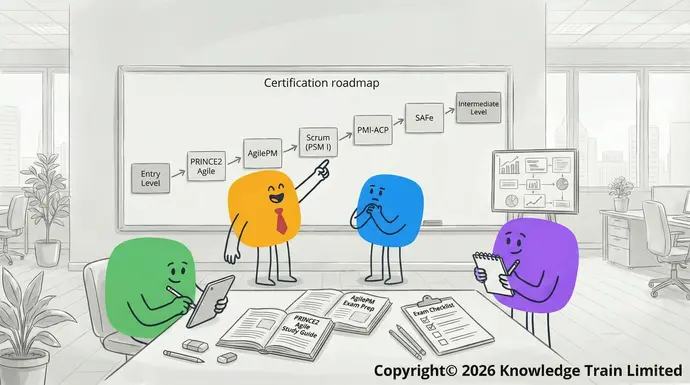
There is a wide variety of certifications for Agile£2,400 +vat available on the market. Given the complexity and scope of many of these, it may be difficult knowing where to start. Here’s a very basic breakdown of which courses are available and their specific niche in Agile practice.
- If you’d like to learn a general-purpose, widely applicable Agile methodology, an See all datesAgile project management certification (Agile PM) will teach you practical Agile tools and methods you can apply to the management of projects right away!
- If you’d like a general education in the various Agile ‘flavours’ like Scrum, DSDM, XP and become an all-round Agile expert, you should consider an Agile Certified Practitioner ®Self-paced Better Business Cases Practitioner (with Foundation) self-paced onlinePMI-ACP qualification.£1,199 +vat
- If you’d like to become a certified Scrum Master Professional, the Professional Scrum Master I (PSM ® I) from Scrum.org was developed and endorsed by Ken Schwaber, the founder of Scrum himself.
£2,400 +vat course does not provide as comprehensive an overview of either PRINCE2 or AgileSee all dates practices as say, a PRINCE2 Foundation course or AgilePM Foundation course.
This course is better suited to those who already have a general understanding of PRINCE2 and Agile and want to learn how to improve the PRINCE2 method with the addition of contemporary Agile practices.Self-paced
AgilePM FoundationBetter Business Cases Practitioner (with Foundation) self-paced online
The APMG Agile PM qualifications equip candidates with the tools and knowledge required to apply the AgilePM method to working projects£1,199 +vat ®Self-paced
or an equivalent qualification.
PRINCE2 Agile Practitioner courses elaborate on those topics covered by the PRINCE Agile Foundation course.
This course explores the practical application of the 11 essential project management techniquesPRINCE2 method to working projects.Knowledge Train
Agile PM Practitioner19 Feb 2026
To be eligible for the Agile PM Practitioner examination, candidates are required to have first passed the Agile PM Foundation exam or have an equivalent certification in Agile.
The AgilePM Practitioner qualification aims to build upon the concepts first taught in the AgilePM Foundation course with a greater emphasis placed on your ability to apply and tailor the method to any given scenario.Enhance your project management skills with these 11 essential techniques. From project planning and visualisation to quality assurance and risk assessment, our ultimate guide will help you learn the art of managing projects for excellent results.
Earning this qualification allows you to demonstrate your competence in DSDM management and your ability to begin work as an Agile project manager to potential employers.
Upon completion, candidates will be equipped with the confidence and in-depth knowledge necessary to implement the AgilePM framework and manage the daily tasks of a professional project manager.
PMI Agile Certified Practitioner (PMI-ACP) ®
The PMI-ACP ®What is PRINCE2? is PMI’s answer to the growing need for experienced Agile project managers. Whilst not itself an Agile project management certificationSimon Buehring, the ACP is PMI’s fastest growing certification with an increasing number of 29 Apr 2026project managers electing to acquire this qualification each year.PRINCE2 (Projects IN Controlled Environments) is a structured project management method used to plan, control and deliver projects through defined roles, stages and management products. It is used by project managers, project teams and governance groups such as a Project Board to improve control, business justification and delivery outcomes.
PMI-ACP ® qualifications recognize practitioners’ ability to work as an Agile practitioner , rather than simply having knowledge of the subject. The PMI brand carries weight and credibility owing to the difficulty of its certification exam, guaranteeing that only those who have a good grasp of course material go on to earn their qualifications.
To be eligible for the PMI-ACP examination, candidates require 2000 hours of project management experience, and 30 contact-hours of training making it mandatory for candidates to first attend a PMI training course provided by select training service providers. It is possible however to earn this experience through other Developing your project management career