What is the best Agile project management certification?

Key takeaways
Choose an Agile qualification that matches your role, experience, and the framework most used in your sector.
- Agile skills are in high demand across industries, and certification can help candidates stand out in a growing job market.
- AgilePM suits those wanting practical, project focused tools based on DSDM that can be applied quickly.
- PRINCE2 Agile fits candidates who use PRINCE2 and need a controlled approach that still allows Agile flexibility.
- PSM I is a strong Scrum credential with a challenging exam and lifetime validity, often valued in IT contexts.
- PMI-ACP targets experienced practitioners and has strict eligibility requirements, but carries strong PMI credibility.
Introduction
Agile project management is a highly collaborative approach to project management that uses short, iterative development cycles. The popularity of Agile owes a lot to its ability to adapt to the fast-paced nature of business today.
That’s why Agile, originally developed for use in the software development industry has been adopted by a wide variety of industries today, from financial services to transportation.
If you want a competitive edge in the project manager job market, a good place to start is with an certification in Agile. With so many options available however, it can be difficult to find which is best for you.
We’ve created a list of Agile qualifications, so you can easily pick the one most relevant to your industry, role and level of experience.
Why get an Agile project management certification
There has been a marked increase in the use of Agile methodologies in all sectors:
- 3 of every 4 businesses report using Agile approaches on a regular basis [1].
- Forbes reports that of 500 senior executives interviewed, 92% believed Agile practices to be critical to business success [2].
- In a 2017 survey, KPMG reported that 76% of business owners in the EU believe Agile projects will outnumber waterfall, or traditional, projects by 2021 [3].
Businesses make regular use of Agile methodologies depending on the nature of projects:
- 1 of every 4 manufacturing businesses rely solely on Agile methodologies, while over half use a combination of traditional and Agile practices [4].
Agile helps foster successful business practices:
- QSM assessed the performance of Agile development projects in three key areas: productivity, time-to-market and quality. Findings show Agile projects were significantly faster and more productive than traditional projects [5].
With the number of Agile project management roles increasing, candidates holding an Agile project management certification will be at an advantage compared to those without.
Choosing the right Agile project management certification
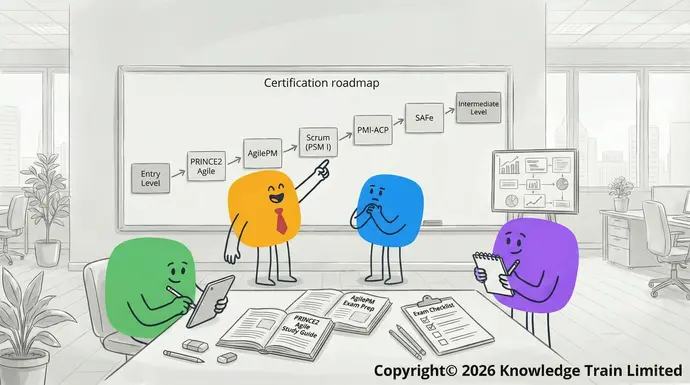
There is a wide variety of certifications for Agile available on the market. Given the complexity and scope of many of these, it may be difficult knowing where to start. Here’s a very basic breakdown of which courses are available and their specific niche in Agile practice.
- If you’d like to learn a general-purpose, widely applicable Agile methodology, an Agile project management certification (Agile PM) will teach you practical Agile tools and methods you can apply to the management of projects right away!
- If you’d like a general education in the various Agile ‘flavours’ like Scrum, DSDM, XP and become an all-round Agile expert, you should consider an Agile Certified Practitioner® PMI-ACP qualification.
- If you’d like to become a certified Scrum Master Professional, the Professional Scrum Master I (PSM® I) from Scrum.org was developed and endorsed by Ken Schwaber, the founder of Scrum himself.
- If you’d like to become a certified Scrum Master Professional, Scrum.org’s Professional Scrum Master I (PSM® I) is developed and endorsed by Ken Schwaber, the founder of Scrum himself!
- If you’re familiar with, or already make use of, the PRINCE2 method and would like to learn how to adapt this popular framework to better suit Agile practices, a PRINCE2 Agile course is perfect for you!
- If you would like to apply Agile methods on an enterprise level, a SAFe® Agilist certification will be a better choice.
Entry-level certifications
The Agile project management qualifications listed below have no formal prerequisites. Candidates do not require any previous experience in a project management role to qualify, some prior knowledge of project management may prove useful, however.
PRINCE2 Agile Foundation
PRINCE2 Agile is a refinement of the Project IN Controlled Environments (PRINCE2) project management methodology. While traditionally, PRINCE2 has a focus on top-down strategy and decision-making, PRINCE2 Agile modifies this framework with Agile practices to improve responsiveness, autonomy and flexibility.
While these two styles of management seem incompatible at first, PRINCE2 has always emphasized flexibility and scalability, key features also present in Agile frameworks.
PRINCE2 Agile seamlessly combines the PRINCE2 framework with compatible Agile practices, allowing for both control and flexibility.
Important to note however, is that while PRINCE2 Agile Foundation certification has no prerequisites, a PRINCE2 Agile Foundation course does not provide as comprehensive an overview of either PRINCE2 or Agile practices as say, a PRINCE2 Foundation course or AgilePM Foundation course.
This course is better suited to those who already have a general understanding of PRINCE2 and Agile and want to learn how to improve the PRINCE2 method with the addition of contemporary Agile practices.
AgilePM Foundation
The APMG Agile PM qualifications equip candidates with the tools and knowledge required to apply the AgilePM method to working projects. Unlike other, more general, qualifications such as the PMI-ACP®, the Agile PM course trains you in the use and application of practical project management tools and roles.
AgilePM is based on the Dynamic Systems Development Method (DSDM) and has guidance in the form of the AgilePM handbook from the Agile Business Consortium.
AgilePM training cover all vital aspects of DSDM product development including the project lifecycle, development roles, quality assurance, KPI’s and much more!
AgilePM is an iterative approach to product development that focuses on setting short-term goals interspersed with regular assessment points.
There are no prerequisites for an Agile PM Foundation course.
PSM I
Professional Scrum Master I courses are the entry-level Scrum certification offered by Scrum.org. Scrum is an Agile development process framework used to manage complex projects in the early 90’s. Developed by Ken Schwaber and Jeff Sutherland, Schwaber left to create his own Scrum certification in 2001. Although Scrum is not actually an Agile project management method, the qualifications are here because people often seek Scrum qualifications when seeking to enhance their Agile project management skillset.
The Professional Scrum Master course benefits from its foundation in a universal body of knowledge. This makes it much easier to attain successive certifications such as PSM II and III.
While either Scrum certifications, such as those offered by Scrum Alliance, take a broader view, Scrum.org certifications focus almost exclusively on the application of Scrum in complex projects, particularly those in the IT industry.
PSM exams are not as easy to pass as other certifications (requiring a significant 85% to pass), it does have a reputation for producing knowledge and competent practitioners. Furthermore, Scrum.org certifications are valid for life and do not require maintenance, saving you money in the long run.
To be eligible for a PRINCE2 Agile Practitioner examination, candidates must hold either PRINCE2 Foundation , PRINCE2 Agile Foundation , PMI ®