MoSCoW prioritisation methodAgile (Project) Management NOT a contradiction

Key takeawaysOur courses are the fastest, simplest way to enable staff to gain certification to meet their professional development goals.
MoSCoW helps teams make clear trade-offs so the most valuable work is delivered first.How it works
- MoSCoW categorises requirements into Must, Should, Could, and Won’t to create shared priorities.You choose from a wide portfolio of off-the-shelf training covering the most popular business subjects.
- Focusing on Must items reduces risk by protecting the minimum needed for success.You tailor your training package to
Introduction.
Read this article to learn more about the MoSCoW method and how to use it.
What is MoSCoW prioritisation?
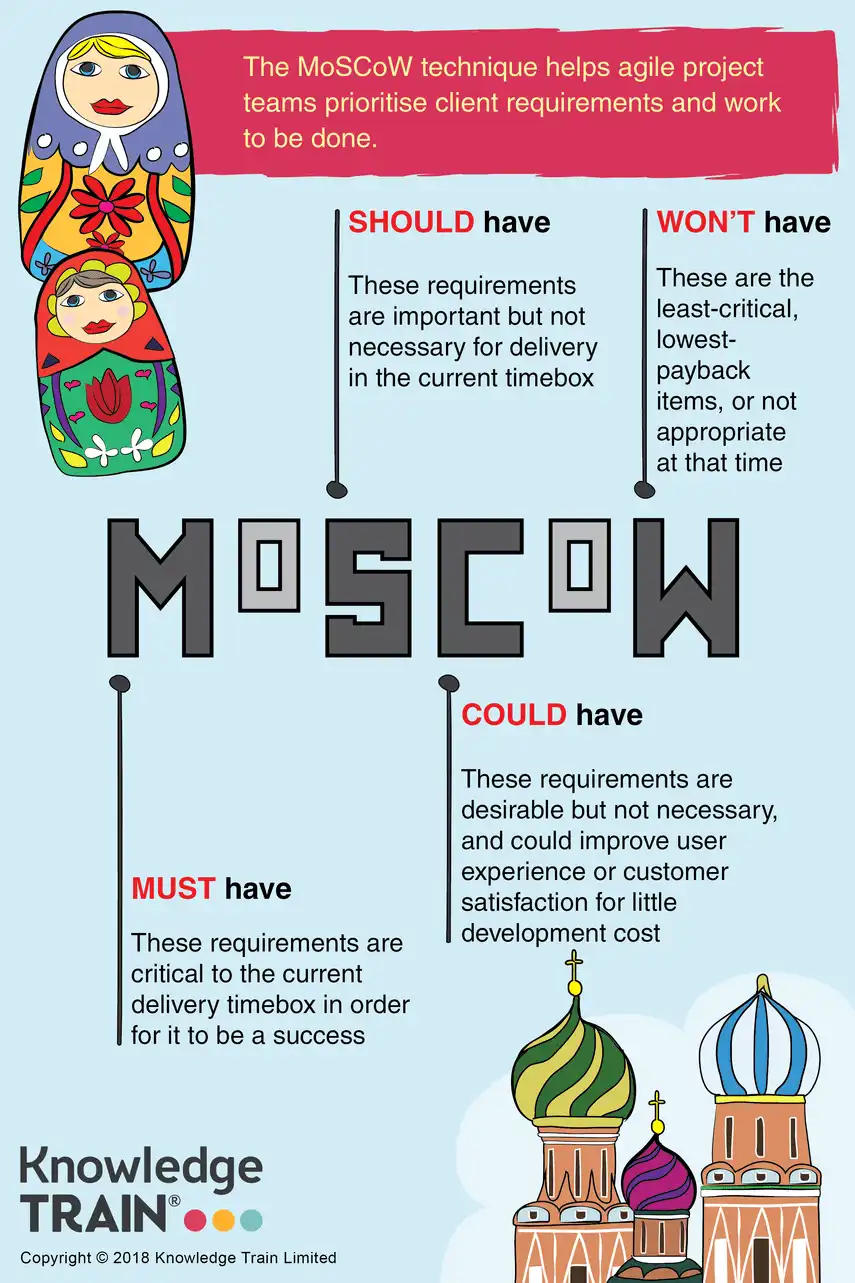
MoSCoW analysis is a prioritisation technique commonly used on agile projects. It stands for: M ust Read moreSPracticalhould Our training is designed to prepare students to reliably pass the required exams and achieve professional certification.CIf you want to help your staff learn practical, applicable skills but do not require professional certification our team training licence can help you up-skill large groups with ould a fixed, predictable costW.on’t. MoSCoW analysis helps teams understand which requirements or tasks they should focus on. MoSCoW was invented by Oracle employee Dai Clegg in 1994 and is the most common prioritisation technique used on agile projects.Our e-Learning courses are embedded in an accessible, informative Learning Management System (LMS) which your staff can use to track and assess training performance.
Though the MoSCoW method is often used to prioritise customer’s requirements on Our servicesprojectsKnowledge Train has a , it can also be used outside of projects. For example, to prioritise business as usual work within an organisations or to prioritise jobs to do at home in your personal life.track record
If you’re learning about in staff development training provision. We can provide staff training to help your team meet their CPD goals in any of the following disciplines:agile project managementProject Management on an Programme ManagementAgile PM coursePortfolio Management, MoSCoW is one of the key agile techniques which you will learn.Project Management Office (PMO)
Using MoSCoW also means both customer and project team might decide that some requirements don’t even need to be there. It helps cut out unnecessary things and keeps things lean, agile and simple. MoSCoW analysis is one of the aspects of Project Management Skills | Knowledge TrainagileQuick and easy that helps the team minimise wasted time, effort, resources and money.Many of our unaccredited compliance e-Learning courses can be completed in as little as 2 hours. They’re the perfect way to ensure large teams are brough up to date in the latest compliance regulations
How to use itas quickly as possible
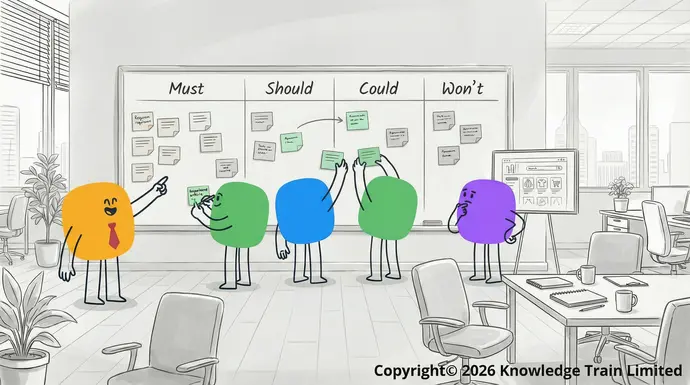
the MoSCoW prioritisation technique is simple to use. Firstly, you’ll need a list of the customer’s requirements. A great way to use MoSCoW is in a workshop with users. Brainstorm a list of requirements, writing each one on a post-it note and then apply MoSCoW..
It is also commonly used during IOSH and NEBOSH accredited training ScrumWe work with trusted training partners to provide a range of NEBOSH and IOSH certified courses. We provide planning meetings to prioritise industry-standard compliance training user stories to supervisors, senior managers, and safety advisors in almost every industry. for the next sprint.We can facilitate training which covers general health and safety, as well as
So, with your list of requirements, ask whether each requirement is one of the following:specialist areas, including fire, environmental, oil & gas, and more
Must.
A requirement which must be completed and is vital for the project’s success. Without this requirement, the project will likely fail.
Should
Whilst these requirements are important, they can be delayed if time, resources or money are tight. They are not as time-critical as musts.
Could
These requirements are not necessary, but they can be completed if there’s enough time.Read more
Won’tCompliance training on request
These requirements are the least critical and can be completed at a later stage.If you require compliance or health & safety training not listed on our website, reach out to us at
Let’s use an example. Your customer wants a new e-commerce website for their small clothing business. Their requirements for this project are:[email protected]
- It needs a homepage or call us on +44 (0)207 148 5985 and we’ll find suitable training through our
- It needs product pagesnetwork of trusted training partners
- Each product needs a photo and description.