MoSCoW prioritisation method

Key takeawaysLuxemburg
MoSCoW helps teams make clear trade-offs so the most valuable work is delivered first.Malta
- MoSCoW categorises requirements into Must, Should, Could, and Won’t to create shared priorities.Netherlands
- Focusing on Must items reduces risk by protecting the minimum needed for success.Poland
- Should and Could items provide flexibility when time, budget, or resources tighten.Portugal
- Won’t items prevent scope creep by explicitly deferring low value work.Romania
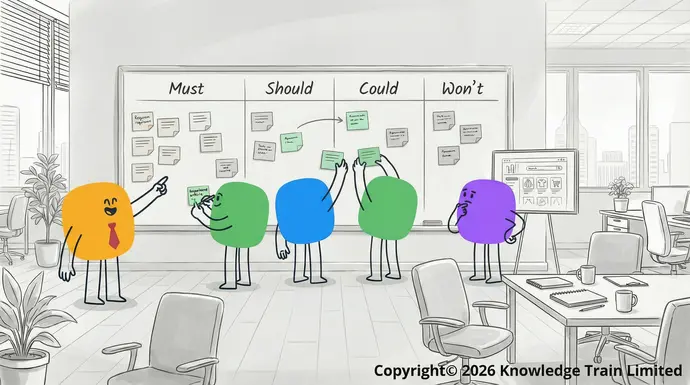
- Running a workshop with post-it notes and tracking outcomes on a Kanban board keeps alignment high.Slovakia
Introduction
Read this article to learn more about the MoSCoW method and how to use it.
How to use itA
the MoSCoW prioritisation technique is simple to use. Firstly, you’ll need a list of the customer’s requirements. A great way to use MoSCoW is in a workshop with users. Brainstorm a list of requirements, writing each one on a post-it note and then apply MoSCoW.fishbone diagram
It is also commonly used during , also known as an ScrumIshikawa diagram planning meetings to prioritise or a cause-and-effect diagram, is a fundamental tool in user storiesquality management for the next sprint.. Named after its creator, Kaoru Ishikawa, this diagram helps in identifying root causes of a problem by organising potential causes into useful categories. The visual structure resembles a fish skeleton, with the problem statement at the ‘head’ and contributing factors branching off as ‘bones.’ This structured approach facilitates effective brainstorming sessions, enabling teams to explore a wide range of possible causes systematically.
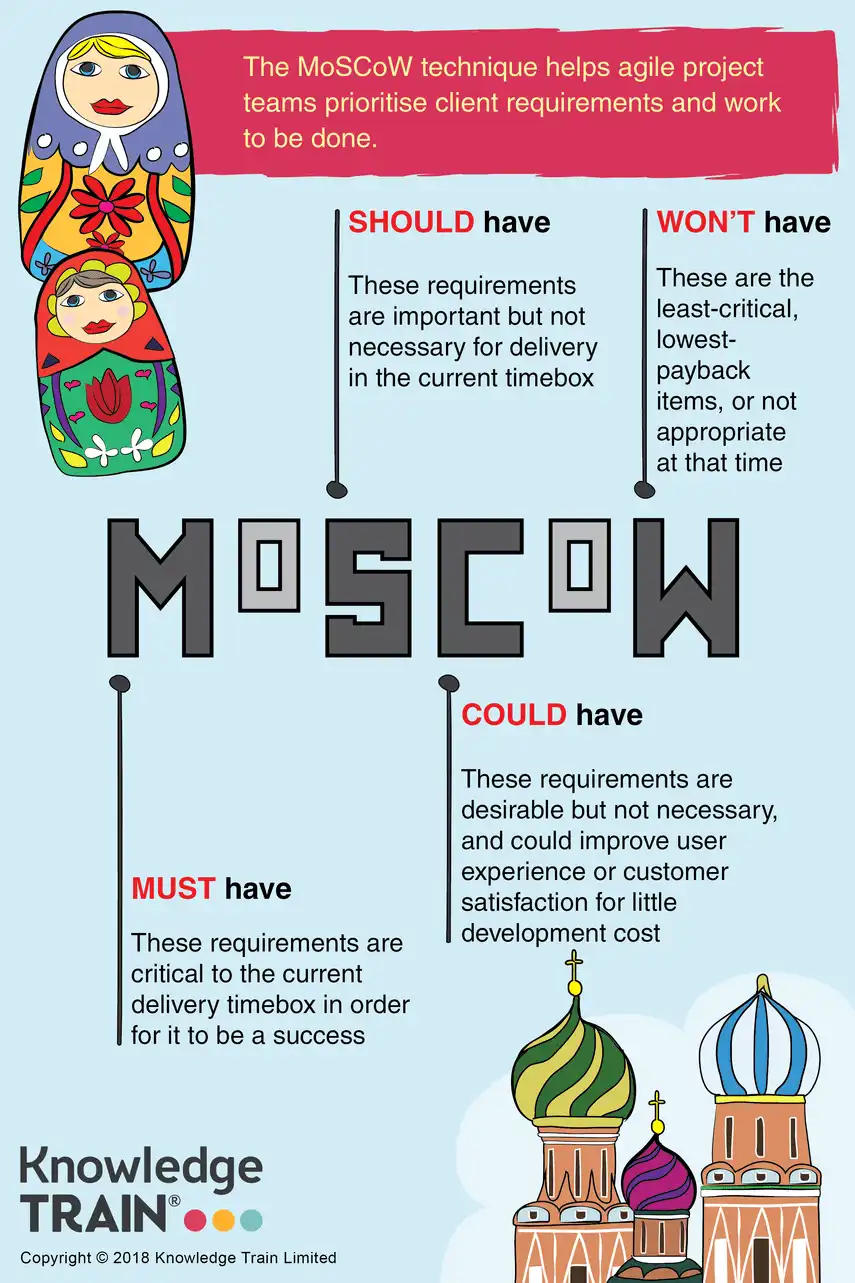
So, with your list of requirements, ask whether each requirement is one of the following:Importance in problem-solving
MustFishbone diagrams are vital in quality management and continuous improvement efforts across numerous industries. They are one of the Seven Basic Quality Tools, essential for identifying and resolving issues efficiently. The diagrams help teams develop specific solutions and are particularly valuable in
A requirement which must be completed and is vital for the project’s success. Without this requirement, the project will likely fail.Manufacturing sectors
Should use them to identify and address production process inefficiencies
Whilst these requirements are important, they can be delayed if time, resources or money are tight. They are not as time-critical as musts.Healthcare organisations
Could use them to improve patient care by analysing procedural issues
These requirements are not necessary, but they can be completed if there’s enough time.Service industries
Won’t use them to enhance customer satisfaction by resolving service concerns.
These requirements are the least critical and can be completed at a later stage.In essence, fishbone diagrams not only aid in identifying the root causes of problems but also promote a culture of systematic analysis and continuous improvement. By applying this method, organisations can ensure that they address issues comprehensively, leading to more effective and lasting solutions.
Let’s use an example. Your customer wants a new e-commerce website for their small clothing business. Their requirements for this project are:Understanding fishbone diagram components
- It needs a homepageBasic structure of a fishbone diagram
- It needs product pagesA
- Each product needs a photo and descriptionfishbone diagram
- There needs to be a shopping cart is a visual tool that helps teams identify and categorise the root causes of a problem. The diagram resembles the skeleton of a fish, making it intuitive and straightforward to use. At the ‘head’ of the diagram, you place the
- There needs to be an about us pageproblem statement
- There needs to a be a terms & conditions, returns page – the issue that needs addressing. This serves as the focal point of the analysis.
- There should be a banner with special dealsBranching off from the spine are the ‘bones,’ which represent potential
- There should be live chatcauses
- It would be nice to have a pop up for subscribing to mailing listsCategories in fishbone diagrams
- Perhaps there can be a blog, but not sureStandard categories
Using MoSCoW, you might want to prioritise these requirements like this: Fishbone diagrams
Must often use standard categories to organise potential causes, especially in
Homepage, product listings, product photos and descriptions, shopping cart, about us page, returns page, terms & conditions page. quality management
Should and engineering contexts. These categories help ensure a comprehensive analysis by covering different aspects of the problem. Commonly used categories include:
Banner and live chat Methods
Could : Processes or procedures that might contribute to the issue
Social media Materials
Won’t : Raw materials or components involved in the process
Blog Once prioritised, your team will know which requirements to work on first. To help keep everyone on the same page, it’s highly recommended you use a Kanban board. This can be a physical board in the office, or you can investigate digital boards, such as KanbanFlow and Trello. Machines