
Key takeawaysPeople first react to change with shock and denial. They might ignore the changes or deny how these affect their work. This natural defensive response gives people time to process what is happening.
Kanban helps teams manage work visually, reduce waste, and improve delivery through steady flow.Stage 2. Anger and fear
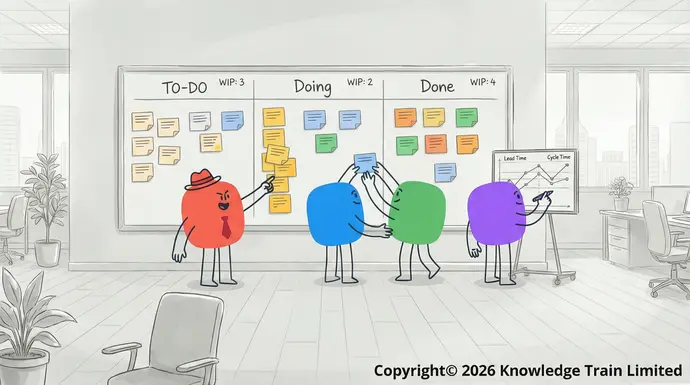
- Make work visible on a board so every character can spot progress, priorities, and problems quickly.When reality becomes clear, people often feel angry and fearful. They worry about their future and may resist changes actively. This reaction can strain team relationships and affect work quality. Leaders need to address worries openly through clear communication.
- Use a pull system so new work starts only when there is capacity, preventing queues and overload.Stage 3. Exploration and bargaining
- Set WIP limits per column to reduce multitasking and expose bottlenecks early.People start exploring what the change means. They suggest different approaches or try to negotiate aspects of the change. Although this might look like resistance, it shows people are beginning to engage with the changes. This stage offers chances to involve team members in planning.
- Focus on flow by watching for stoppages and tracking simple measures like lead time and cycle time.Stage 4. Depression and confusion
- Continuously review the board and adjust the process so improvements become routine, not occasional.As people understand what change truly means, they might lose motivation and confidence. Work quality and team spirit often decrease as everyone adjusts to new ways. Leaders should offer extra support and clear guidance during this difficult time.
IntroductionStrategies for guiding teams through the change curve
Kanban is discussed on many Successfully guiding a team through the agile courseschange curve, including a requires thoughtful strategies. These strategies should address communication, support, and progress monitoring. By implementing these approaches, leaders can facilitate smoother transitions and foster a positive environment.PRINCE2 Agile courseCommunication strategies and Effective Agile Project Management coursecommunication. is crucial at every stage of the change curve. Leaders must tailor their messages to the team’s current emotional state. During the initial stages of shock and denial, it is important to provide clear, concise information to alleviate uncertainty. As the team progresses through anger and bargaining, open forums for discussion can help address concerns and reduce frustration. In the later stages, such as acceptance and integration, reinforcing positive outcomes and recognising achievements can boost morale. Consistent and empathetic communication helps in maintaining trust and engagement throughout the process.
What is Kanban?Support and training
Developed by ToyotaProviding ongoing
Kanban is a highly visual work management method, developed in Japan in the late 1940’s by Toyota engineers. The word Kanban roughly translates in Japanese as “visual card”.support and training
Limiting waste is essential to help team members adapt to change. Training programmes can equip individuals with the skills needed for new roles or processes, reducing anxiety and promoting confidence. Additionally, offering emotional support through coaching and counselling services can address personal challenges faced during transitions. Leaders should encourage a culture of learning and adaptability, where team members feel supported in acquiring new competencies and embracing change.
By displaying cards on a board, a team can easily display a workflow to everybody involved in the team. The fundamental benefit of working in this way is that any disruptions to workflow are easily identified, and team members can collaborate to rectify issues before they get out of control.Monitoring progress
The approach also limits the amount of work in progress, thereby minimising any build-up of tasks which wastes time and money.Regularly
Pulling workmonitoring progress
Kanban is based on a pull rather than a push system. This means that team members only start work when they have capacity, rather than work being pushed to them with the potential of getting piled up. Kanban can be a valuable tool when managing allows leaders to assess how well the team is adapting to change and to identify any areas that require additional support. Setting measurable milestones and goals can provide structure and motivation. Leaders should conduct periodic check-ins to gather feedback and adjust strategies as needed. This responsiveness ensures that the team remains aligned with organisational objectives while addressing any concerns promptly. By focusing on progress and adapting strategies accordingly, organisations can maintain momentum and ensure successful change implementation.projectsConclusion that require deliverables frequently and is also a popular choice for software development teams.In summary, the
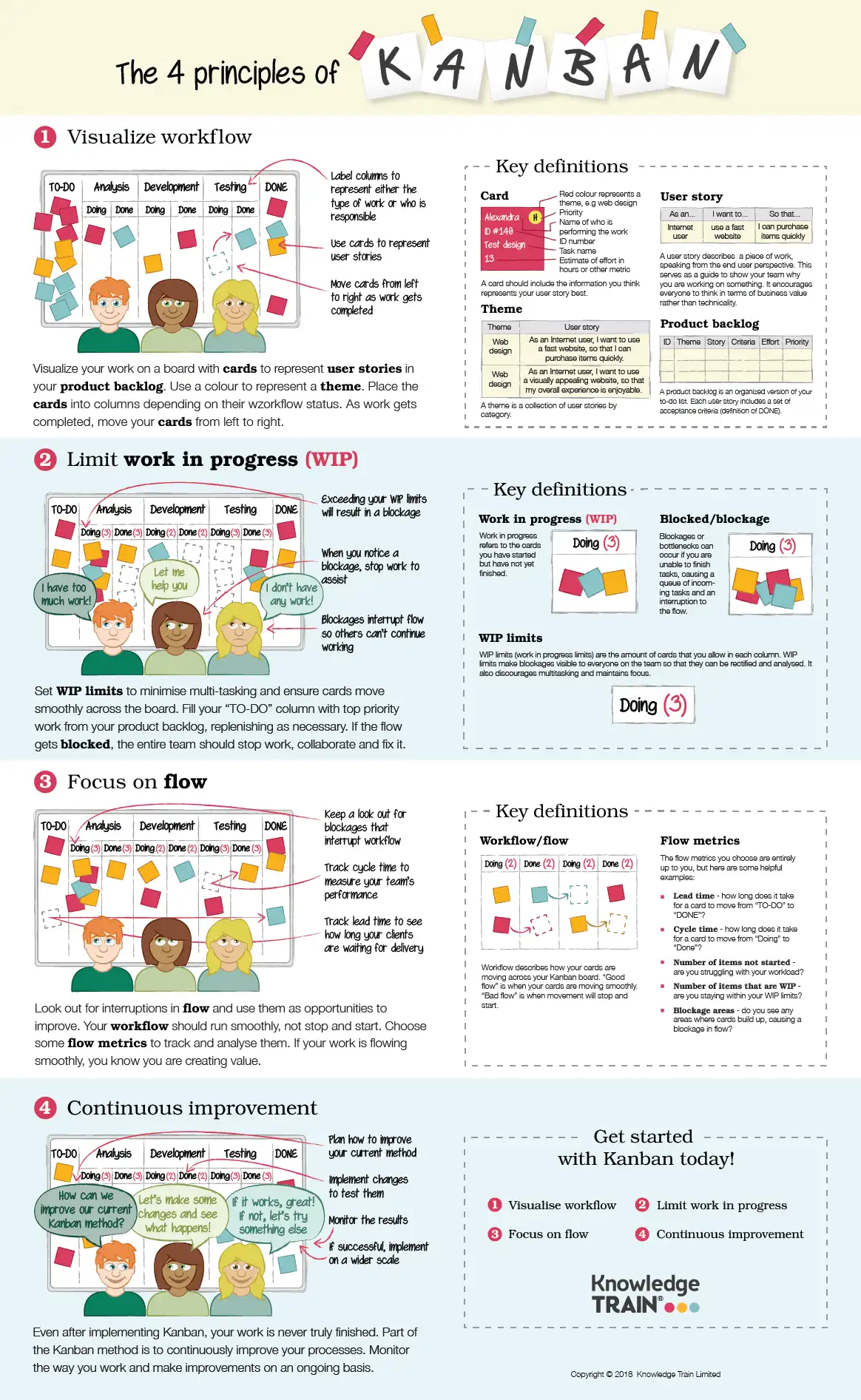
The graphic below was created to help you get a basic understanding of the 4 principles of Kanban. If you like it, please show your appreciation by linking back to this page.change curve
The 4 principles of Kanban
1. Visualize workflowSubscribe now
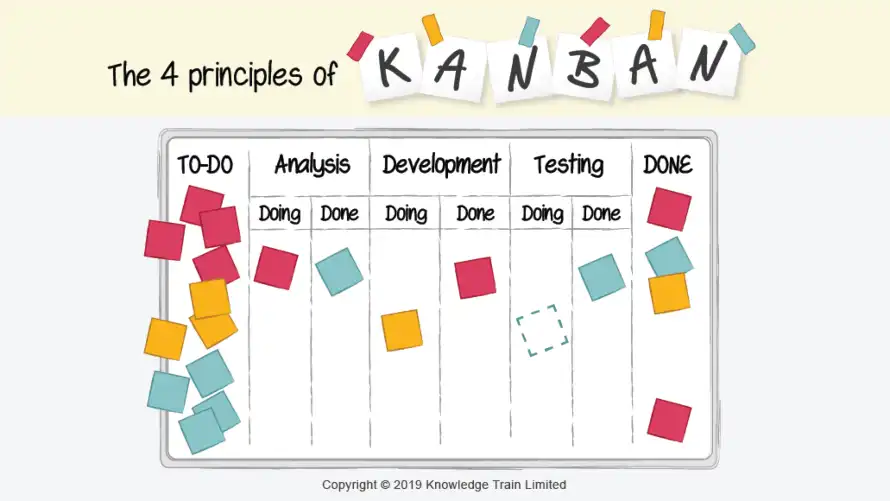
Visualize your work on a board with cards to represent user stories (work) in your product backlog (inventory). Use colours to represent the theme of your user stories . For a simple Kanban board, label one column “TO-DO” and another “DONE”. Label columns in between “TO-DO” and “DONE” to represent either the type of work or whoever is responsible for undertaking it. Split these columns into two and label “Doing” and “Done”. Place the cards into columns depending on their workflow status. Doing this enables the whole team to view work in progress, work that has been completed and work to be started next. As work gets completed, move your cards from left to right.{"@context":"https://schema.org","@type":"ImageObject","contentUrl":"https://www.knowledgetrain.co.uk/training-courses/change-management-model-kubler-ross-890x501.webp","description":"The Kubler Ross model is known as the change curve.","license":"https://www.knowledgetrain.co.uk/license","acquireLicensePage":"https://www.knowledgetrain.co.uk/license","creditText":"Knowledge Train","uploadDate":"2023-05-16T10:10:48.000Z","copyrightNotice":"© 2023 Knowledge Train Limited. All rights reserved.","creator":{"@type":"Organization","name":"Knowledge Train","url":"https://www.knowledgetrain.co.uk"}}
Top tip: Keep your column labels simple and intuitive.{"@context":"https://schema.org","@type":"ImageObject","contentUrl":"https://www.knowledgetrain.co.uk/training-courses/res/images/change-management/kubler-ross-model-change-management-800x4784.webp","description":"Kubler Ross Change Curve Infographic.","license":"https://www.knowledgetrain.co.uk/license","acquireLicensePage":"https://www.knowledgetrain.co.uk/license","creditText":"Knowledge Train","uploadDate":"2023-05-16T10:10:48.000Z","copyrightNotice":"© 2023 Knowledge Train Limited. All rights reserved.","creator":{"@type":"Organization","name":"Knowledge Train","url":"https://www.knowledgetrain.co.uk"}}
2. Limit work in progress (WIP)
Set a limit on how much work can be in progress at one time in each column. In other words, how many cards can be in each column at a given time. This ensures that cards are moving smoothly across the board as and when the team are ready for them.Related articles
Do the top priority work first
Your “TO-DO” column should be filled with top priority work from your product backlog. When you have a space in your “TO-DO” column, you can fill it with another user story from your product backlog.
By setting work in progress limits (WIP limits), the entire team can quickly see if there is a blockage and collaborate to fix it. Setting WIP limits eliminates multi-tasking, which is the ultimate productivity killer.
Top tip: Teams can assist other teams when bottlenecks are identified, regardless of expertise.
3. Focus on flow
By now, your work should flow freely through the Kanban system. It might even feel very easy! Make sure that you keep a lookout for any interruptions in flow and use these as opportunities for improvement. Workflow should run smoothly and not stop and start. Choose some flow metrics to track and analyse them. Which ones you choose are entirely up to you, but here are some helpful examples:
- Lead time – how long does it take for a card to move from “TO-DO” to “DONE”?
- Cycle time – how long does it take for a card to move from “Doing” to “Done”?
- Number of items not started Change management models– are you struggling with your workload?
- Number of items that are WIP Simon Buehring– are you staying within your WIP limits?23 Feb 2026
- Blockage areas – do you see any areas where cards build up, causing a blockage in flow?Discover popular change management models and their applications. Click through for colorful infographics and detailed descriptions.
Top tip: