How to become an Agile project manager

Key takeaways
Agile leadership shifts from directing work to enabling teams to deliver and improve.
- Move from task allocation to facilitation, helping self-organising teams remove blockers and access the right information.
- Use existing project management experience, but adapt it with lighter agile tools like Kanban or lean agile before full framework changes.
- In Scrum or SAFe, the focus becomes servant leadership, coaching, and communication rather than authority over tasks.
- Plan in rolling waves, keeping scope high-level early and adding detail only when needed.
- Reduce waste such as excessive documentation, long meetings, and multitasking, while using feedback, retrospectives, and velocity to forecast and improve.
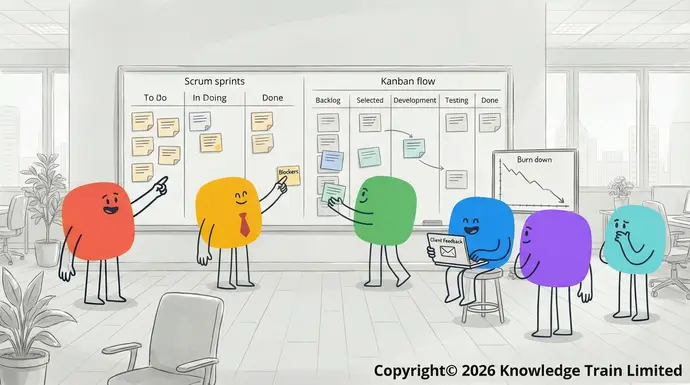
Agile comes in many shapes and forms. One of the great features of Agile is that it can be adapted to suit almost any context.
Not every agile method
Understanding the Agile mindset
If you are considering moving into an agile environment, the Agile Manifesto is a great way to understand the agile mindset and how it differs from other project management methodologies .
If you want some practical examples of how to make the move into Agile, here are a few tips:
- Understand that an agile project manager is no longer the primary authority of the project. Responsibility is now decentralized as everyone in the project is accountable for its success. While the project may have control points, responsibility is shared.
- Agile projects start with a high-level scope. Planning is done in ‘rolling waves’ i.e. higher-level plans and scope are progressively broken down into more details as the project progresses. Detailed requirements are added by product owners if/when needed.
- Agile project managers should ensure that documentation is kept to the minimum required for the team to do its job properly. Teams need documentation to help them understand what they must deliver, but also to help them reflect on past progress and make improvements.
- Proactively look out for risks in the development processes and make continuous improvements. Retrospective meetings are a good source of lessons to learn to identify areas that can be improved. You’ll need to implement regular improvements to the development process.
- Make forecasts using the current development speed. Work with the product owners to understand the scope and with developers to understand their development speed.
- Leverage the flexibility of Agile: Monitor project risks, address them as early as possible. Work proactively, not reactively.
- Communication is critical for the success of a project. It is also essential to the agile approach. Utilize low-tech communication methods such as whiteboards or burn-down charts and keep everyone informed about the status of the project.
- Keep upper-management away from your developers by mediating the project-level issues across the teams.
- Foster a collaborative environment that doesn’t punish small errors and rather encourages learning from mistakes.