What is the Association for Project Management (APM)?

Key takeaways
APM is the UK chartered professional body that sets expectations for project delivery and professional development.
- APM supports better project, programme, and portfolio outcomes through standards, guidance, and a shared professional language.
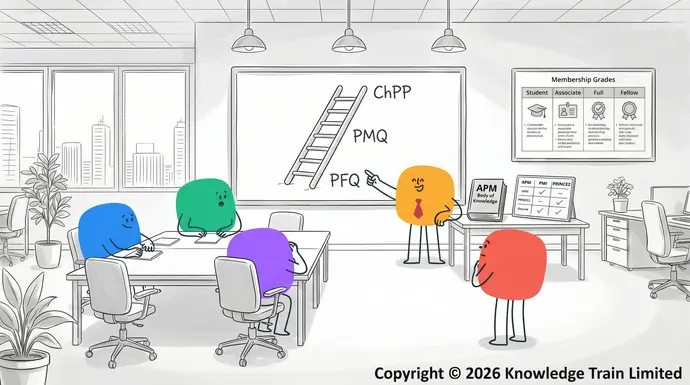
- PFQ builds fundamentals, PMQ validates broader knowledge, and ChPP recognises assessed competence and judgement in practice.
- The APM Body of Knowledge helps standardise terminology and strengthens governance, decision making, and capability building.
- Membership grades signal career progression and provide CPD resources, networking, and professional recognition.
- APM is different from PRINCE2 and PMI, and many professionals combine routes based on role scope and employer needs.
Key facts
The Association for Project Management (APM) is a United Kingdom based professional association for project management. It supports the profession through membership, qualifications, standards, and guidance such as the APM Body of Knowledge.
Not to be confused with: APM can also mean Applications Performance Monitoring or other industry acronyms. This page is about the Association for Project Management in the UK.
| Full name | Association for Project Management |
|---|---|
| Acronym | APM (acronym) |
| Organisation type | Professional association (professional body for project management) |
| Country | United Kingdom |
| Headquarters | Buckinghamshire, England (UK) |
| Mission | To advance the discipline of project management and support project professionals and organisations. |
| Core services | Professional membership, qualifications and certification, events and community, publications and guidance, Continuing Professional Development (CPD) |
| Flagship qualifications | APM Project Fundamentals Qualification (PFQ), APM Project Management Qualification (PMQ), Chartered Project Professional (ChPP) |
| Membership types | Student, Associate, Full, Fellow (grade availability and criteria vary) |
| Official website | https://www.apm.org.uk/ |
What APM does for project management in the UK
The Association for Project Management (APM) is the chartered professional body for project management in the United Kingdom. In practice, it works to improve how projects, programmes, and portfolios are delivered by providing a recognised qualifications framework, professional standards, and membership pathways for a
project manager and wider delivery roles.
APM’s activities commonly relate to:
- Professional membership and recognition, including progression through membership grades.
- Qualifications and certification that assess knowledge and professional competence.
- CPD expectations and learning resources to support ongoing capability.
- Guidance on project governance, ethics, and good practice.
- Community building through events, interest networks, and publications.
APM qualifications and certifications
APM qualifications are designed to support learning and professional development across different career stages, from introductory project management to more advanced competence assessment. The best starting point depends on your experience, the
project management methodology used in your organisation (for example PRINCE2 environments), and whether you need knowledge validation or professional recognition.
APM Project Fundamentals Qualification (PFQ)
- Purpose: Introductory certification covering key concepts, language, and foundational knowledge in project management.
- Who it is for: Beginners, new starters, and people who work with projects (including stakeholders) but are not yet project managers.
- Prerequisites: None.
- Format: Typically a short course plus a multiple choice exam.
- Outcomes: APM PFQ provides a baseline understanding of planning, roles, risk, and communication, supporting progression to more advanced study.
APM Project Management Qualification (PMQ)
- Purpose: Knowledge based certification aligned to the APM Body of Knowledge and common delivery practices.
- Who it is for: Practitioners who contribute to projects, including aspiring or current project managers.
- Prerequisites: No formal prerequisite, but some experience or prior study helps.
- Format: Assessed by a written exam.
- Outcomes: APM PMQ provides a stronger grasp of planning, governance, stakeholder management, and control, supporting improved performance in project delivery roles.
Chartered Project Professional (ChPP)
- Purpose: Competence based assessment recognising professional capability and judgement in project delivery.
- Who it is for: Experienced professionals working in project management, programme management, or portfolio management.
- Prerequisites: Demonstrable experience and evidence of professional practice, typically supported by membership and CPD.
- Format: Application with evidence and assessment (process can evolve over time).
- Outcomes: Professional recognition that you can apply good practice, leadership, and governance in real delivery contexts.
How APM qualifications relate to PRINCE2 and other methodologies
APM qualifications are generally methodology agnostic and focus on transferable principles and knowledge. PRINCE2 is a project management methodology used widely in the UK and beyond; many organisations use PRINCE2 alongside APM aligned learning. In practice, PRINCE2 may provide a structured method for managing stages and controls, while APM learning may broaden understanding across domains such as governance, stakeholder engagement, risk, and professionalism.
APM Body of Knowledge
The APM Body of Knowledge is a reference framework that describes key concepts, functions, and areas of knowledge used in project based work. It is used by learners, practitioners, trainers, and employers to build a shared language and improve capability across delivery roles.
It supports the profession by helping to:
- Standardise terminology across teams and organisations.
- Inform learning pathways and a qualifications framework.
- Provide a common basis for improving governance and decision making.
High level knowledge areas commonly associated with the APM Body of Knowledge include:
- Governance and organisational context, including project governance
- Planning and scheduling
- Risk, issues, and change control
- Quality management
- People, leadership, and teamwork
- Communication and stakeholder management
- Commercial and procurement considerations
- Integration across programme management and portfolio management
Membership
APM membership (professional membership) provides a way to demonstrate commitment to the profession and access support for career development. Membership criteria and naming can change over time, but grades typically align to experience and contribution.
Typical APM membership grades
- Student: For people in education who are building foundational knowledge.
- Associate: For early career professionals and those developing competence.
- Full: For experienced practitioners who meet defined experience and professionalism requirements.
- Fellow: Senior recognition for significant contribution and leadership in the profession.
Common member benefits
- Access to learning resources that support Continuing Professional Development (CPD).
- Professional recognition and use of post nominal designations where applicable.
- Networking through events, branches, and special interest groups.
- Publications and guidance supporting better project delivery and governance.
- Career support, including frameworks and pathways for project roles.
Chartered status and what it means
APM holds chartered status (chartered body) as the professional body for project management in the UK. In general, chartered status signals formal recognition and a public interest role in maintaining standards, professionalism, and development routes within a discipline.
For individuals, chartered recognition is commonly associated with assessed competence, professional behaviours, and continuing development rather than only passing a knowledge exam.
APM vs PMI
Some people compare APM with the Project Management Institute (PMI) when deciding on training, certification routes, or professional membership. Both support project management, but they have different histories, geographies, and qualification portfolios.
| Factor | APM (UK professional body) | PMI (global professional body) |
|---|---|---|
| Geography focus | United Kingdom centred, with wider international reach through members and partners | International membership and certifications used globally |
| Common certifications | PFQ, PMQ, ChPP | PMP (Project Management Professional) and other PMI credentials |
| Primary emphasis | Professional body, membership grades, standards, and UK chartered role | Professional body with a broad certification ecosystem and global communities |
| Terminology and frameworks | APM Body of Knowledge oriented language in many UK contexts | PMI standards and terminology used widely across industries |
| Typical audiences | UK based project professionals, employers, and sectors using APM aligned frameworks | Project professionals seeking globally recognised certification such as PMP |
If you work in a PRINCE2 environment, you may still choose APM or PMI learning depending on organisational expectations, role scope (project, programme, portfolio), and your preferred certification path.
APMG Change Management
Sources
- APM official website: membership, qualifications, chartered information, and publications.
- General reference entry for Association for Project Management for high level organisational facts.
- UK professional standards and governance references where relevant to chartered bodies.
FAQs
What does APM stand for in project management?
In project management, APM most commonly stands for the Association for Project Management, the United Kingdom based professional association for the project profession. Because APM is also used in other industries, it is worth confirming the context, especially in IT where APM can refer to Applications Performance Monitoring.
What is the Association for Project Management (APM)?
The Association for Project Management (APM) is the chartered professional body for project management in the United Kingdom. It supports the profession through membership (professional membership), CPD, standards and guidance such as the APM Body of Knowledge, and a qualifications framework that includes certifications like PFQ, PMQ, and Chartered Project Professional.
What does APM do?
APM advances project management by setting professional expectations, providing training aligned qualifications and certification, supporting CPD, and publishing guidance on topics such as project governance and stakeholder management. It also connects members through events, communities, and resources that help individuals and organisations improve project, programme, and portfolio delivery.
Is APM a chartered body?
Yes. APM holds chartered status as the professional body for project management in the UK. Chartered status indicates formal recognition of a professional body’s role in promoting standards and competence. For individuals, APM also provides chartered style professional recognition through routes such as Chartered Project Professional (ChPP).
What qualifications does APM offer?
APM offers a range of project management qualifications and certifications including the Project Fundamentals Qualification (PFQ) for beginners, the Project Management Qualification (PMQ) for broader knowledge assessment, and Chartered Project Professional (ChPP) for experienced practitioners. These routes align with APM guidance and support development across project, programme, and portfolio roles.
How do I join APM membership?
You typically join by choosing a membership grade that matches your career stage, such as Student, Associate, Full, or Fellow, then applying through the APM website. Requirements can include experience evidence and commitment to CPD for higher grades. Check current criteria directly with APM, as grades and requirements may change.
Is APM equivalent to PMI or PMP?
APM and the Project Management Institute (PMI) are different professional bodies. PMP (Project Management Professional) is a PMI certification, not an APM qualification. They are not direct equivalents, but both can be valuable depending on your location, employer expectations, and whether you need UK aligned chartered recognition or a widely used global certification route.
Is APM better than PRINCE2?
APM and PRINCE2 are not like for like. APM is a professional association offering membership, standards, and qualifications, while PRINCE2 is a project management methodology. Many professionals use both: PRINCE2 for method and controls, and APM learning for broader professional knowledge including governance, stakeholder management, and development pathways.
What is the APM Body of Knowledge used for?
The APM Body of Knowledge is used as a reference for learning and consistent practice across the profession. It supports a shared understanding of key topics such as governance, planning, risk, quality, people, and stakeholder management. It is often used by trainers, learners, and employers to structure development and align capability.
Does APM cover programme and portfolio management?
Yes. While APM is often associated with project management, its guidance and professional development coverage extends to programme management and portfolio management. This reflects how organisations govern and deliver change at different levels, linking individual projects to strategic objectives through structured governance, benefits focus, and stakeholder engagement.