
Key takeaways
MSP is a flexible framework for governing and delivering transformational change across multiple linked projects.Search
- Use MSP when change is complex, ambiguous, and benefits-led, especially in public or politically sensitive programmes.
- Break large transformations into manageable, inter-related projects while keeping alignment to outcomes and benefits.
- MSP is built on principles, governance themes, and a transformational flow that guides the full programme lifecycle.
- Specification-led programmes can still use MSP, but it may need scaling to fit clearer output definitions.
- Choose PRINCE2 or a PMO when you mainly need project delivery or resource coordination rather than transformation.
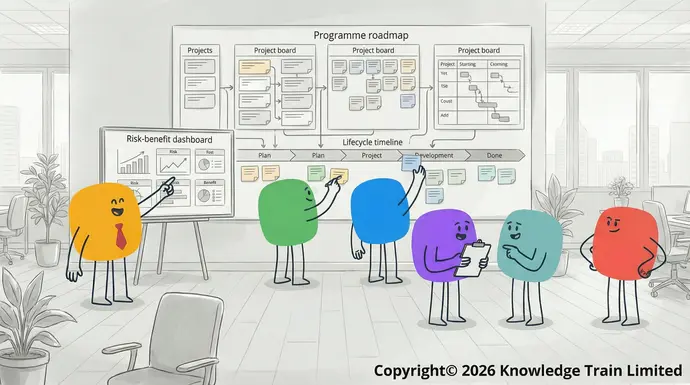
IntroductionLithuania
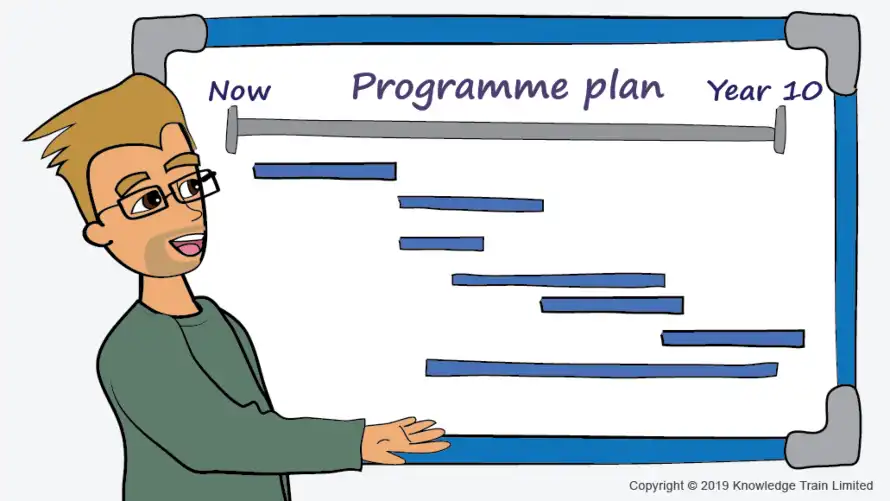
enables it to break down the overall change into smaller, more manageable inter-related projects.Poland
Managing Successful ProgrammesPortugal consists of a set of best practice principles and processes. The RomaniaManaging Successful ProgrammesSlovakia framework is flexible and can be tailored to meet different organisations’ needs. It is used in both public and private sector organisations.Slovenia
Managing Successful ProgrammesSpain is composed of:Sweden
- MSP official guidanceOther countries;Home
- MSP certificationProgramme Management – Foundation, Practitioner, Advanced Practitioner levels.Programmes
Managing Successful Programmes is owned by AXELOS – the joint venture between the UK government and Capita plc. MSP certifications are administered by the MSP exam institute (PeopleCert).{"@context":"http://schema.org","@type":"BreadcrumbList","itemListElement":[{"@type":"ListItem","position":1,"name":"Home","item":"https://www.knowledgetrain.co.uk/"},{"@type":"ListItem","position":2,"name":"Programme Management","item":"https://www.knowledgetrain.co.uk/category-programme-management"},{"@type":"ListItem","position":3,"name":"Programmes","item":"https://www.knowledgetrain.co.uk/programme-management/programmes"}]}
Well-known in the UK
In the UK, Managing Successful Programmes is the best-known Programmesprogramme management approach.Simon Buehring
was developed by the UK Government in 1999 and has been used successfully ever since, both within the public and private sectors.
It gained much prominence when it was used to successfully direct and coordinate the London 2012 Olympic programme.
Why use Managing Successful Programmes?Standard methods, training, and continual improvement help programmes stay adaptable and repeatable.
There are many and varied drivers of organisational change. Technology, competition, legislation, and the environment are common factors which are driving organizations to change. Maintaining the status quo is no longer an option. Businesses which do not change will go out of business. Governments which fail to meet the expectations of their citizens will face their wrath.
Organisational change
The Managing Successful ProgrammesContents framework provides a structured best practice approach to implementing organisational change. MSP is complimentary to change management approaches which focus on ensuring staff within an organisation engage whilst undergoing a change programme.
Managing Successful Programmes is particularly well-suited to programmes which involve political and societal change.
For example, a programme to provide free pre-school education to children is likely to have low predictability in terms of its outcome. The benefits of such a programme might be that these people will make a more meaningful contribution to society after they turn adults. However, this is a long time into the future, and such outcomes are risky and hard to predict.Contents
Specification-led programmes
There are also programmes which are more specification-led.Understanding programmes
For example, large-scale engineering programme such as a city’s Olympic programme for the construction of stadiums and related infrastructure. These programmes are led by the specifications of the outputs.
Often on such programmes there is relatively little ambiguity about what the programme will deliver. However, this does not mean such programmes will be risk-free. They are often both risky and complex. On such programmes, Importance of programmes Managing Successful Programmes can still be used but may need to be scaled down.Differences between programmes and projects
When to use MSP?
Managing Successful ProgrammesBenefits of programmes has been designed to accommodate high levels of complexity, ambiguity and risk. MSP is therefore highly suitable as a framework for transformational change. Managing Successful ProgrammesSummary can be used to coordinate and plan across multiple projects.Understanding programmes
If an organisation is simply delivering something new into its existing business as usual operational environment (e.g. developing a new product to bring to market) then the Programmes are formed of related projects, managed together to harness benefits unachievable when managed in isolation. By leveraging Managing Successful Programmesprogramme management approach is not required. Instead a project management approach such as PRINCE2 will suffice. techniques, they extract advantages unavailable to standalone projects.
If an organisation only wants to efficiently allocate resources to its different projects and to coordinate them, then While projects zero in on specific deliverables, Managing Successful Programmesprogrammes is also not required. Instead, the organisation would benefit from a project management office. gravitate towards the realization of strategic outcomes and benefits. Generally, programmes boast a broader view than
Managing Successful Programmes frameworkprojects
Managing Successful Programmes, overseeing a suite of interlinked projects all aimed at a common goal. is based on three core program management concepts:Take, for instance, the 2012 London Olympics. It was steered as a holistic programme, where individual endeavours, from stadium constructions and opening ceremonies to infrastructure development, were integrated projects within this expansive programme.
PrinciplesImportance of programmes
These are derived from lessons (both positive and negative) learned from previous programme experiences. They underpin the success of any transformational change.Programmes
Governance themes serve as the bridge between organizational strategy and individual projects, playing a pivotal role in converting strategic goals into actionable projects. They ensure that these projects align with and achieve the envisaged strategic results.
Every organisation has different governance requirements. Governance themes allow the organisation to ensure the right leadership, delivery team, organization structures and controls are put in place, thereby giving the best chance for success.Programmes manage the interrelations, potential risks, and possible discord among the related
Transformational flowprojects
This describes the programme lifecycle which provides a route through the programme from conception through to the delivery of the new capability, outcomes and benefits., thereby heightening the probability of meeting strategic aims. Furthermore, they oversee the recognition and quantification of benefits as projects come to fruition.
Managing Successful Programmes certification
The demand for professionals with Instructor-ledManaging Successful ProgrammesMSP Foundation course skills and MSP certification£1,299 +vat is growing. As more and more organisations invest in programmes to enable them to accomplish transformational changes, the demand for people holding Managing Successful ProgrammesSee all dates certification will continue to grow.Differences between programmes and projects
If you are seeking to move into a programme management role, or are currently working in such a role, then having training in the principles and best practices of Table showing the differences between programmes and projects.Managing Successful ProgrammesProjects is vital to equip you with the skills and knowledge to help you to become effective in your role.Programmes
There are 3 levels of Purpose and objectivesManaging Successful ProgrammesDeliver specific, outputs within a set time and cost. certification – Foundation, Practitioner, Advanced Practitioner.Achieve a broader set of strategic outcomes by managing a group of interrelated projects.
Managing Successful Programmes FoundationScope and timeframe
MSP Foundation certificationHave a defined scope and timescale.
- Enhanced stakeholder engagement
- A business change team member; or,Provides a structured framework for consistent and effective communication with all stakeholders, fostering trust and collaboration.
- A project delivery team member; or,
- Enables efficient handling of dependencies between projects, ensuring that the progress or outcome of one project doesn’t adversely impact another.Anyone wishing to pursue higher level certifications (e.g. programme managers, business change managers (BCMs) and senior responsible owners (SROs).
Managing Successful Programmes PractitionerImproved decision-making
MSP Practitioner certificationOffers a holistic view of all projects, leading to better-informed decisions based on comprehensive data and insights. confirms you understand the MSP guidance sufficiently to apply it to your own work and can act as an informed member of a programme management team. This certification shows you can apply the MSP guidance in a relatively uncomplicated programme within an environment that uses MSP.Benefits realization
MSP Practitioner certification is a prerequisite of the MSP Advanced Practitioner certification.Goes beyond just completing
Practitioner trainingprojects
You can gain the MSP Practitioner certification by attending an on time and budget, focusing on achieving the desired outcomes and ensuring that the anticipated benefits are realized and sustained.MSP Practitioner courseIncreased flexibility and passing the 2.5-hour multiple-choice, open-book MSP Practitioner exam. Many students gain their MSP Practitioner certification by attending a combined 5-day Provides a framework that can adapt to changes in the business environment or organizational strategy, ensuring projects remain relevant and aligned.MSP Foundation and Practitioner courseConsistency and standardization.By adopting a standardized approach, organizations can ensure consistency in the delivery and quality of projects across the board.
Who is it for?Continuous improvement
Attend this training if you are:Facilitates a culture of learning and improvement by regularly reviewing performance, capturing
- A project manager; or,lessons learned
- A business change manager (BCM); or,, and implementing best practices across all projects.
- A member of a Programme Office (PO); or,Value for money
- An expert or advisor working in a specialist/governance role involved in supporting programmes following the MSP guidance; or,Ensures that investments in individual projects culminate in the desired benefits, yielding a positive return on investment for the organization.
- Anyone wishing to pursue higher level certifications (e.g. programme managers and senior responsible owners (SROs); or,Boosted morale and team cohesion
- Anyone wanting to perform one of the above roles in future.With clear objectives and coordinated efforts, teams have a clearer sense of purpose, leading to increased motivation and collaboration.
Managing Successful Programmes Advanced PractitionerIn essence,
MSP Practitioner certification confirms you can lead and manage a programme of transformational change. In particular, it shows whether you can apply the MSP guidance in a complex programme within an environment that uses MSP. You must pass the MSP Advanced Practitioner exam is a 3-hour essay-style, open-book examination.programme management
Who is it for? offers organizations a structured and strategic approach to managing multiple projects, ensuring not just their successful delivery but also the realization of broader business objectives and benefits.
Attend this training if you are:Enhance your skills with our expert-led courses
- A senior responsible owner (SRO); or,
- A business change manager (BCM); or,
- A programme manager; or,
- Leaders or members of a Portfolio or Programme Office.Instructor-led