
- Recovery: Restoring systems and data following an incident through backups and patching vulnerabilities.
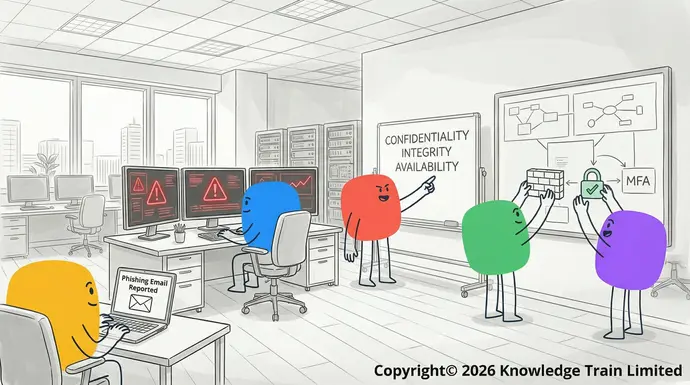
The CIA Triad underpins all cybersecurity strategies: ensuring confidentiality (only authorised access), integrity (accuracy of information), and availability (information accessible when needed).
Types of cybersecurity
| Type | Description |
|---|---|
| Network security | Protects data during transfer between devices and prevents unauthorised access to networks using firewalls, intrusion detection, and encryption. |
| Application security | Ensures applications are resistant to threats by identifying and mitigating vulnerabilities in software. |
| Endpoint security | Secures devices such as computers, laptops, tablets, and mobiles from threats. |
| Cloud security | Protects data, applications, and infrastructures involved in cloud computing from breaches and leaks. |
| Information security | Protects the confidentiality, integrity and availability of data regardless of its format. |
| Operational security | Establishes policies and procedures for handling and protecting data assets. |
Common cybersecurity threats
- Malware: Malicious software such as viruses, worms, ransomware, and spyware.
- Phishing: Fraudulent messages designed to trick users into disclosing sensitive information.
- Follow cyber hygiene routines and educate staff about social engineering risks.
- Develop an incident response plan and conduct regular security training.
- Adopt a zero trust approach by continuously verifying devices and users.
Cybersecurity roles and careers
The demand for cybersecurity professionals continues to grow. Typical roles include:
- Security analyst
- Penetration tester (ethical hacker)
- Security architect
- Incident responder Request a quote
- Chief Information Security Officer (CISO)
Qualifications such as CISSP, CompTIA Security+, and NIST Framework knowledge are often required for advancement.
Cybersecurity vs information security[email protected]
While cybersecurity +44 (0)207 148 5985 focuses on protecting digital assets from cyber threats, Coursesinformation securityPROJECT MANAGEMENT encompasses the protection of all information assets, both digital and physical. Cybersecurity is thus a subset of information security.PRINCE2
Glossary of key cybersecurity entities®
- Malware:Foundation Harmful software aimed at damaging or stealing data.Learn the fundamentals of the PRINCE2 method.
- Firewall:Practitioner Hardware or software for controlling traffic based on security rules.Includes Foundation & Practitioner combined option.
- Encryption:Association for Project Management (APM) Transforming data so it is unreadable without a key.Project Fundamentals Qualification (PFQ)
- Phishing:Start your APM project management career. Deceptive messages to acquire sensitive data.Project Management Qualification (PMQ)
- Zero trust:Advance your APM project management expertise. Security approach requiring all users be continuously verified.Project Risk Single Certificate Level 1
- NIST:Enhance your project risk management skills. US National Institute of Standards and Technology, provider of key cybersecurity frameworks.AgilePM
- CIA Triad:® Confidentiality, Integrity, Availability – three core cybersecurity goals. – Agile Project Management
- Intrusion detection:Foundation Identifying unauthorised activity on networks or systems.Learn the key principles of Agile Project Management.
- Vulnerability:Practitioner Weakness in a system that may be exploited by threats.Includes Foundation & Practitioner combined option.
- Incident response:PRINCE2 Organised approach to addressing and managing security incidents.®
FAQs Agile
What is cybersecurity in simple words?Foundation
Cybersecurity means protecting computers, networks, and data from unauthorised access and attacks to keep them secure and private.Learn the fundamentals of the PRINCE2 Agile method.
What are the main types of cybersecurity?Practitioner
The main types are network security, application security, endpoint security, cloud security, and information security.Includes Foundation & Practitioner combined option.
What are the top cybersecurity threats?AI Project Governance Framework (AIPGF)
Major threats include malware, phishing, ransomware, social engineering, data breaches, and zero-day exploits.Foundation
How is information security different from cybersecurity?Learn the fundamentals of the governance framework.
Information security covers protection of all types of information, while cybersecurity is focused specifically on securing digital data and systems from cyber threats.Practitioner
How can individuals and organisations protect themselves?Includes Foundation & Practitioner combined option.
Use unique strong passwords, enable multi-factor authentication, regularly update software, guard against phishing, use antivirus and firewalls, and maintain data backups.
What is the CIA Triad in cybersecurity?Better Business Cases
The CIA Triad refers to the three core principles: confidentiality, integrity, and availability, which all security measures aim to protect.™
What does a cybersecurity professional do?Foundation
A cybersecurity professional safeguards networks and systems from attacks, detects vulnerabilities, manages incidents, and ensures compliance with security policies.Learn the fundamentals of Better Business cases.