
What is certification? View courses
Certification is the process by which a person, organisation, or product is formally recognised as meeting specific standards or requirements, usually through evaluation by an independent Enrol now certifying body or professional organisation . Gaining a certificate typically requires passing an Overviewexam or assessment, demonstrating certain skills or competency , and often maintaining standards through Comparerenewal or continuing education .Delivery
Comparison: Certification, accreditation, licence, and credential
| Term | Definition | Awarded ByEnrol | Example |
|---|---|---|---|
| Certification | |||
- Employability:Best for Enhances job prospects and professional reputation.Prerequisites
- Professional development:Duration Supports career progression and commitment to lifelong learning through Delivery optionscontinuing educationExam included.Exam format
- Recognition:Qualification gained Recognised by employers, customers, and peers as evidence of capability.View courses
Types of certifications
- Professional certification: Awarded by professional bodies or organisations in fields such as project managementFoundation, finance, See courseIT , or healthcare. Examples include certifications from ANSI or Anyone working in or with IT and digital services who needs a clear understanding of ITIL 4 concepts, practices, and the service value system.state boards .None
- Academic certification: Issued by educational institutions after completing a course of study or passing qualifying exams – for instance, university 3 days or 16 hourscertificates and diplomas.Instructor-led, Self-paced
- Technical certification: Validates competency in technical or vocational areas like IT, electrical work, or health and safety. Managed by certifying bodies, sometimes requiring assessment at a test centre.ITIL Foundation exam
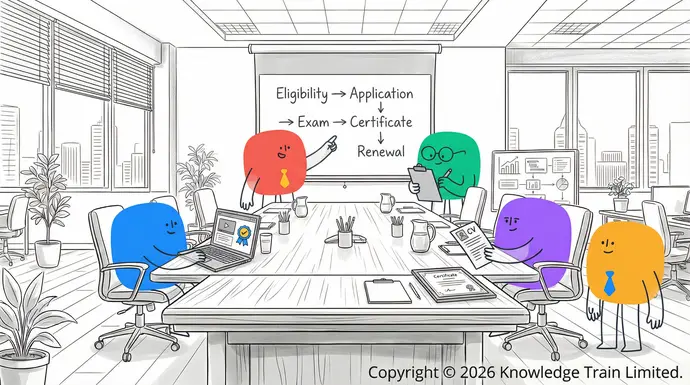
How to get certified
- Eligibility:60 minutes, multiple choice Confirm you meet any prerequisites, such as specific qualificationsITIL 4 Foundation Certificate, training, or work experience. These are outlined by the certifying body or governing bodyFoundation.
- Application:ITIL 4 Specialist - CDS Submit your application and supporting evidence (e.g. qualifications, training records). Pay applicable fees.See course
- Exam/Assessment: Pass a formal exam or practical assessment, usually held at a test centre or digitally. The assessment measures your knowledge or practical abilities against industry standards.Service desk, operations, support, and service owners who focus on designing, running, and improving end-to-end service delivery.
- Validation and recognition: Successful candidates receive a certificate as proof of certification, which can be validated by employers and professional organisations.ITIL 4 Foundation
- Renewal: Many certifications require regular renewal, either by re-examination, showing continuing education, or completing professional development activities.3 days
Costs involved in certification
The cost of obtaining certification varies. Typical expenses may include application fees, exam fees, training costs, and renewal charges. Some certifying bodies or professional organisations may offer discounts for members or bulk applications.Instructor-led
Key certifying bodies and their roles
- ANSI (American National Standards Institute):ITIL 4 Specialist – CDS exam Oversees development of standards and accredits certification programmes ensuring conformity to industry standards.
- ISO (International Organization for Standardization):1.5 hours, multiple choice International body setting global benchmarks for certification and quality assurance across industries.
- State boards/governing bodies:ITIL 4 Specialist Certificate Regulate professions such as medicine, law, or teaching, often requiring official licencesSpecialist: CDS or certifications to practise legally.
- Professional organisations: Award and manage industry-specific certifications (e.g. engineering, accountancy, ITITIL 4 Specialist - DSV) and establish up-to-date requirements for practice via continuing education and assessment.See course
Key facts about certification
- Definition: Formal recognition of meeting specific standards through evaluation.
- Examples:Service managers, customer success, account management, and anyone responsible for customer journeys, experience, and value co-creation. Project management certificate, occupational Health & Safety certification, IT professional certificate.
- Process:ITIL 4 Foundation Eligibility -> Application -> Exam/Assessment -> Validation -> Renewal.
- Duration:3 days Validity typically ranges from 1 to 5 years, with renewal processes in place.
- Top certifying organisations:Instructor-led ANSI, ISO, various state boards, and leading professional organisations.
FAQsITIL 4 Specialist – DSV exam
What is a certification?
A certification is formal recognition awarded by an independent certifying body, confirming that an individual has met specific knowledge and skill standards through assessment or an exam.1.5 hours, multiple choice
How do you get certified?
To get certified, you must meet eligibility requirements, apply to a certifying body, pass the designated exam or assessment, and complete any required training or continuing education. Renewal may also be required.ITIL 4 Specialist Certificate
How long does a certification last?
The validity of certification varies by profession and certifying body, but typically lasts between 1 and 5 years. Renewals may involve continuing education or re-examination.Specialist: DSV
Is certification the same as a license?
No, certification and licence are different. A licence is a legal authorisation from a governing body to practise an occupation. Certification recognises achievement of a standard but does not, by itself, grant legal authority to practise.ITIL 4 Strategist - DPI
Are certifications worth it?See course
Yes, certifications can enhance your career prospects, validate your skills, promote professional development, and increase your credibility in an industry. However, their value may depend on the field and employer requirements.