The 4 Kanban principles: A visual guide

Key takeaways
Kanban helps teams manage work visually, reduce waste, and improve delivery through steady flow.
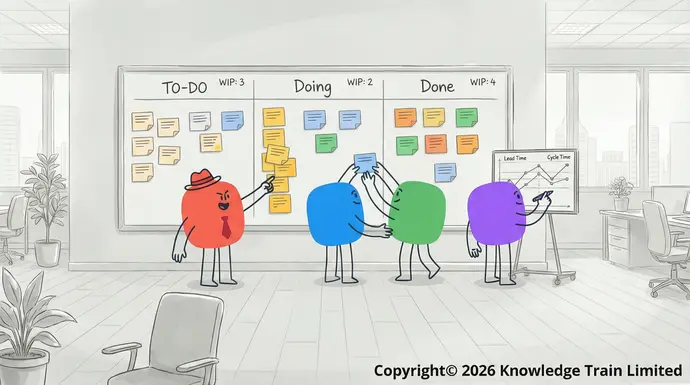
- Make work visible on a board so every character can spot progress, priorities, and problems quickly.
- Use a pull system so new work starts only when there is capacity, preventing queues and overload.Which is better, PMI-ACP
- Set WIP limits per column to reduce multitasking and expose bottlenecks early.®
- Focus on flow by watching for stoppages and tracking simple measures like lead time and cycle time. or PMI-PMP
- Continuously review the board and adjust the process so improvements become routine, not occasional.®
IntroductionKnowledge Train
Kanban is discussed on many 19 Feb 2026agile courses , including a Dive into the world of project management lessons learned and transform your future endeavours. In this article, you’ll uncover the key benefits of reflecting on past experiences, gaining valuable insights, and improving your project management skills.PRINCE2 Agile course and Agile Project Management course .
What is Kanban?
Developed by Toyota
Kanban is a highly visual work management method, developed in Japan in the late 1940’s by Toyota engineers. The word Kanban roughly translates in Japanese as “visual card”.
Limiting wasteProject management: fundamentals, methodologies and best practices
By displaying cards on a board, a team can easily display a workflow to everybody involved in the team. The fundamental benefit of working in this way is that any disruptions to workflow are easily identified, and team members can collaborate to rectify issues before they get out of control.
The approach also limits the amount of work in progress, thereby minimising any build-up of tasks which wastes time and money.Simon Buehring
Pulling work28 Apr 2026
Kanban is based on a pull rather than a push system. This means that team members only start work when they have capacity, rather than work being pushed to them with the potential of getting piled up. Kanban can be a valuable tool when managing projectsProject management is the discipline of planning, organising, and controlling resources to achieve specific goals within a defined timeline and budget. Learn the key processes, methods, roles and skills vital for successful project delivery. that require deliverables frequently and is also a popular choice for software development teams.
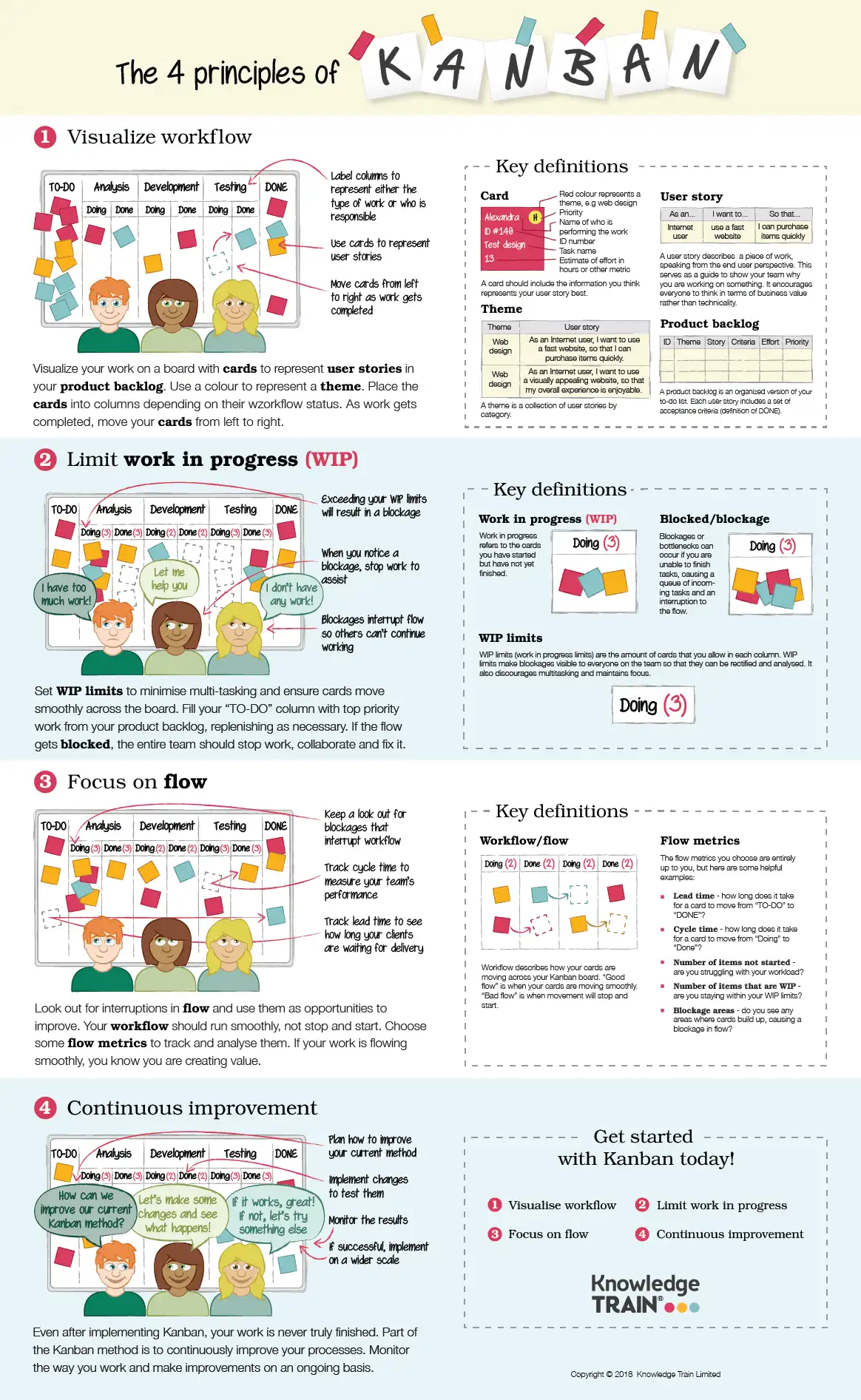
The graphic below was created to help you get a basic understanding of the 4 principles of Kanban. If you like it, please show your appreciation by linking back to this page.
The 4 principles of Kanban
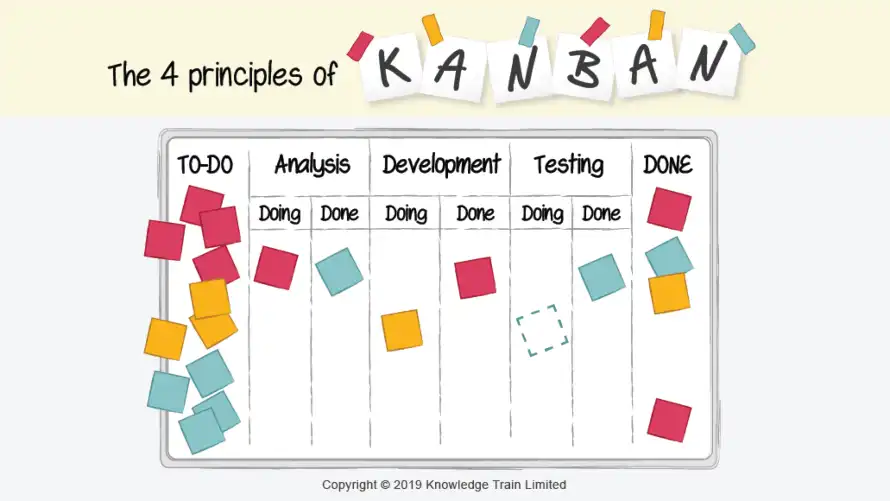
19 Feb 2026. For a simple Kanban board, label one column “TO-DO” and another “DONE”. Label columns in between “TO-DO” and “DONE” to represent either the type of work or whoever is responsible for undertaking it. Split these columns into two and label “Doing” and “Done”. Place the cards into columns depending on their workflow status. Doing this enables the whole team to view work in progress, work that has been completed and work to be started next. As work gets completed, move your cards from left to right.
Top tip: Consider the impact of diversity and inclusion in your project teams. Learn how to harness these aspects for better decision-making. Read on for professional insights.Keep your column labels simple and intuitive.
Set a limit on how much work can be in progress at one time in each column. In other words, how many cards can be in each column at a given time. This ensures that cards are moving smoothly across the board as and when the team are ready for them.
Do the top priority work first
Your “TO-DO” column should be filled with top priority work from your product backlog. When you have a space in your “TO-DO” column, you can fill it with another user story from your product backlog.
By setting work in progress limits (WIP limits), the entire team can quickly see if there is a blockage and collaborate to fix it. Setting WIP limits eliminates multi-tasking, which is the ultimate productivity killer.Project management CV
Top tip: Teams can assist other teams when bottlenecks are identified, regardless of expertise.Knowledge Train
3. Focus on flow23 Feb 2026
By now, your work should flow freely through the Kanban system. It might even feel very easy! Make sure that you keep a lookout for any interruptions in flow and use these as opportunities for improvement. Workflow should run smoothly and not stop and start. Choose some flow metrics to track and analyse them. Which ones you choose are entirely up to you, but here are some helpful examples:
- Lead time Write a project management CV that helps you stand out from the crowd. This guide will show you how to present your skills and achievements. Keep reading to give your job application a boost.– how long does it take for a card to move from “TO-DO” to “DONE”?
- Cycle time – how long does it take for a card to move from “Doing” to “Done”?
- Number of items not started – are you struggling with your workload?
- Number of items that are WIP – are you staying within your WIP limits?
- Blockage areas – do you see any areas where cards build up, causing a blockage in flow?
Top tip: Smooth flow = creating value
4. Continuous improvement
Remember that even after implementing Kanban, the work is never truly finished. Part of the Kanban method is to continuously improve your processes. Monitor your Kanban system and make improvements on an ongoing basis.
Conclusion
By following these 4 principles, you should have enough of an overview to get yourself started with a Kanban board and some cards to represent your user stories .
For some teams, Kanban may be all they need to effectively manage their day to day development. Kanban ensures that there is a seamless flow to your production line regardless of the type of work you do. However, you might like to use Kanban alongside a good Scrum framework , which will provide even more structure and organisational improvements.