- : Helps individual projects by giving project managers both guidance and best practices.
- Programme Management Office : This office supervises projects that align with a particular program while managing their interdependencies and resolving conflicts.
- Portfolio Management Office : Manages all projects and programmes within the portfolio while distributing resources and setting initiative priorities according to strategic goals.Marketing
- Enterprise-level PMO : Integrates project management activities with the comprehensive strategic aims and targets of the entire organisation throughout all departments.
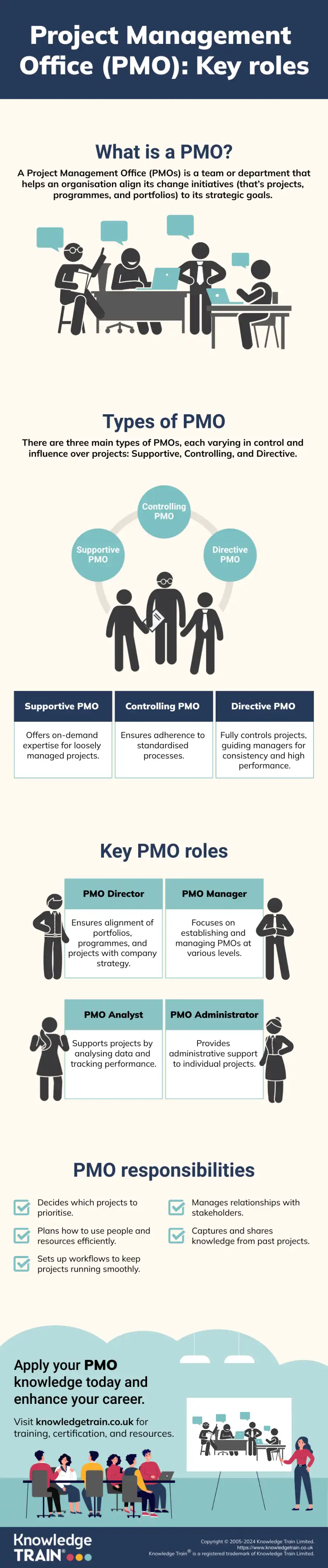
- Supportive PMO : This functions as a consultative resource that delivers guidance and support for project managers whenever required.Marketing
- Controlling PMO : Ensures adherence to project management processes and standards and conducts reviews to approve project plans.
- Directive PMO : Holds decision-making power over projects while managing resources and budgets.
Different PMO types fulfil specific organisational requirements and structural demands. The appropriate selection depends on multiple variables including the size of the company, the specific industry sector, and the strategic goals set by the organisation.
Key PMO roles and responsibilities
PMO directorThe technical storage or access is required to create user profiles to send advertising, or to track the user on a website or across several websites for similar marketing purposes.
The PMO director Manage options holds a senior executive position with responsibilities which include:Manage services
Statistics
The technical storage or access that is used exclusively for statistical purposes.
The technical storage or access that is used exclusively for anonymous statistical purposes. Without a subpoena, voluntary compliance on the part of your Internet Service Provider, or additional records from a third party, information stored or retrieved for this purpose alone cannot usually be used to identify you.
View preferences
- Save preferences
- View preferences
{title}
- {title}{title}
- Manage consentManage consent
xplore the key benefits:
Real-time visibility across the enterprise
Organisations gain access to unified data collection from diverse sources alongside customised dashboards tailored for various stakeholders and current project performance insights through PMOs.
Improved visibility leads to faster problem detection and more efficient decision-making.
Reduced project resourcing costs
PMOs achieve cost savings by strategically scheduling project resources which prevents costly last-minute hiring and ensures projects finish on time thereby increasing customer satisfaction.
Optimal resource utilisation
PMOs boost resource efficiency by monitoring future resource requirements and predicting usage patterns while actively transferring resources from non-billable tasks to billable work and addressing both underutilisation and overutilisation problems.
The strategy ensures maximum productivity while protecting employees from burnout.
Improved business decision-making
PMOs improve decision-making by tracking KPIs and metrics to supply data-driven strategic insights while identifying future trends and potential challenges proactively.
The capabilities enable informed decision-making throughout all levels of the organisation.
Future-proofing the workforce against market volatility
PMOs enable organisations to adapt to market shifts through capacity planning for resource forecasting and establishing an ideal balance of permanent and contingent employees while creating strategies to handle risks in fluctuating market conditions.
The proactive approach strengthens both organisational flexibility and durability.
Organisations that utilise these advantages will achieve greater project management strengths and operational efficiency while reaching their strategic goals more successfully.
Establishing a successful PMO
Building an effective PMO demands precise planning combined with accurate execution. This step-by-step guide will help you create a successful PMO by following clear directives.
Assess current project management state
To evaluate project management effectiveness, you must review current practices and methodologies while identifying strengths and improvement areas along with collecting feedback from project teams and stakeholders.
Define PMO purpose and objectives
A PMO requires a clear operational foundation through establishing its purpose and objectives which align with organisational strategy while defining its project management enhancement role and creating measurable objectives.
Recruit the right professionals
You need to assemble a high-performing team through the recruitment of experienced project management professionals who possess both technical and soft skills as well as relevant certifications and industry experience.
Create a PMO charter
The comprehensive PMO charter should detail the PMO’s scope and responsibilities, grant its authority, establish reporting structures along with stakeholder relationships and specify resource needs alongside budget provisions.
Choose appropriate PMO model
Select a PMO model that matches organisational requirements by evaluating whether supportive, controlling or directive options are appropriate based on company size, industry type and project complexity while ensuring cultural alignment with your organisation.
Develop standardised processes
Implement consistent project management methodologies together with tools and templates for project execution while establishing clear communication channels and reporting methods to establish robust project management practices.
Establish Key Performance Indicators (KPIs)
To measure performance reliably it is essential to develop Key Performance Indicators (KPIs) through metrics that assess PMO and project success while ensuring alignment with organisational goals and establishing tracking and reporting systems.
Organisations that implement these steps will develop a solid PMO which will lead projects to success while advancing strategic goals.
Future trends in PMO
The PMO landscape transforms to address evolving business requirements. Key trends include:
- Hybrid methodologies : PMOs combine traditional methods with Agile techniques to enhance their flexibility while maintaining adaptability.
- AI and automation : Advanced technologies enable organisations to streamline their operations while improving forecasting capabilities and optimising how resources are allocated.
- Innovation focus : PMOs promote creative thinking by establishing innovation labs and developing platforms for cross-departmental teamwork.
- Holistic resource management: Organisations are now focusing on complete resource management throughout different projects and departments.
- Real-time business intelligence : PMOs use customised data analytics tools to enhance their decision-making capabilities and monitor performance outcomes.
These developments underscore the increasing strategic significance of PMOs in organisations. The adoption of these new developments enables PMOs to strengthen their value proposition and enhance both organisational efficiency and project achievement. PMOs need to adjust their approach to maintain effectiveness and relevance as they support organisational goals in an evolving business environment.
Conclusion
Modern organisations rely heavily on PMOs for their strategic guidance and operational assistance. PMOs achieve higher project success rates while optimising resource utilisation and ensuring project alignment with business goals. Different PMO positions exist from directors to analysts who deliver distinct values.
FAQs
What is the main purpose of a PMO?
Project management standardisation must align projects with organisational goals through consistent processes.
How does a PMO differ from a project management team?
A PMO manages several projects at once whereas a project management team concentrates on carrying out individual projects.
What skills are essential for PMO professionals?
Successful PMO professionals must demonstrate leadership skills along with analytical thinking abilities and strategic planning expertise.
Can small organisations benefit from implementing a PMO?
PMOs can be adjusted for organisations of any size to deliver improved efficiency alongside greater project success.
How does a PMO contribute to project success rates?
Standardised processes and best practices together with strategic oversight help PMOs achieve higher project success rates.
What tools do PMOs typically use?
The typical tools used by PMOs include project management software alongside data analytics platforms and collaboration tools.
How can a PMO adapt to Agile methodologies?
Organisations can adapt PMOs to Agile methodologies through the application of hybrid approaches while building a culture that emphasises flexibility and ongoing improvement.
Infographic