
BUSINESS LEARNING LIBRARY (BLL)™_blank
Agile methodologiesCHANGE MANAGEMENT QUALIFICATIONS, for a more adaptive approach.Select your preferred qualification.PERT (Program Evaluation and Review Technique) PERTAPMG CHANGE MANAGEMENT COURSES is a project management technique that can be used for Select your preferred training course below:

projects

with uncertain or variable task durations. Developed in the 1950s for the U.S. Navy’s Polaris missile program, PERT allows project managers to incorporate probabilistic time estimates into their project schedules.PROGRAMME MANAGEMENT QUALIFICATIONS

PERT requires the creation of a network diagram of all project tasks, along with three time estimates for each task:Select your preferred qualification.

Optimistic time (O): The shortest time the task could possibly take.

Most likely time (M): The best estimate of how long the task will take, based on available information.MSP COURSESPessimistic time (P): The longest time the task could possibly take, considering all potential issues.Select your preferred training course below:
The expected time (E) for each task is then calculated as E = (O + 4M + P) / 6.
Continuous improvement: The team optimises the workflow over time.PRINCE2 AGILE COURSESchallenges-in-workforce-training

Benefits of using Kanban boards include:Select your preferred training course below:

Improved transparency and communication

  • Increased focus and productivitySCRUM COURSESFlexibility to adapt to changing prioritiesSelect your preferred training course below:
  • Reduced waste of time and resources. Kanban boards can be physical or digital. A physical board can be as simple as a whiteboard and some sticky notes. A digital board is a virtual representation of the physical board that can be accessed and updated by the team members using LEAN SIX SIGMA COURSES
  • project management softwareSelect your preferred training course below:. Digital boards offer more features, such as automatic updates, task details, and integration with other tools.
  • Implementing Kanban boards is easy, but it requires the team to be committed to updating the board regularly and following the work-in-progress limits.BUSINESS ANALYST COURSESRisk and stakeholder managementSelect your self-paced training course topic.

Risk management matrix

A BCS BUSINESS ANALYST COURSESsolutions-we-offer

Risk Management MatrixSelect your preferred training course below:

, also referred to as a Probability and Impact Matrix, is a graphical representation used in project management to prioritise and manage risks. It allows project managers and teams to evaluate potential risks based on their likelihood of occurrence and potential impact on the project.

  • The matrix typically displays a grid with probability on one axis and impact on the other. Risks are plotted on this grid, enabling quick visual identification of high-priority risks that require immediate attention and action.CHANGE MANAGEMENT COURSESEssential elements in a Risk Management Matrix:Select your self-paced training course topic.
  • Probability: The chance of a risk happening (typically rated as low, medium, high) Impact: The severity of the outcome if the risk occurs (usually ranked from minor to major)APMG CHANGE MANAGEMENT COURSES
  • Risk score: A value obtained by multiplying the probability and impact assessments.Select your preferred training course below:Advantages of employing a Risk Management Matrix:
  • Facilitates a clear, visual summary of potential project risks.PROGRAMME MANAGEMENT COURSESAssists in prioritising risk responses.Select your self-paced training course topic.

benefits-and-value-proposition

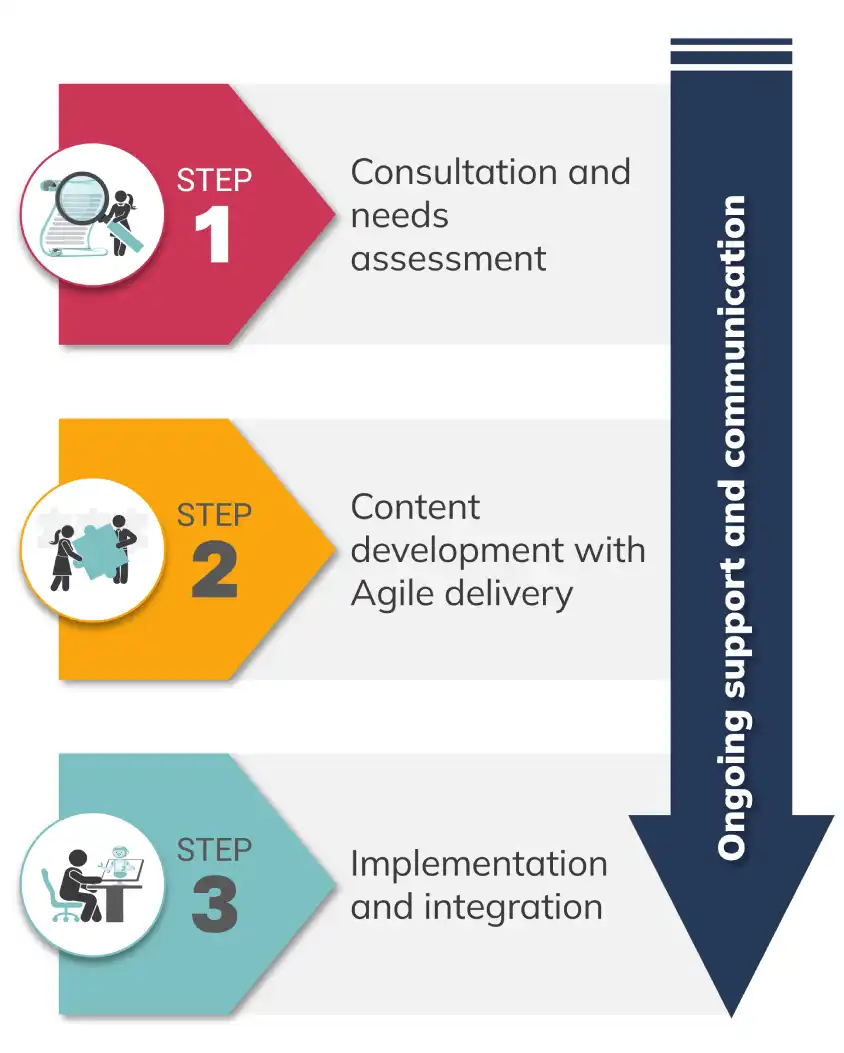
course-development-process-how-it-works

why-choose-us


PROGRAMME MANAGEMENTMSP®
Foundation Learn the fundamentals of programme management.
Includes Foundation & Practitioner combined option.INFORMATION TECHNOLOGY (IT)
®Foundation
Strategist DPI