How to pass your Practitioner PRINCE2 exam

Key takeaways
Passing PRINCE2 Practitioner is about applying PRINCE2 in context and managing your time under exam conditions.
- The exam tests your ability to apply and tailor PRINCE2, not just recall definitions.
- Know the exam format: 70 scenario-based questions, 2.5 hours, with a 60% pass mark.
- Use practice papers to master standard and matching question styles and build speed.
- Learn to navigate the manual quickly via contents, glossary, and index, rather than searching per question.
- Plan time explicitly, either with equal time per question or a disciplined two-pass approach.
- Arrive ready on exam day with the required setup, ID, and conditions to avoid preventable issues.

Introduction

Note: This article was updated in November 2023 to reflect changes to the syllabus made since the launch of PRINCE2 7th edition. Any references to the PRINCE2 manual in this article are to the latest edition.
If you came to this page because you wanted to book your Practitioner-level PRINCE2 exam, visit our PRINCE2 exams page.
Knowledge Train has helped thousands of people gain Practitioner-level PRINCE2 certification. Since 2012, our pass rate for the Practitioner exam has been 10% above the UK national average at 83%.
With thorough training methods and understanding about exam techniques our delegates consistently achieve their Practitioner-level PRINCE2 certification.
Practitioner exam purpose
The purpose of the exam is to assess whether you can apply and tailor PRINCE2 in context. If you pass the exam you should, with suitable direction, be able to start applying the method to a real project. However, you but may not be sufficiently skilled to do this appropriately in all situations.
Some factors which may affect your ability to apply PRINCE2 on a real project includes your project management expertise, the complexity of the project and the support provided to you in the use of PRINCE2 in your work environment.
Assessment criteria
The exam assesses whether you are able to:
- apply the PRINCE2 principles in context
- apply successful people management in successful projects
- apply and tailor relevant aspects of PRINCE2 practices and processes in context
- assess whether an approach to applying the practices or processes is effective and fit for purpose in a given context
- apply the practices of PRINCE2, demonstrating an understanding of the key management products required to support the practices, and the relevant recommended roles and responsibilities
- carry out the activities of the processes and their recommended actions, demonstrate an understanding of the inputs and outputs, recommended roles and responsibilities, and how the practices are applied.
Syllabus areas examined
Prerequisites
You are required to have any one of the following:
- PRINCE2 Foundation or Practitioner (6th edition)
- APM Project Management Qualification (PMQ)
- APM Project Professional Qualification (PPQ)
- Project Management Professional (PMP)
- Certified Associate in Project Management (CAPM)
- IPMA® Levels A to D (IPMA® is a registered trademark of IPMA in Switzerland and other countries.)
What’s in the exam?
Questions
This contains all 70 questions, divided into topics. Each topic is clearly labelled e.g. PRINCIPLES, ORGANIZING PRACTICE, etc. The sequence of the topics follows the chapters in the PRINCE2 manual.
Scenario
In addition to the questions, the exam consists of a scenario which contains a fictional project. This describes an organization investing in a project and normally takes about 5 minutes to read. It is this scenario upon which all the questions are based.
Duration
The exam takes 2.5 hours to complete, and non-native English speakers get 25% more time!
You may use the PRINCE2 manual during the exam. If you have a license for the digital manual, you will be given access to it within the exam platform. Alternatively you may have your digital manual on a 2nd device set to ‘flight mode’. If you have a physical PRINCE2 manual you may bring that the exam room instead.


What’s examined?
You will be examined on all five elements of PRINCE2: the principles, people, practices, processes, and tailoring of the method to the environment.

The total number of marks is 70 and the table below shows the allocation of marks for the different topics. The pass mark is 60% which means you must score 42 marks or more to pass.
| Learning outcome | Marks |
| Understand how to apply the PRINCE2 principles in context | 7 |
| Understand how to apply effective people management in successful projects | 7 |
| Understand how to apply and tailor relevant aspects of PRINCE2 practices in context | 35 |
| Understand how to apply (and tailor) relevant aspects of PRINCE2 processes in context | 21 |
Answers
You select your answer on the screen. You may edit your answer if you think you have selected the wrong one. When selecting your answer, if you are not sure, you should flag it so you can quickly return to it later and change it if necessary.
Question types
After attending a PRINCE2 course, or studying a PRINCE2 course online, practice papers are the best way to prepare for the types of questions used during the exam. Even when the training day is over, you should practice at home to fully ensure you get to grips with the type of questions used.
There are two styles of objective test questions you’ll have to answer during the exam: standard and matching.
Standard
This question style is where you must choose one from a range of 4 options, like this:

As an example, take a look at this:

Tip: for a question such as this where you have 2 ‘Yes’ and 2 ‘No’ answers to choose from, first decide whether it is yes or no. Then from the 2 options remaining, choose which one sounds the most appropriate.
Matching
This question style is where you must link items in one list to items in a second list. There is only one correct response to each question item, but options from the second list may be used once, more than once (in most cases), or not at all. Look at this:
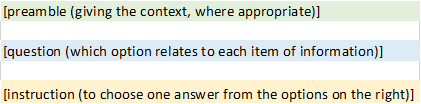
As an example, take a look at this:

How to prepare
Sample exams
Trying the 2 sample exams which comes as part of your course will help you enormously. Timing yourself whilst completing practice papers is also crucial so that you become used to working at a speed required to pass all questions. We’ll talk about exam time-management a little later.
Familiarise yourself with the manual
Although you may take the manual into the exam, it’s pointless flicking through it for each question, when you could be using it only for the tricky parts.
When preparing for your exam I recommend that you study the Contents pages and try to remember where it is (it’s the 2nd page in the book). Then when you need to look something up during the exam you should quickly turn to the contents section to find the relevant chapter.
You might also find the glossary useful to quickly remind yourself of a definition. The glossary is at the end of the book, followed by a detailed index for more precise look ups.
Mindmaps
Learning about a new subject requires you to engage your brain with the material. Having to think about the different elements forces your brain to process the information and make connections between them. A good way to do this is to draw mind-maps – one for each theme and process.
A good way to do this is to draw mind maps – one for each theme and process. After you have drawn yours, compare them to the one in the course guide given as part of your classroom training, or as part of your online course.
Just remember, there is no ‘perfect’ mind-map so although yours might not look the same as ours it doesn’t mean it’s wrong.
Sleep
Ensure you get a good night’s sleep the night before your exam. You want to arrive at the exam venue bright and alert, not sleepy after a late night.
Time management
The exam lasts for 2.5 hours (or 3 hours 8 minutes if you’re a non-native English speaker).
Read the scenario first
When the exam starts, spend 5 minutes reading the scenario. Make a mental note of anything which appears significant. The scenario usually explains the number of management stages in the project and will probably say which products are delivered in each stage.
After reading the scenario, there will then be a further 145 minutes left.
Let’s now look at the two time management strategies to consider.
Strategy 1: equal time per question

Allocate 2 minutes for each of the 70 questions. After answering a question, move to the next one. This will take 140 minutes which, if you spend 5 minutes reading the scenario will leave you 5 minutes for checking at the end that you have answered all 70 questions and haven’t missed any.
Strategy 2: two pass approach
Starting at the beginning go through the entire exam paper twice. The first time through you will answer the easy questions and you will mark your answer. “Easy” questions might be the ones which are quick to answer, or the ones which you are confident that you know the answer for.
Skip any questions which you think are too difficult or take a lot of time to read.

During the second pass through, you will attempt the questions which you skipped in the first pass. The risk with this approach is that it is more difficult to keep track of time and you might end up not completing all questions.
Lastly, remember to answer every question. As marks are not deducted for wrong answers, you might just be right, and trusting your instincts will usually serve you well.
Exam day

On the day of the exam, you must be prepared by having the following:
- Photo ID (such as a passport or driving license) otherwise you cannot sit the exam.
- Computer with internet access, webcam, audio with mic
- Quiet room with an empty desk – you cannot have any papers or books on the table
- Water – ensure you have water to drink during the exam. Studies show that students who drink water during exams, on average score 4.8% higher marks than students who don’t drink water. [1]
[1] Pawson, C. (2004, April). Bring water into exams to improve your grade. http://www.uel.ac.uk/news/press-releases/2012/04/waterexams.htm
Pre-exam
Just prior to the examination starting, the exam proctor will ask you to show your photo ID, turn your camera 360 degrees to show the room, and will read out the instructions and rules for the exam.
During the exam
If English is not your first language you will automatically get 25% extra time – 188 minutes instead of 150!
Similarly, you may find completing the exam difficult if you have dyslexia or another medical condition. To get the extra time, you must contact PeopleCert before the exam with a report from your doctor or other medical professional proving your condition. This will then get approved by PeopleCert and you will be awarded extra time.
If you fail the exam, you can re-take it at a later date, although you will need to pay the exam fee again.
At the end of the exam, you will not be able to mark any more answers. If you finish the exam early you can submit your answers.
You will receive your exam result on screen as soon as the examination is over. You will receive confirmation by email shortly afterwards.
Conclusion
We hope you have found this guide to passing the PRINCE2 Practitioner exam useful. Thorough knowledge of PRINCE2 and a great exam technique should help you to pass your exam.
Study, effective revision and practicing sample exams will all boost your chances of passing the exam, and achieving a qualification recognized in industries throughout the world.
Infographic
