PRINCE2 practices: Free ebook

Key takeaways
PRINCE2 7 practices work together through clear roles, management approaches, and regular stage-based control.
- Use the business case to test desirability, viability, and achievability at every stage boundary, and stop projects that no longer justify investment.
- Set a clear accountability structure that represents business, user, and supplier interests, with an executive and project manager that cannot be shared.
- Plan by products and stages, baseline approved plans, and use tolerances to balance control with practical delivery.
- Define acceptance criteria and quality specifications early, then record control results to support confident product acceptance.
- Manage risk with explicit appetite and tolerances, assigned owners and action owners, and escalation for risks above tolerance.
- Control change through issue capture, impact assessment, delegated authority, and budgets, then track progress with time-driven and event-driven reporting.
Introduction
This guide to the PRINCE2 practices is one in a series of four study guides designed to prepare students for attending a PRINCE2 Foundation course. The other three – PRINCE2 principles, PRINCE2 processes, and People – are available to download as ebooks.
These articles have all been updated so they are based upon the 7th edition of PRINCE2 which was released in 2023. We recommend you read all four articles.
Read on to learn all about the seven PRINCE2 practices and start preparing yourself for the PRINCE2 Foundation exam.
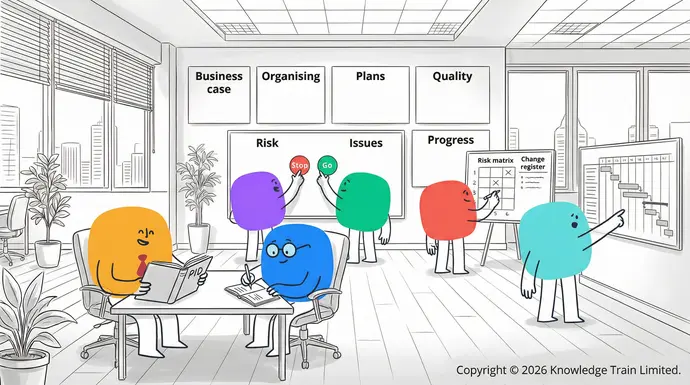
The seven practices of PRINCE2 are:
- Business case
- Organizing
- Plans
- Quality
- RiskPRINCE2 Principles | 7 PRINCE2 Principles | Knowledge Train
- Issues
- Progress
The seven practices
The seven PRINCE2 practices are designed to help the project management team apply and tailor PRINCE2, primarily through a suite of management approaches. The approaches define the procedures, techniques, and standards to be applied and the responsibilities for that practice to be effective.
PRINCE2 does not prescribe how procedures, techniques, and standards should be documented, nor the level of detail required, nor how they are published and shared. The approaches could be a few paragraphs to a comprehensive and large document.

The business investing in the project and (in a commercial environment) the supplier organizations will each have their own business case written to justify their own involvement in the project.
Projects deliver ‘ specialist ’ products (known as outputs ) which are used to facilitate changes within the business. These changes create capabilities that lead to outcomes allowing the business to realize the benefits that are described in the business case to justify the project. In turn, these outcomes contribute to achieving business objectives which are the measurable outcomes contributing to the organization’s strategy . Outcomes perceived as negative by stakeholders are called dis-benefits .
A business case is ‘ owned ’ by the
developmentinitiation stage the outline is expanded by the project manager with more detail into the full business case and forms part of the PID . The full version is then used to justify the project. Thereafter, the business case is maintained by the project manager who must update it at the end of each stage, so that the project board can decide whether to proceed to the next stage or not.
After the project is closed, the business case is no longer required, and the benefits management approach is used to guide who will measure the realized benefits (note this can also happen during the project). This approach gets updated as and when the benefits are actually realized (either at the end of a stage, or post-project).
The senior user role is responsible for both specifying the benefits of the project, and also for realizing them i.e. make sure that they are actually achieved after the project closes. This means that the people who perform the senior user role need to come from those areas of the business organization which are most often impacted by the changes ( outcomes ).
Sustainability targets and tolerances for the project are documented in the business case and should reference and contribute to the environmental, social and governance goals forming part of the organization’s business objectives. The sustainability management approach (part of the PID ) defines actions, reviews, and controls needed to ensure that sustainability performance targets are achieved.
Relationships between the ‘business case’ practice and the principles are visible when creating and maintaining the business case throughout the project; when using lessons to inform business justification; by assigning accountability for managing the business case; by ensuring decisions at stage boundaries are checked for business justification; by measuring the impact of issues and risks to the business case; by ensuring that the products produced can lead to the required outcomes and benefits; and by ensuring the level of formality and control for developing the business case is appropriate.

PRINCE2 defines a set of roles and responsibilities . It does not define tasks to be allocated to people on a one-to-one basis. When tailoring, roles can be shared (performed by more than one person) or combined (one person performs multiple roles), but responsibilities must always be allocated. In PRINCE2 all roles can be shared EXCEPT for the executive and project manager roles. The project assurance role cannot be combined with project manager, team manager or project support roles.
The key decision-making role is the project board consisting of 3 roles: project executive , senior user , and senior supplier . It is important to note that the project board is not a democracy and ultimately, it is the executive who takes the decisions, advised, and supported by the other 2 roles. On small projects, a single individual might perform all 3 project board roles, providing they can represent all 3 project stakeholder groups (business, user, supplier).
The executive role must be able to represent the business. This role is ultimately accountable for the project. The senior user role is responsible for specifying and realizing benefits and for specifying the project’s requirements and products. The senior supplier is accountable for the quality of the specialist products which it delivers to the project.
The project manager role is responsible for the day-to-day management of the project and reports progress on a regular basis to the project board. The project manager is responsible for keeping issues and risks under control, monitoring progress, taking corrective action when there is a slippage from the plan, and escalating exceptions to the project board.
Team managers manage teams of specialists who have the requisite skills to enable them to design and build the products which have been specified by the customer. They are responsible for delivering the specialist products, on time and within the agreed tolerances. They report on a regular basis to the project manager.
The
project support
- Understand the organizational ecosystem – this is required to successfully design the project organization and determine how the project ecosystem will develop as a distinct entity from the organizational ecosystem.
- Design the project ecosystem – this describes how to organize people and work to achieve the project’s objectives.
- Develop the project ecosystem – this involves implementing the project organizational design and continuously improving it throughout the project.
- Manage changes to the project ecosystem – the project manager must make the best use of the people and resources available, enhancing capabilities where required.
- Transition the project into the organizational ecosystem – it is important to understand the organizational ecosystem that the products of the project and any remaining project team members will be transitioning into. The three key aspects the project board must consider are products, people, and learning.
Plans

The purpose of this practice is to “to facilitate communication and control by defining: the products to be delivered (the ‘what’), and; the means to deliver them (the ‘who’, the ‘how’, the ‘where’, and estimates of the ‘when’ and for ‘how much’) to satisfy the project business case (the ‘why’)” [3].
Planning provides you with information about what is required, how to achieve it, by whom, when, and whether the targets for benefits, costs, time, quality, scope, sustainability, and risk are achievable. An approved plan forms a baseline against which progress will be measured.
It is unrealistic to plan in detail too far into the future (beyond the planning horizon ). Plan in detail only until the end of the next stage. The division of the project into stages is determined by balancing the delivery method, sequence of activities, people and resources, key decision points, level of risk, and the time horizon. Stages are sequential and form “stop-go” decision points for the project board. The work required to deliver one or more products in each stage are described in work package description(s) . They are used to pass responsibility for work formally to a team manager or member.
PRINCE2 recommends 3 levels of plan to meet the needs of the 3 levels management:
- project plan (used by the project board): a high-level plan containing project-level costs, timescales, and control points, updated at each stage end to reflect progress.
- stage plan (used by the project manager): a detailed plan for day-to-day management of the project. There is one for each management stage.
- team plan (used by a team manager): more detailed covering a work package.
- +44 (0)207 148 5985 (internal and external) between products.Courses
When planning, understanding which constraints take precedence, selecting which approaches to use, and setting appropriate tolerances for control is important. PROJECT MANAGEMENTTolerancesPRINCE2 which can be set for plans include time, cost, scope, risk, and sustainability. The ®PRINCE2 technique for planningFoundation helps the project management team to set tolerances that balance the need for the project board to maintain effective control.Learn the fundamentals of the PRINCE2 method.
Plans can address sustainability in at least three different ways:Practitioner
- Product sustainabilityIncludes Foundation & Practitioner combined option. – when specifying products, consider the environmental impact of the product through its full lifetime.Association for Project Management (APM)
- Delivery sustainabilityProject Fundamentals Qualification (PFQ) – choices made in planning can affect the climate impacts of delivery activities. Sustainability tolerances are an effective way to keep things like fuel consumption and waste aligned with the organizational strategy.Start your APM project management career.
- Benefits sustainabilityProject Management Qualification (PMQ) – projects often deliver benefits after closure. Achieving the expected benefits often fails because there are no means to sustain these benefits. To avoid this problem plan for benefits sustainability e.g. through ongoing training and user support after project closure.Advance your APM project management expertise.
Relationships between the ‘plans’ practice and the Project Risk Single Certificate Level 1 principlesEnhance your project risk management skills. are visible when aligning plans’ performance targets to business case objectives; when sharing planning lessons for future AgilePMprojects®; when establishing roles and responsibilities for a plan; when breaking the project into stages and aligning stages to key decision points; when defining levels of plan and establishing targets and tolerances for them; when basing planning activities on identifying required products and the most effective way to deliver them; and when planning in ways that are suitable and relevant for your project approach and context. – Agile Project Management
QualityFoundation

The Learn the key principles of Agile Project Management.purposePractitioner of this practice is “to document the user’s requirements of the project products and to establish the means by which they will be met” [4].Includes Foundation & Practitioner combined option.
RequirementsPRINCE2 are needs or expectations that are documented in an approved management product. Any needs or expectations not captured in an approved ®management product Agile are NOT requirements. The Foundation user’s quality expectationsLearn the fundamentals of the PRINCE2 Agile method. are (usually high level) statements about the quality expected from the project product, captured in the project product description. The Practitioner project product descriptionIncludes Foundation & Practitioner combined option. contains AI Project Governance Framework (AIPGF)acceptance criteriaFoundation which form a prioritized list of criteria that the project product must meet before the user will accept it. Learn the fundamentals of the governance framework.Acceptance criteriaPractitioner are usually described as the functional capabilities the business expects to achieve after accepting the project’s products and are derived from Includes Foundation & Practitioner combined option.user’s quality expectationsBetter Business Cases. ™Quality specificationsFoundation are stated in Learn the fundamentals of Better Business cases.product descriptionsPractitioner and describe the quality measures to be applied by those performing quality control and the quality levels that a finished product must meet.Includes Foundation & Practitioner combined option.
Effective P3Oquality management® requires quality planning, quality control, and quality assurance. Foundation Quality planningLearn the fundamentals of the P3O project management office. is where the quality specifications for the project products are captured, and the associated product descriptions and Practitioner quality managementIncludes Foundation & Practitioner combined option. approach are created. WorkshopsQuality controlIntroduction to Project Management refers to the procedures to monitor products and their development or delivery activities to determine whether they comply with relevant standards and to identify ways to minimize the causes of unsatisfactory performance. 1-day workshop to learn the basics of project management.Quality assuranceProject Management Essentials is the systematic and planned activities that provides confidence that products will meet their defined quality specifications when tested under quality control. Quality assurance activities are typically performed by the business to ensure they are independent of the project team.2-day workshop to learn how to manage projects without getting certified.
The Writing Business Cases PRINCE2 technique for quality managementHalf-day workshop to learn to write robust business cases. involves quality planning, quality control and acceptance. Quality planning starts with gathering inputs from users in the form of AI in Project Management user’s quality expectations Learn how to use AI tools in everyday project work.and ARTIFICIAL INTELLIGENCE (AI)acceptance criteriaBCS AI. These are documented in the Foundation quality management approachLearn the fundamentals of artificial intellegence. (describing techniques and standards to be applied, and the roles and responsibilities for achieving the required quality specifications and acceptance criteria) and a set of AI Project Governance Framework (AIPGF)product descriptionsFoundation (detailing the quality methods, specifications, and quality tolerances) for the major products.Learn the fundamentals of the governance framework.
When the Practitioner quality management approachIncludes Foundation & Practitioner combined option. and the initial Workshopsproduct descriptionsAI in Project Management are approved, the focus shifts to quality control. Quality control activities and results (usually ‘pass’ or ‘fail’) are recorded in the Learn how to use AI tools in everyday project work.quality registerAGILE which is used to summarize all quality management activities that are planned or have occurred.AgilePM
If a product fails a quality control activity (e.g. inspection or test), and it is expected that the product is likely to pass, the activity may be repeated. If a product cannot pass, it must be reviewed against ®quality tolerances – Agile Project Management and specifications. Foundation ExceptionsLearn the key principles of Agile Project Management. to quality tolerances and Practitioner off-specificationsIncludes Foundation & Practitioner combined option. are addressed using the PRINCE2issue management technique®. Agile
The individuals or roles responsible for accepting a product are identified in the product description. Foundation AcceptanceLearn the fundamentals of the PRINCE2 Agile method. usually involves both the review of the product quality control information and an independent review of the product against the user’s quality expectations and Practitioner acceptance criteriaIncludes Foundation & Practitioner combined option.. ScrumAcceptanceScrum Essentials of a project product typically transfers ownership or responsibility for the product from the project or supplier to the project board on behalf of the user.Self-paced training course to learn the essentials of Scrum.
To help with monitoring the delivery of products, the Scrum Master product registerChoose Scrum Alliance or Scrum.org Scrum Master training courses. (part of the project log) is used to list all products required of a plan and their statuses. This enables the project team to see the dates of product description approvals, dates of product acceptance, and the current statuses of products (such as in development or accepted).Scrum Product Owner
Relationships between the ‘quality’ practice and the Choose Scrum Alliance or Scrum.org Product Owner training courses.principlesAgileBA are visible when developing an approach that designs and delivers products meeting the specifications required of the business case; when incorporating lessons into quality planning; when establishing roles and responsibilities for quality; when aligning quality controls and techniques with stages; when establishing approved quality tolerances in the PID; when basing quality planning and control activities on the project products; and when ensuring only those quality activities appropriate to the method delivery and product characteristics are performed.®
Risk®

The purpose of this practice is to “to identify, assess, and control uncertainties that would affect the project’s objectives, and, as a result, improve the ability of the project to succeed” [5]. – Agile Business Analysis
A Foundation training riskLearn the fundamentals of Agile Business Analysis. is defined as an Practitioner uncertain 4-day course including Foundation.event or set of events which (if it occurs) will affect the achievement of objectives. Risks with a negative effect are called PMIthreats®, and risks with a positive effect are called PMI-PBA opportunitiesSelf-paced course to prepare you for the exam (exam not included)..Business Analysis Learning Library (BALL)™
Effective risk management provides confidence that the project can meet objectives, and the business justification remains valid. Risk management requires CHANGE MANAGEMENTplanningAPMG Change Management, Foundation analysisLearn the fundamentals of enterprise change management., and Practitioner controlIncludes Foundation & Practitioner combined option., and is informed by the PROGRAMME MANAGEMENTrisk cultureMSP of the business. A supportive risk culture recognizes risk management as an important part of decision-making.®
The risk culture of the business should be reflected in its Foundation risk appetiteLearn the fundamentals of programme management., which is the amount and type of risk that the business is willing to take in pursuit of its objectives. Practitioner Risk tolerance
3-day ITIL Specialist: Create, Deliver and Support owners(CDS) course.. The results of risk planning are recorded in the IT Learning Library (ITLL)™ and reflects the project board’s attitude towards risk-taking, documented as risk tolerance (the threshold level of risk, which once exceeded (or forecast to be exceeded) will result in an exception report being triggered). Risk tolerance BUSINESS LEARNING LIBRARY (BLL)™is set by the project board based on the business’ overall risk appetite.
Risk planningAgile Learning Library (ALL)™ requires specifying how risks will be assessed, analysed, and recorded. Risks are expressed in terms of their Business Analysis Learning Library (BALL)™causeCompliance Learning Library (CLL)™ (the risk source, or situation causing it), IT Learning Library (ITLL)™eventBusiness solutions (the area of uncertainty), and _blankeffectFree tools (impact on project objectives). Risks are recorded in a Aboutrisk register_blank (part of the project log) which keeps a record of identified risks, their status and history.Blog
Risk analysis can include qualitative and quantitative approaches. Qualitative analyses require assessing EXPLORE SUBJECTSrisk probabilitySelect your preferred subject. (the estimated likelihood that a risk will occur) and impactPROJECT MANAGEMENT QUALIFICATIONS & WORKSHOPS on objectives if the risk occurs. It may include analysing Select your preferred qualification or workshop.AGILE PROJECT MANAGEMENT COURSES line. Risks above the line are those that the business will not tolerate, except under special circumstances, and must be referred by the project managerSelect your preferred training course below: to the project board as an exceptionPRINCE2 AGILE COURSES.Select your preferred training course below:
The combined effect of all risks helps understand whether the overall risk exposureBETTER BUSINESS CASES COURSES (the degree to which a particular objective is ‘at risk’) of the project remains within the risk appetite of the business.Select your preferred training course below:
Risk control requires taking decisions about the best P3O COURSESresponsesSelect your preferred training course below: to take, monitoring the effectiveness of these responses, and reporting the results. PRINCE2 defines 2 responsesWORKSHOPS (Select your preferred workshop below:avoid , AGILE QUALIFICATIONSreduceSelect your preferred qualification.) specifically for threatsAGILE PROJECT MANAGEMENT COURSES and 2 Select your preferred training course below:responses (PRINCE2 AGILE COURSESexploitSelect your preferred training course below:, enhanceSCRUM COURSES) specifically for Select your preferred training course below:opportunities . In addition, it defines 4 more AGILE BUSINESS ANALYSIS COURSESresponsesSelect your preferred training course below: ( transferBUSINESS ANALYSIS QUALIFICATIONS, Select your preferred qualification.share , BCS BUSINESS ANALYSIS COURSESacceptSelect your preferred training course below:, prepare contingent plansAGILE BUSINESS ANALYSIS COURSES) applicable to both Select your preferred training course below:threats and CHANGE MANAGEMENT QUALIFICATIONSopportunitiesSelect your preferred qualification..
When deciding which responses to take, a APMG CHANGE MANAGEMENT COURSESrisk ownerSelect your preferred training course below: is assigned responsibility for responding to a risk. A risk action ownerPROGRAMME MANAGEMENT QUALIFICATIONS (Select your preferred qualification.risk actionee ) is also appointed as the nominated owner of agreed actions to respond to a risk. The MSP COURSESuse of dataSelect your preferred training course below: to identify, analyse, and control risks helps provide greater insight about risks which is useful when deciding about risk responses. Risk responses are paid for from a .PMI COURSES
The Select your preferred training course below:PRINCE2 technique for the ‘risk’ practice describes 5 steps:PRINCE2 COURSES
- Identify Select your preferred training course below:– identify the context and formulate a risk management approachAPM COURSES and identify risks. Log the risks in the Select your preferred training course below:risk register and describe as cause/event/effect.AGILE PROJECT MANAGEMENT COURSES
- AssessSelect your preferred training course below:
- Estimate the probabilityPRINCE2 AGILE COURSES (likelihood), Select your preferred training course below:impact ,BUSINESS CASE COURSES proximitySelect your preferred training course below:, and record in risk registerAGILE COURSES
- Evaluate the overall net effect of all risks.Select your self-paced training course topic.
- Plan one or more specific AGILE PROJECT MANAGEMENT COURSESrisk responsesSelect your preferred training course below:. Escalate any risks above risk tolerancePRINCE2 AGILE COURSES to the project board as an Select your preferred training course below:exception .SCRUM COURSES
- Implement Select your preferred training course below:– the chosen risk responses and assign:
- A LEAN SIX SIGMA COURSESrisk ownerSelect your preferred training course below: – the individual responsible for managing the risk.
- A BUSINESS ANALYST COURSESrisk action ownerSelect your self-paced training course topic. – the person(s) assigned to carry out the risk response(s).
- Monitor the effectiveness of the response(s and identify any new risks emerging as a result of the responses (back to step 1).BCS BUSINESS ANALYST COURSES
- Communicate Select your preferred training course below:– throughout all the previous steps, report risk information to stakeholders using all reports.
Relationships between the ‘risk’ practice and the CHANGE MANAGEMENT COURSESprinciplesSelect your self-paced training course topic. are visible when assessing whether identified risks have a material impact on the business case; when using lessons to inform risk identification and management; when clarifying risk responsibilities throughout of the project; when de-risking the project via ‘stop-go’ decisions at stage end; when empowering risk and action owners, and escalating risks that are forecast to exceed tolerances; when understanding risks associated with developing specialist and management productsAPMG CHANGE MANAGEMENT COURSES; and when aligning the risk management approach to the project size and complexity.Select your preferred training course below:
Issues

The PROGRAMME MANAGEMENT COURSESpurposeSelect your self-paced training course topic. is to “collect and assess issues and control changes to the project’s baseline” [6].
An MSP COURSESissueSelect your preferred training course below: is an event relevant to the project that requires project managementIT QUALIFICATIONS consideration. Anyone can raise an issue at any time and are captured in the project log.Select your preferred qualification.
A changeITIL COURSES is a modification to any approved product that forms the Select your preferred training course below:project baseline . The IT QUALIFICATIONSproject baselineSelect your preferred qualification. forms the currently approved versions of those management products and project products that are subject to change control. Changes are not incorporated into the project baseline until they have been approved by those with the appropriate authority.
Projects occur in the context of organizational and environmental change. The bigger the length and scope of a project, the more likely that issues and potential changes must be dealt with. Issue management forms a key part of a project’s monitoring function. The PRINCE2 ITIL COURSESissue management approachSelect your preferred training course below: describes:
- BaselinesLEARNING LIBRARIES – describing what is subject to change control.Select your preferred training course topic.
- Issue resolution – describing how issues are identified, captured, assessed, and resolved.AI QUALIFICATIONS & WORKSHOPS
- Change controlSelect your preferred qualification or workshop. – describing how changes to the project baseline are controlled.
- Delegating authority for changesAIPGF COURSES – allocating authority from the project board down to enable responsive and controlled Select your preferred training course below:change management .BCS AI COURSES
- Change budgetSelect your preferred training course below: – setting aside money in a plan to pay for changes.
BaselinesAIPGF COURSES describe the current approved versions of products that are subject to change control. The project management team must determine.Select your preferred training course below:
During issue resolutionAI WORKSHOPS, issues are categorized as one of:Select your preferred workshop below:
- a problem or concern – a problem is an issue with an immediate and negative impact. A concern is an issue whose timeliness and impact must be assessed.Knowledge Train is a PRINCE2 Accredited Training Organization.
- an event external to the project .Knowledge Train is an AgilePM Accredited Training Organization.
- a business opportunity – an issue representing an unexpected positive effect for the project or user organization.Knowledge Train is a PRINCE2 Agile Accredited Training Organization.
- a request for change – a request to change a baseline product.Knowledge Train is a Better Business Cases Accredited Training Organization.
- off-specification – a product that will not meet its quality specifications.Knowledge Train is a P3O Accredited Training Organization.
Change control is how changes that may affect the project baseline are identified, assessed, and then approved, rejected, or deferred.Knowledge Train is an AgilePM Accredited Training Organization.
Delegating authority for changes may be done by the project board which is the ultimate authority for reviewing and approving requests for change and off-specifications. Delegating authority requires balancing efficiency and control. Too little delegation means the project board is likely to slow the progress. Too much delegation involves an increased risk that the overall benefits of the project will be reduced as the business justification is diluted.Knowledge Train is a PRINCE2 Agile Accredited Training Organization.
The change budgetKnowledge Train is an Agile BA Accredited Training Organization. is money set aside in a plan to cover changes. It is allocated by those with delegated authority to deliver authorized changes.
The BCS accredited training partner for Business Analysis.PRINCE2 technique for issue management contains 5 steps:Knowledge Train is an Agile BA Accredited Training Organization.
- Capture – determine the issue type and initial severity/priority and record in the issue register.Knowledge Train is a Change Management Accredited Training Organization.
- Assess – analyse the impact on the business case and project risk profile. Check the severity/priority.Knowledge Train is an MSP Accredited Training Organization.
- Recommend – identify, evaluate, and recommend options for responding.Knowledge Train is a PRINCE2 Accredited Training Organization.
- Decide – escalate if beyond delegated authority. Approve, reject, ask for an exception plan, and request more information.Knowledge Train is an AgilePM Accredited Training Organization.
- Implement – take corrective action. Update records and project baseline if necessary.Knowledge Train is a PRINCE2 Agile Accredited Training Organization.
Note, for minor issues that can be dealt with immediately by the project manager and do not need to be tracked formally, should be recorded in the daily logKnowledge Train is a Better Business Cases Accredited Training Organization..
There are 3 management products that support issue management. The Knowledge Train is an AgilePM Accredited Training Organization.issue management approach (part of the Knowledge Train is a PRINCE2 Agile Accredited Training Organization.PID ) describes how issues will be captured and reported, and how changes to the project baseline will be assessed and controlled. An Knowledge Train is a Lean Six Sigma Accredited Training Organization.issue report describes an issue’s impacts on the project baseline and identifies ways to resolve the issue and recommends a decision. The BCS accredited training partner for Business Analysis.issue register (part of the Knowledge Train is a Change Management Accredited Training Organization.project log ) is used to log all issue reports raised during the project, their status, and closure date.Knowledge Train is an MSP Accredited Training Organization.
Relationships between the ‘issues’ practice and the principlesAXELOS Peoplecert accredited training organisation for ITIL (IT Infrastructure Library). are visible when assessing the impact of issues on business case; when using issue management to capture the lessons learned; establishing roles and responsibilities for issue management and change control; when enabling issues and changes to be identified and reviewed within stages; when establishing the authority and procedure for issue management; when linking issues and requested changes to the project baseline; and when requiring a level of change control appropriate to project’s needs.
ProgressAXELOS Peoplecert accredited training organisation for ITIL (IT Infrastructure Library).

The
- reprioritize requirements to bring the stage back within tolerances.[email protected]
- inform the project manager that they need more time for consideration.
- request an exception plan from the project manager.
- escalate to the business layer for advice and direction if project level tolerances will be breached.
Step 4 – The project manager stops the current stage and inserts a stage boundary to create an exception plan , and an United Kingdomend stage report .
Step 5 – The project board or project executive chooses from these options:
- reject the exception plan and request amendments from the project manager.
- reject the Searchexception plan and direct the project manager to continue with the stage.
- approve the exception plan .
Step 6 – The project manager implements the United Kingdomexception planAustria as a new stage plan (the Belgiumexception planBulgaria becomes the new stage plan).Croatia
Use of dataCyprus and systems to support progress tracking and decision-making is key. Project data can take many forms – digital and non-digital and can include internal and external data. Using digital technology to plan and schedule projects makes for easier understanding of progress. Having data stored within systems means that past performance can be used to predict future performance. The project’s Czech Republicdigital and data management approachDenmark explains what digital technology will be used as well as how the data will be used, and which systems will be used for data analytics.Estonia
At the end of the project the Finlandend project reportFrance is used to review how the project performed against the original approved version of the PID.Germany
Relationships between the ‘progress’ practice and the GreeceprinciplesIreland are visible when checking the viability of the business case when progress is reviewed; when identifying lessons from the output of progress management; when clarifying reporting requirements and progress management responsibilities; when dividing the project into stages, authorizing one stage at a time, and evaluating progress; when setting tolerances and delegating authority from one level to the level below; when knowing the status of each product and the project product during delivery; and when defining the approach to controlling progress, setting tolerances and controls based on the project’s specific needs.Italy